By Tolu Ogunlesi
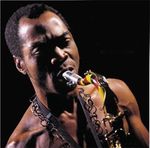
There were only two Nigerians in TIME Magazine’s ’60 Years of Heroes’ special issue in 2006: Writer Chinua Achebe and musician Fela Anikulapo Kuti. Apart from being artists both men were politicians too – drawn, when democracy beckoned in the late 1970s, onto that treacherous terrain by the prospects of providing an alternative to that god-awful brand of leadership Nigeria throws up with the constancy of clockwork.
Last November, I encountered both men in the United Kingdom – Fela as a reincarnated being in a National Theatre Musical (the Musical first opened on Broadway, earlier in 2010), and Achebe in flesh at Cambridge University, at a lecture he delivered in honour of Audrey Richards, the founder of the University’s Centre of African Studies.
I have written about my Achebe encounter elsewhere. Here is where I will pay my tributes to Fela, arguably the greatest musician to ever come out of Nigeria.
On the National Theatre stage in London, Fela came alive. But only just – in my opinion as a Nigerian speaker of pidgin, the corrupted version of English that served as the universal solvent for Fela’s lyrics and philosophy.
The “Fela” onstage clearly didn’t speak pidgin, he merely learnt it for the performance. And so his awkward handling of it kept getting in the – er, my – way. Fela’s pidgin (in which he delivered his trademark yabis – stinging verbal attacks on the political class, business elite and religious leaders) was as crucial to his persona as his saxophone was. Using a non-native pidgin speaker to play Fela was for me the equivalent of putting a violin in the maestro's hands.
But it was an ambitious performance, the kind one hardly ever sees in Nigeria – detailed costuming and stage set-up, and the accompanying band combined to (re)create a convincing setting. The scene in which Fela’s ‘Kalakuta Republic’ base is invaded is so well done you feel like you were a fleeing bystander on that horrible February day. Hundreds of soldiers stormed the premises on February 18, 1977, brutalising Fela’s band members, dancers and hangers-on.
By the time the soldiers were done, Kalakuta lay in ruins, and Fela's much-beloved mother, Funmilayo – the first Nigerian woman to drive a car, a woman who had left a revolt that deposed and popular monarch in the 1940s and, in defiance of the colonial authorities, visited the Soviet Union and China in the 1950s – lay dying. The soldiers had thrown her out of an upstairs window. She would die soon after.


 The correct answer would be “it depends” or “compared to what”? After all, it’s not so much that everyone else in Eurasia stopped thinking 500 years ago, but rather than an explosion of knowledge occurred in Europe that rapidly outstripped other centers of civilization in Eurasia. And after a period of relative decline,