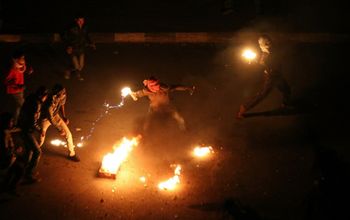
3 Quarks Daily asked a number of scholars, academics, journalists, writers and others to give us brief reactions to the recent events in Egypt. Their responses are given below in the order in which they were received:
- Akeel Bilgrami
- Mohsin Hamid
- Mark Blyth
- Frans de Waal
- Pablo Policzer
- Ejaz Haider
- Mona El-Ghobashy
- Gerald Dworkin
- Ram Manikkalingam
- Jonathan Kramnick
- Amitava Kumar
- Alexander Cooley
- Suketu Mehta
- Justin E. H. Smith
Akeel Bilgrami:
It is far too early to write with any prognostic depth about the spontaneous and ongoing democratic movement in Egypt. But two immediate observations: First, it is interesting to see American pundits on television, despite their pious support for 'democracy', uniformly expressing a subdued anxiety about what worse and chaotic things might befall Egypt now. These very same pundits expressed no such anxiety about worse and more chaotic periods to follow the regime change that came with the American bombing and slaughter in Baghdad, Fallujah…. And second, it seems at the moment that the best thing for Egypt is for this popular movement to prolong itself on the streets for a measurably long time since real political deliberation and genuinely public education occurs (whether in democracies or in dictatorships) only on the site of popular movements, not hugger-mugger in round table negotiations and conferences among leaders and advisers, not in universities, not in the widely read or viewed media, not in editorials…. Even in a democracy like the United States, people got educated into civil rights on the site of popular movements through the sixties, not by the classroom and editorial commonplaces about 'racial equality'.
Akeel Bilgrami is the Johnsonian Professor of Philosophy and the Director of the Heyman Center for the Humanities at Columbia University.
Mohsin Hamid:
It's still possible that the old regime will find a way to cling on in Egypt, that the army will find a new front man. But what is clear is that beneath the ossified surface of the US-backed dictatorships and monarchies that span the Middle East, from Morocco to Saudi Arabia and from Jordan to Yemen, something profoundly different is waiting to be born. Turkey and Indonesia may already offer us a glimpse of that possible future: a future of modern, moderate, independent-minded democracies, pursuing their own interests, and no longer obsessively shaped by security concerns. If Egypt can do it, then maybe one day Saudi Arabia can follow, and if that happens, so much that is wrong in Muslim-majority countries today, so much that is inegalitarian, sectarian, and stifling, has the potential to be put right. Here, in Pakistan, such a possibility gives me much-needed hope.
Mohsin Hamid is a Pakistani novelist and the author of The Reluctant Fundamentalist.