by George Wilkinson
The points of leaves and twigs on which the spider begins her work are few, and she fills the air with a beautiful ciruiting. Man should be content with as few points to tip with the fine Web of his Soul, and weave a tapestry empyrean full of symbols for his spiritual eye.
–Keats, letter to Reynolds
The webs of orb spiders are truly fascinating structures. Although the details of their construction are 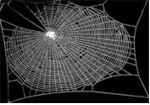 adjusted to local conditions, members of a given species create highly characteristic patterns. It is thought that orb webs arose once in the spider lineage, aided by two interacting innovations: extreme behavioral stereotypy, leading to regularly spaced radial lines and sticky spirals; and the ability to suspend webs on frames of structural threads, allowing spinning of webs just about anywhere.
The web is an extended phenotype of the spider. It modifies and interacts 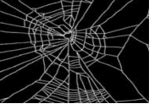 with the environment, and in turn influences spider health, since an effective web leads to a well-fed spider. Since web construction requires a complex sequence of actions by the animal, it is also an external display of the spider’s health. There is a fascinating literature on the effects of pesticides and drugs of abuse on spider webs.
I came to the topic of spider webs from this Wired article, chronicling parasites that subvert the behavior of their hosts. Among these, Hymenoepimecis wasps lay their eggs on orb-weaving spiders. The growing wasp larva interferes with the spider’s nightly web spinning, inducing the spider to spin modified webs, until, on the same evening that the larval wasp kills the host, the spider makes a specialized “cocoon web” which will support the larval cocoon a few hours later. What is really arresting about this phenomenon is that the construction of the cocoon web is also highly stereotyped, consisting of many repetitions almost identical to one subroutine of normal orb weaving. Furthermore, if the parasite is removed, some spiders recover, again in a characteristic nightly sequence. As a geneticist, this makes me really wonder what genes operate, and in what order, to generate the elaborate spider behavior and allow its shunting by the parasite.
William Eberhard, the scientist who first reported the Hymenoepimecis parasitism, has performed numerous experiments regarding the mechanism by which the larva manipulates the spider’s behavior. It is fast-acting, apparently chemical (i.e. circulating), and has long-term, dose-dependent effects. The extreme hypothesis– that the larva secretes a single neuromodulator– would be consistent with the stereotypy of the larva’s impact and the inverse order of web changes during recovery. There are examples of multiple behavioural responses to single neuromodulator, for example the effect of octopamine on honeybee foraging. And, of course, sex hormones in humans also can correlate with repetitive subroutine behavior.
Picture: A normal orb web (top) and a web constructed by a spider treated with benzadrine.