by Justin E. H. Smith
The idea that there is a hierarchy or ladder of world cultures, with European culture at the top (often promoted to the status of 'civilization'), was a cornerstone of most Enlightenment philosophy. It was rejected in the era by a handful of counter-Enlightenment thinkers such as Herder, but it continued to reign in the burgeoning discipline of anthropology until the early-20th-century innovations of Franz Boas and others. It was only definitively displaced from anthropology in the decade or so after World War II. In philosophy today, by contrast, though everyone officially abjures the ladder model of human cultures, it continues to determine much of our reasoning about what counts as philosophy and what does not.
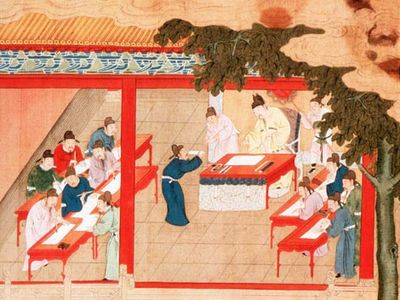
It is worth pointing out that all societies that have produced anything that we are able to easily recognize as philosophy are ladder societies. We might in fact argue, if not here, that philosophy as a discrete domain of activity in a society is itself a side-effect of inequality. The overwhelming authority of the church in medieval Europe, the caste system in ancient India, the control of intellectual life by the mandarin class in ancient China (meritocratically produced by the Confucian examination system, but still elite) present themselves as three compelling examples of the sort of social nexus that has left us with significant philosophical works. The fact that philosophy always comes from the top rungs of ladder societies could have something to do with the difficulty, in spite of our best intentions, of de-Eurocentrizing the current academic discipline of philosophy: New York, London, and the idyllic campuses that are an easy commute from these metropolises are the true locus of philosophy today, in just the same way that royal courts were in ancient India. It is as hard for us to think of the intellectual activity of, say, some village sage in postcolonial, third-worldified India as 'philosophy', as it would have been for a high-caste member of the literate elite to think of the folk beliefs of some forest-dwelling ādivāsī in this way.
When philosophers try to get away from the ladder, as most agree for political reasons it is necessary to do, what they usually end up with is the museum, or perhaps, with apologies to André Malraux, the imaginary museum of philosophical multiculturalism. As the Soviets once did with the traditional costumes of their empire's ethnic minorities, those who aim to promote non-Western philosophy usually end up putting the Chinese and the Indians, and sometimes a slapped-together group they dub 'Africans' as well, in entirely separate, non-overlapping display cases, as if their philosophical traditions were just so many traditional costumes or pieces of pottery.