by Holly A. Case
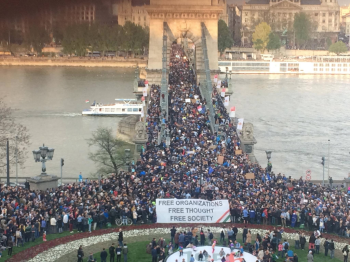
Demonstration in Budapest in support of CEU, April 9, 2017
On Tuesday of last week, the Hungarian parliament passed a law that seeks to drive the Central European University, founded in 1991, out of the Hungary. Many articles and op-eds have been written condemning the law, and declarations of support have come from Hungarian universities and student unions, scores of universities and scholarly organizations in Europe and the US, and from CEU students and alumni. Demonstrations and solidarity events have taken place in Budapest, New York, London, Lisbon, Friedrichshafen, St. Petersburg, Warsaw, Saarbrücken, Amsterdam, Barcelona, Paris, Bucharest, Mainz, Vienna, Berlin, Cluj, Stockholm, Heidelberg, Zagreb, and Prague. Members of the European Parliament, as well as US and European diplomats and statesmen have criticized the law, all to no avail. The governing party in Hungary, Fidesz, with Prime Minister Viktor Orbán at its head, remains unmoved.
Somewhere in between all the domestic and international support and the Hungarian government's attacks on CEU is the actual place and the people who have studied or worked there. What follows is a series of anecdotes about an educational institution in the heart of Europe like no other, one that has no obvious forerunners or successors. The child of a euphoric moment in the region's history (1989), CEU has since grown and changed, but has also transformed the many people who have passed through it.
1996: The Conference (by yours truly, no affiliation with CEU)
I first visited CEU in the spring of 1996. A friend of mine and I had come up from the town of Szeged for a conference. We met the other participants in a cafeteria-like setting at the brand new Kerepesi dormitory on the outskirts of Budapest. The conditions for language surfing were ideal. Everyone had a few, it seemed: all the former Soviets knew Russian, all the former Yugoslavs knew…well, that language that they all spoke (the name of which was a plaything in that cafeteria, but a minefield outside it; the war in Bosnia had barely ended). Plus there were the displacement stories, like Leonid, a Russian-speaking Jew from Moldova, who also happened to speak Bulgarian as well as that language, thanks to friendships and a love interest from Serbia.
I gave my conference presentation on absurdism in Polish and Hungarian literature. While the cafeteria conversations had unfolded in numerous languages, the conference proceedings were all in English, which was rough for many of the participants who had only been learning the language for a short time. After my panel, a group of us—myself, a Croat, a Latvian, a Hungarian, and Leonid—were standing in the lobby when someone commented on how good my English was. "How did you learn it so good?" he wondered. Before I could tell him it was my native language, the Latvian spoke for me, waving a hand dismissively: "You know how it was, the borders were changing so quickly."
We burst out laughing. The collapse of multi-national states, the fall of the Berlin Wall, and the end of the bipolar world order: the borders had indeed changed very quickly.
Read more »