by Yohan J. John
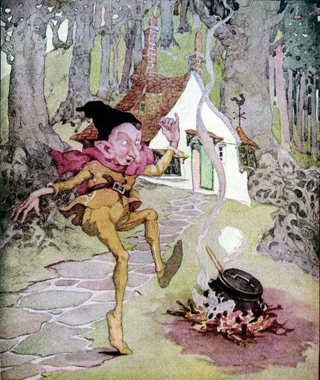
Of all the strange and wonderful fairy tales I encountered as a child, Rumpelstiltskin always struck me as the most peculiar. The story revolves around a girl who must spin straw into gold or face death at the hands of the king. A dwarf appears out of nowhere, and spins the straw into gold — for a price. On the first night he takes a necklace, and on the second a ring. On the third night the girl has nothing left to pay him with, and so the dwarf makes her promise to give him her firstborn child. The king's greed is sated after three days of gold-spinning, and he marries the girl. In due time the new queen gives birth to a child, and sure enough, the dwarf returns to receive his pounds of flesh. But the queen refuses, and tries to offer him some of her newly acquired riches instead. The dwarf agrees to give up his claim on the child, but only if the queen can guess his name within three days. Her guesses on the first two days fail. But then one of her spies returns with a strange tale. He came across a little cottage in the woods, in from of which he saw a dwarf prancing around a fire, singing a song that ended “Little does my lady dream / Rumpelstiltskin is my name!” On the third day the queen initially pretends not to know the dwarf's name. Finally she says, “Could your name be Rumpelstiltskin?” At this the dwarf flies into a rage, and stomps his foot on the ground so hard that a chasm opens up in the ground, swallowing the dwarf, who was never seen again.
As a child I found the dwarf's plunge into the subterranean void the most eerie element in the story, but in recent years I've been pondering another, perhaps deeper mystery. Why did Rumpelstiltskin's name have so much power?
Fairy tales notwithstanding, by the time I got to college I had come to think that names were mere conventions that had no intrinsic meaning or value. For all practical purposes, surely one label was as good as any other? Dismissing a debate on what to call something as “mere semantics” seemed to be an act of hard-nosed skepticism and realism.
But as I came to discover, naming involves much more than simply assigning a label to something that has already been identified. The act of naming is one of the central mysteries of human cognition — it is the visible tip of an iceberg whose depth below the surface of conscious thought we have only just begun to plumb. I cannot claim to have solved this mystery, but I'd like to present what I have cobbled together so far: a handful of puzzle pieces which I hope will entice the reader to join in the investigation. (Perhaps more puzzle pieces will turn up in future columns.) I've divided up the essay into four parts. Here's the plan:
- We'll introduce two key motifs — the named and the nameless — with a little help from the Tao Te Ching.
- We'll examine a research problem that crops up in cognitive psychology, neuroscience and artificial intelligence, and link it with more Taoist motifs.
- We'll look at how naming might give us power over animals, other people, and even mathematical objects.
- We'll explore the power of names in computer science, which will facilitate some wild cosmic speculation.


![Image[1]](/wp-content/legacy/6a00d8341c562c53ef01a73d982b76970d-400wi "Image[1]")