by Katharine Blake McFarland
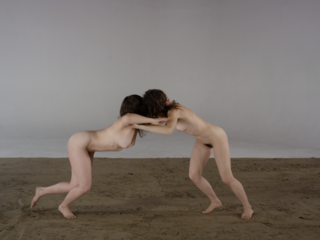 Jennifer Bornstein, Untitled, 2014. © Jennifer Bornstein
On a trip to New York to visit friends last month—a trip that coincided with the city's first beautiful spring weekend after a grueling, endless winter—I walked four miles uptown to see the Whitney Biennial exhibit. Mostly I found the show to be difficult and pedagogical, but there were a few standout pieces, works I will remember for their ability to open up some previously closed part of the heart. A pencil drawing by Elijah Burgher; a massive series of paintings by Keith Mayerson called My American Dream, which sets iconic images next to the personal moments of the painter's life; a kind of totem by Jimmie Durham called Choose Any Three, made of stacked wood pieces inscribed with names like Malcolm X, Annie Wauneka, and Kafka.
But one of the most unforgettable moments of the exhibit wasn't an installation. It was a conversation I overheard among young girls about an installation.
In a small dark room, a short film played on a loop. The film, Untitled by Jennifer Bornstein, features a group of naked women dancing. In true modern dance form, the women are barefoot, pushing and pulling their bodies across the barren backdrop, dragging and circling, arching and caving in. At one point, two of the dancers seem to be in struggle, gripping each other's bodies like wrestlers; other times, the movements are languid, more peaceful and maybe even sad. The dancers themselves are beautiful—capable bodies, confident movements, their long brown hair falling in front of their faces.
As I stood with my back to the wall, just about to leave, three little girls scurried into the room, full of secrets, followed by a bedraggled-looking father. They couldn't have been more than six or seven years old.
“Eeeewwww” the tallest girl whispered loudly.
“They're JUST NAKED!” gasped another, which prompted a general chorus of audible, enraptured disgust (that kind of disgust, so familiar to childhood, that prohibits the possibility of looking away).
“Girls,” whispered the father, “if you don't like it, let's move along.” The girls reacted to this suggestion by taking a seat on the front-most bench, closest to the screen, and continued their chorus. The father tried a different approach: “What do you find so gross about it?”
“Their vaginas!” said the tallest girl. At this, the father glanced around the room embarrassedly, caught my eye, and I smiled.
“What about them?” the father asked, turning back to the girls.
“They're hairy!”—and then, after a reflective pause, “They look like men pretending to be women.”
As I left the dark room and walked into the bright white hallways of the museum, I immediately thought of Barbie. Her impossible proportions, gravity-defying and devoid of muscle; her smooth, and (of course) hairless, plastic skin.
Read more »