by Madhu Kaza
* Located in the Dorsoduro section of Venice, the Gallerie dell'Accademia hold a collection of pre-19th century Venetian art.
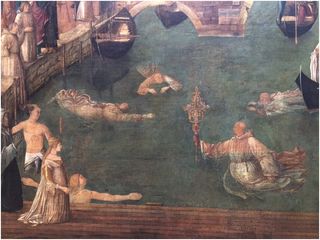
[detail of “Miracle of the Cross at the Bridge of San Lorenzo,” Gentile Bellini. c. 1500]
Introduction:
What if I walked through the doors of Europe (I am an immigrant, but not there; the doors swing open easily) casting aside much of my education, the narrow ways in which I’d been schooled to think about culture, history and art? What if I wandered through France and Italy not in a posture of submission and not as a student of Western Civilization? I know Europe well, even if I’ve hardly been there. I know how greedy (how desperate) it is for affirmation of its superiority to all other places. There is so much that is particular and beautiful there, no different from any place else with its own particular beauty.
What if I walked through the galleries of the Accademia letting my attention land where it wanted? This summer when I saw the painting, “Miracle of the Cross at the Bridge of San Lorenzo,” I wondered what the canals were like in the 15th century; today no one swims or bathes in the water. But I didn’t spend much time reading about Gentile Bellini and the symbolism of the “miracle” he depicted. Instead this image made me think of the bodies of migrants and refugees that were in the waters off the Italian coasts. I’ve long been trained to look for beauty and to prostrate myself in the pursuit of knowledge. But I noticed when I had left the galleries that all the photos I had taken were of details, and that when I had looked at the paintings I had looked through them, reaching for something else: a correspondence.
*
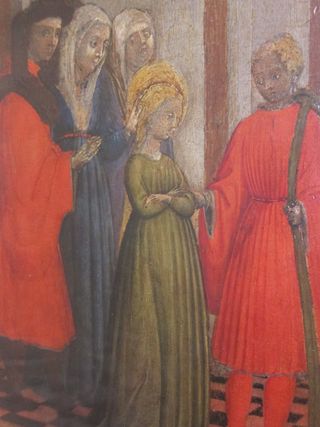
[detail of “The Marriage of St. Monica,” Antonio Vivarini. c. 1441]
Why anyone might love Lila, the brilliant friend in Elena Ferrante’s novel, My Brilliant Friend, is because she is a brutal girl with a voracious intellect– no saint. She won’t be loved by a man.