by Jonathan Kujawa
The Mittag-Leffler Institute has two patron saints: Gösta Mittag-Leffler and Sofia Kovalevskaya. The Institute is located in Mittag-Leffler's home just outside Stockholm. He donated his home and its extensive library in 1916 with the goal of establishing a place for mathematicians to visit and collaborate. Both were built using Mittag-Leffler's personal wealth (which he obtained the old fashioned way: he married into it). Nowadays there are a number of such institutes, but at the time it was the first of its kind.
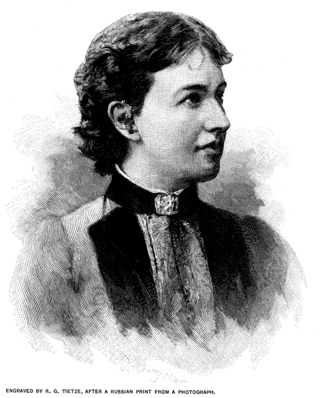
Over my desk, however, was the watchful eye of Kovalevskaya. She was a truly remarkable woman who obtained significant results on differential equations during the second half the nineteenth century. Those being the times, she struggled to find opportunities to study mathematics. When she finally earned her PhD in 1874 she was the first woman in Europe to do so. And even then it was only thanks to rule-bending by the famous Weierstrauss. In 1883 Mittag-Leffler used his considerable influence to procure Kovalevskaya a position at the University of Stockholm. In addition to mathematics, Kovalevskaya wrote several books. Sadly, she died in 1891 at the young age of 41. For a taste of her life, I recommend Alice Munro's short story “Too Much Happiness”.
Whenever I had a bad math day [1], Kovalevskaya's portrait gently and kindly reproached me. At my age she had done all of the remarkable things mentioned above. Almost to the day, when I arrived at the Institute I was the age she was when she passed away. Every day when I arrived it was yet another day more than she had, and as a white, middle-class, American male I couldn't hardly claim any disadvantages to Kovalevskaya! As I'd leave for the day, she would tsk, tsk over all my dead ends and miscalculations.