Also known as Tottle and Stutter. But the real name was Tudor and Stuart: The Tudor and Stuart Club.
The Tudor and Stuart Club was a literary society at The Johns Hopkins University in Baltimore – yes, they insist upon that “the” before “Johns” – and I was the club secretary for several years back in the late 1960s and 1970s. I don’t know just how that honor came to me. But I’d taken many literature courses as an undergraduate, half of them or so with (the now legendary) Richard Macksey and the others with members of the English Department: Earl Wasserman, Donald Howard, D. C. Allen, and J. Hillis Miller. They must have decided that I had a future as a literary critic and so deserved this honor, though, naturally, it came trailing a few pedestrian duties. I was pleased. I’m pretty sure it was Dick Macksey who told me.
T&S was established athwart the boundary between those pesky Two Cultures academic reformers are wont to natter on about [1]. The club room was located on the Arts and Sciences campus (where I was), but the Medical School (across town in East Baltimore) had an equal partnership in the club’s affairs. Sir William Osler, FRS, FRCP [2], one of the four founders of The Johns Hopkins Hospital – yes, you read right, “Sir” in the New World no less – endowed the club in 1918 as a memorial to his son, Edward Revere Osler, who was killed in World War I. Osler was a legendary character, the Father of Modern Medicine, but also a bibliophile and historian. Part of his son’s book collection went to the club, along with some of his fishing tackle – at least I think it was his Revere’s. But it might have been Sir William’s. I don’t rightly recall what I was told at the back then. Anyhow, I assure you, there was fishing tackle in the club’s oak-paneled room in Gilman Hall and it had a distinguished provenance. Had to, it belonged to T&S!
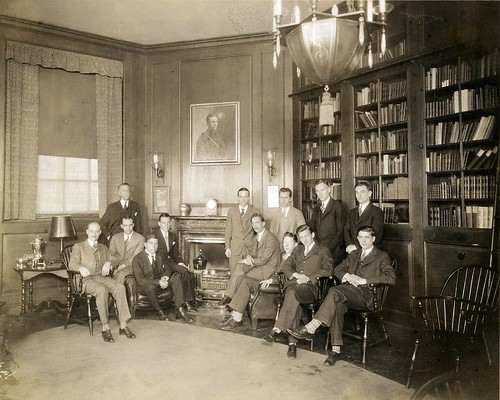
The Tudor and Stuart Club Room, c. 1929
Meetings were organized around an academic presentation, which was followed by cold cuts, tobacco, beer, conversation and, on a good evening, conviviality. As Sir William had been a physician, not a literary scholar or critic, the Medical School contingent and the Arts and Sciences contingent alternated in picking topics and choosing speakers for the monthly meetings.