
by Gary Borjesson
Among the many excellent and indeed divine institutions which Athens has brought forth and contributed to human life, none, in my opinion, is better than those mysteries. For by their means we have been brought out of our barbarous and savage mode of life and educated and refined to a state of civilization; and as the rites are called “initiations,” so in very truth we have learned from them the beginnings of life, and have gained the power not only to live happily, but also to die with a better hope. —Cicero
There is something astonishing, and mysterious, about the flowering of human culture, wherever it happens. I think of ancient China, India, Greece, and the Abbasid Caliphate (centered in Baghdad from the 8th to 10th centuries CE), which extended Greek philosophy and science, in addition to making original contributions of its own. What bloomed in ancient Athens and spread through Greece and the Roman world was an extravagant flowering of philosophy, mathematics, science, art, and political government that became the foundation of western civilization.
This essay explores the Eleusinian Mysteries, which played a key role in that flowering, as Cicero and many others observed. Sophocles said of his experience: “Thrice happy are those mortals who, having seen those rites, depart for Hades; for to them alone is granted to have a true life there.”
Such extravagant praise makes it curious that, while the importance of the Mysteries is widely acknowledged, their deeper significance is often neglected or ignored altogether in academic quarters. It’s even more curious when you learn that its initiates included Socrates, Plato, Aristotle, Sophocles, Pindar, among other famous Greeks; and Romans such as Augustus Caesar, Cicero, Hadrian, and Marcus Aurelius. These rites spanned more than a millennium, dating back to at least the 7th century BCE. (Some archaeological evidence suggests they may be far more ancient, extending as far back as 1500 BCE.) Emperor Theodosius destroyed the temple and the rite around 392 CE, as part of the larger Edict of Thessalonica (380 CE), which made Christianity the official religion of Rome, and prohibited all pagan rites or worship.
Many leading Greek and Roman thinkers, artists, and politicians made the pilgrimage to Eleusis. Yet we come closer to the heart of the Mysteries when we learn that initiation into the Mysteries was open to everyone: man or woman; citizen or foreign worker; free or slave; black, brown or white. We’ll come back to this. But first let’s start with the origin story of the mysteries. Then we’ll sketch what initiation involved, including, as the evidence suggests, the ritual use of a psychoactive substance at its center.
The Origin Story
The Eleusinian Mysteries are rooted in a story about the goddess Demeter and her daughter, Persephone. The version recounted here is from the Homeric Hymn to Demeter (7th century BCE), which is most associated with the Eleusinian Mysteries. (Translation and quotations are from The Road to Eleusis.) Here’s the Hymn’s invocation:
Let me tell you the story of Demeter, the holy goddess whose hair grew in rich plaits as only a goddess’s does, and of her daughter, whom Hades seized.
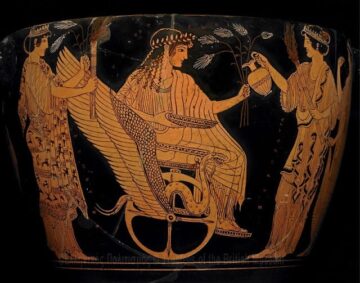
Young Persephone was seized by Hades while playing far from her mother, Demeter, “the lady of the harvest.” As she was reaching down for a narcissus, the earth opened “and Lord Hades, whom we all will meet, burst forth with his immortal horses….Begging for pity and fighting him, she was dragged off in his golden chariot.”
Her mother heard her cries and “threw over her shoulders a great black cloak, the mantle of death.” “Swift as a bird” she went searching for her daughter. Soon she came to Eleusis, and there she stayed, mourning and seeking word of her daughter. In her inconsolable anguish, Demeter “made a deadly year for mankind, withering the soil that is so nourishing.” At Zeus’s urging, several gods implored her to end the famine and come live among them again. But she refused.
Finally, Zeus sent Hermes to Hades, and Hermes said, ’Lord of Death…father Zeus commanded me to lead glorious Persephone back to us gods, so that her mother will stop her wrath.’ Hades obeyed, and said, ‘Go, Persephone, to your mother….in the realm above, you will rule over all the plants that grow and all moving creatures.’” So Persephone returned to her mother, who was overjoyed.
But then her mind darkened and Demeter asked Persephone, “My child, when you were below the earth, did you eat any food?” Hades had forced her to eat a pomegranate seed. Demeter then prophesied that, “if you did eat anything you will have to make the journey back again to the depths of the earth and live with Hades for a third part of the seasons of the year…When the earth abounds with all the fragrant blossoms that come with Spring, then from the sunless west out of the dark night you’ll rise and appear as a great miracle to the gods and mortal men.” Zeus agreed to this prophecy, and asked Demeter “once again to give the earth’s fruits to mankind.” She did as Zeus asked.
Then Demeter went to the mortal kings who administer justice around Eleusis. They built a temple in her honor and she showed them how to perform her rites—
holy rites that are awesome, that no one may transgress nor reveal nor express in words, for an overwhelming reverence for the gods stops his voice. Whoever among men has seen these Mysteries is blessed, but whoever is uninitiated will not have the same lot as the others, once he is dead and dwells in the mould [soft loose soil] where the sun goes down.
Initiation
It’s impossible to know exactly what happened, for the initiates were barred from speaking about specifics; the punishment was death, by Demeter’s decree. The historical record suggests her decree was largely observed, as the Mysteries were indeed an incredibly well guarded secret, and remain so to this day. Yet initiates were free to speak in general terms, as Sophocles and Cicero and Pindar and many others did, about the life-transforming experience.
Here’s a sketch of what’s known about the initiation.
Initiates are thought to have prepared for months prior to the pilgrimage. Then, twice a year, people from diverse backgrounds met to walk the Sacred Way from Athens to Eleusis. Anyone who spoke Greek, and didn’t have the unexpiated blood of a murdered person on their hands, could make the journey and undergo the ritual. The “Lesser Mystery” was held in the Spring, the “Greater Mystery” in the Fall.
The Sacred Way was 22 kilometers long and the only paved road in central Greece. As they walked to Eleusis, the initiates called aloud for Kore (which means maiden and is another name for Persephone). They were re-enacting Demeter’s search for her lost daughter. Walking and chanting together, fasting and undergoing purification rites such as bathing in the sea, the journey and rituals brought them together, leaving behind their diverse social identities.
Eleusis is situated near the sea, on a fertile plain with rolling hills that have been planted with grain for millennia, making it a natural dwelling place for Demeter, goddess of fertility and the harvest. Once the pilgrims arrived at Eleusis, they were initiated into the mysteries over a period of several days. First they underwent further rites of purification.
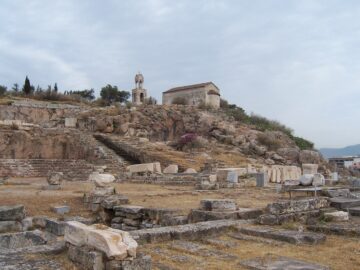
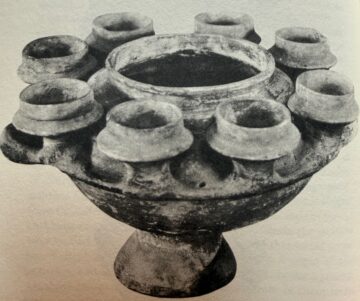
The main event took place in the great initiation hall. Priests and priestesses prepared the sacred kykeon, a drink made from local grains mixed with water, mint and other herbs. Once initiates had drunk the kykeon, they sat in darkness on tiers of steps along the walls of the cavernous hall. They sat for hours, hearing music and watching a play of shadows in torch light against a long wall; these were actors dramatizing Demeter’s return from the underworld with her daughter, Persephone. (Scholars have wondered whether the Republic’s famous allegory of the cave, which bears resemblance to the journey undergone by the initiates, was inspired by Plato’s experience at Eleusis.)
After drinking the kykeon, the initiates experienced a transcendent ecstasy filled with visions. Many initiates reported that the experience that night was life-changing, and that they came away no longer afraid of death. Whatever was in the kykeon, the rite reliably facilitated a cosmic vision. The deepest mystery revealed at Eleusis appears to have been this unifying vision of life and death and rebirth. The great lyric poet Pindar, an initiate, wrote in the 5th century BCE, “Blessed is he who has seen these things before he goes beneath the hollow earth; for he understands the end of mortal life, and the beginning [of a new life].” As noted, Sophocles had much the same vision.
That’s the ritual. Let me wrap up with a teaser for part two on the Eleusinian Mysteries, which will appear here in four weeks. In that essay we’ll go into the significance of the mysteries, with attention to why the kykeon is likely to have included a psychedelic compound, and why this special ingredient seems likely to have played a key role in the flowering of Greek culture.
The teaser concerns a remarkable fact mentioned earlier, that the mysteries were open to anyone. At a time when social castes and discrimination were pervasive, once you started down the Sacred Way to Eleusis, you left those divisions behind, entering into communion with the other pilgrims. The Mysteries didn’t discriminate because they weren’t about our personal or social identity. They were about our deeper common humanity, about what unites us as a species, not what divides us into tribes.
Enjoying the content on 3QD? Help keep us going by donating now.