
by Gary Borjesson
Among the many excellent and indeed divine institutions which Athens has brought forth and contributed to human life, none, in my opinion, is better than those mysteries. For by their means we have been brought out of our barbarous and savage mode of life and educated and refined to a state of civilization; and as the rites are called “initiations,” so in very truth we have learned from them the beginnings of life, and have gained the power not only to live happily, but also to die with a better hope. —Cicero
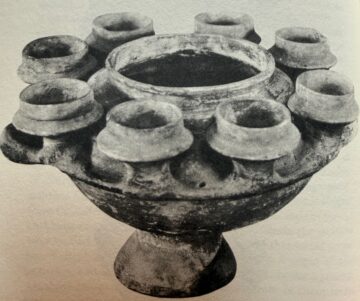
There is something astonishing, and mysterious, about the flowering of human culture, wherever it happens. I think of ancient China, India, Greece, and the Abbasid Caliphate (centered in Baghdad from the 8th to 10th centuries CE), which extended Greek philosophy and science, in addition to making original contributions of its own. What bloomed in ancient Athens and spread through Greece and the Roman world was an extravagant flowering of philosophy, mathematics, science, art, and political government that became the foundation of western civilization.
This essay explores the Eleusinian Mysteries, which played a key role in that flowering, as Cicero and many others observed. Sophocles said of his experience: “Thrice happy are those mortals who, having seen those rites, depart for Hades; for to them alone is granted to have a true life there.”
Such extravagant praise makes it curious that, while the importance of the Mysteries is widely acknowledged, their deeper significance is often neglected or ignored altogether in academic quarters. It’s even more curious when you learn that its initiates included Socrates, Plato, Aristotle, Sophocles, Pindar, among other famous Greeks; and Romans such as Augustus Caesar, Cicero, Hadrian, and Marcus Aurelius. These rites spanned more than a millennium, dating back to at least the 7th century BCE. (Some archaeological evidence suggests they may be far more ancient, extending as far back as 1500 BCE.) Emperor Theodosius destroyed the temple and the rite around 392 CE, as part of the larger Edict of Thessalonica (380 CE), which made Christianity the official religion of Rome, and prohibited all pagan rites or worship.
Many leading Greek and Roman thinkers, artists, and politicians made the pilgrimage to Eleusis. Yet we come closer to the heart of the Mysteries when we learn that initiation into the Mysteries was open to everyone: man or woman; citizen or foreign worker; free or slave; black, brown or white. We’ll come back to this. But first let’s start with the origin story of the mysteries. Then we’ll sketch what initiation involved, including, as the evidence suggests, the ritual use of a psychoactive substance at its center. Read more »