
by Kyle Munkittrick
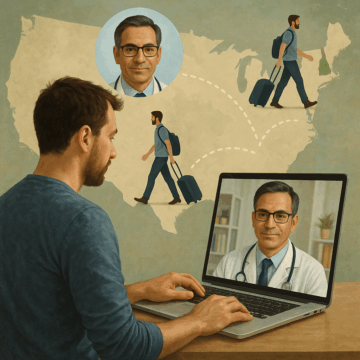 During covid, amid the maelstrom that was American healthcare, a miracle happened. State medical boards suspended their cross-state licensure restrictions.
No special legislation required, no political capital spent. Overnight, every state declared they would recognize medical licenses from any other state. One day you needed 50 licenses to practice nationwide—an expensive, tedious, slow process. The next day, you needed only the license you already had. The nation’s entire health system stayed this way for nearly two years.
As a patient, this was an incredible boon. If you had a primary care doctor you liked in New York and moved to Vermont, Texas, or anywhere in the US, you could keep seeing them over Zoom.
Moving did not mean losing your doctor. You could keep seeing someone you knew and trusted, even across state lines. Telehealth boomed. Whole new ways to deliver and build healthcare businesses emerged.
And then, at the end of the pandemic, all that freedom was quietly destroyed. Why? Because State Medical Boards don’t trust each other.
Pointlessly Expensive, Tedious, and Slow
To practice medicine in a state, you need to be licensed by the state’s medical board. This seems reasonable. Prudent even! Clinical care is risky, there’s huge information asymmetry, and we can’t just let anyone practice medicine. Fair enough. But let’s be clear about what’s being asked.
Let’s say Dr. Jane lives in Texas and wants to care for a patient in Idaho. To start, Dr. Jane is board-certified. That means she took a nationally recognized test in her discipline, such as internal medicine. Next, Dr. Jane gets her license in Texas. To do this, she pays a fee, usually around one to two thousand dollars, fills out a bunch of paperwork, then waits a few months while the medical board double checks everything – she is who she says she is, she’s in good standing, and so on. Now Dr. Jane is licensed to practice medicine in Texas. Hooray!
Dr. Jane has been the PCP for her patient, Bob, for over a decade. During covid, Bob moves to Idaho to take care of his aging parents. Because the cross-state restrictions were lifted Dr. Jane just keep treating Bob over Zoom. During covid, Dr. Jane needed only two things: her national board certification and her Texas state license. During covid, Idaho’s medical board trusts that Texas’ board knows what it’s doing.
But in 2023, the state-based restrictions came back. Suddenly, for reasons unspecified by the board, Idaho no longer trusts Texas. Jane had a choice: drop Bob as a patient, or get a second state license for Idaho. Dr. Jane spends another few thousand dollars, fills out hours of forms (all on paper, all mailed), and waits a few months.
Now ask yourself, what value did that Idaho state license add?
Jane wasn’t forced to memorize Idaho laws, so she’s no more informed on how to practice medicine there. The national board certification proving Dr. Jane was a competent clinician didn’t change. Texas had already confirmed all her information—that she’d gone to medical school, that she passed the boards.
What did Bob get from Dr. Jane paying a few extra thousand dollars, filling out paperwork, and waiting months to treat him in Idaho?
He got nothing. Which is the value state-based license restrictions add.
This becomes more absurd as you add states. Another patient moves to Oklahoma, a third to Vermont, a fourth to Florida. Suddenly keeping a few patients has cost Dr. Jane over $10,000, a week of paperwork, and months of waiting to do something she did instantly and for free three years ago. And for what? Do we really think Idaho has higher standards than Texas? Or that Florida can’t trust the boards of Texas, Idaho, Oklahoma, and Vermont?
But here is the real question: If state medical boards have so little faith in one other’s abilities, should we really be placing so much faith in them?
One License to Rule Them All
Contrast this with your driver’s license. You get tested and register once in your state of residence. If you move, you update it within a reasonable time frame (usually a year). You can use your license everywhere—not just to drive, but as an ID for travel, to rent a car, to get into bars. It’s tempting to say “Well driving isn’t healthcare.” Sure, but your driver’s license lets you pilot a 3-ton SUV at 80 miles per hour. It lets you buy restricted substances. It lets you get through the highest security scrutiny most Americans face. A driver’s license isn’t trivial!
Now, some part of your brain is tingling, saying “this can’t be true. It doesn’t work that way. There is a good reason medical licenses are distinct. I bet it’s… the law! Healthcare laws are complex.”
You’re not wrong, but consider two things. First, driving introduces the same legal nightmare: if you crash in Montana with a New York license hitting a driver with a Texas license, what happens? Which laws apply? Good news—we’ve figured this out. It’s a daily occurrence and our legal system hasn’t imploded.
But second, and far more important: clinicians are already licensed in multiple states. The legal system already knows how to manage the most byzantine permutation of clinical state law combinations. We’re not talking about if providers should be allowed to practice across state lines. They are! They do it all the time. Medical malpractice already handles these situations. The question is not “can we figure out how to allow clinical practice across state lines?” We know the answer. Yes. We already have. You’re soaking in it.
The difference is that State Medical boards have gone back to charging fees and requiring paperwork to do so.
The State Medical Board Monopoly

Every state has its own medical board that approves who can practice medicine within its borders. And not just who can practice, but who can touch the healthcare system. Every healthcare business, provider, and payer needs agonizingly slow, bespoke approval in each state. It’s why there’s a Blue Cross of [Insert Your State Here] rather than just Blue Cross. It’s why there are no national radiology chains. It’s why billion-dollar startups like Hims and Teladoc must very carefully confirm where you claim you are—they must pair you with a clinician licensed in your state.
This isn’t happening in a vacuum. Think of everyone you know who gets medical advice on TikTok or from a podcaster. Every one of us can get medical advice from AI—designed in California, running on servers in Virginia—with no licensing requirements whatsoever.
If you’re a doctor and want to be licensed in all 50 states, it will cost over $200,000 in fees, plus weeks of work, plus tens of thousands every couple years to maintain. By the way, this would still be basically true with the Interstate Medical Licensure Compact, which agrees to ‘streamline the processing’ from months to days. Don’t worry, they still collect a ~$500-$1000 fee per state, so it’s only ~$25,000 – $50,000 to practice everywhere.
State medical boards will counter by saying they’re responsible for overseeing care. They maintain safety. They punish out-of-line doctors. They uphold high standards. In making these arguments, they’re subtly making two claims, one bolder one stranger.
The bolder claim: Clinicians are the only group we should trust to self-regulate. Medical boards are run primarily by doctors, regulating other doctors, with minimal external oversight. Economists call this regulatory capture. We typically balk at letting industries regulate themselves. Yet healthcare is so very special that it works with physicians and physicians only? Seems convenient if you’re a physician!
The results are what you’d expect. Physicians in Ohio are disciplined 11 times as often as physicians in neighboring Indiana. It’s not because Ohio doctors are worse—it’s because the boards perform differently. 70% of physicians with documented sexual misconduct aren’t disciplined by medical boards at all. Research shows that “the principle determinant of board vigilance was the degree to which boards were not dominated by physicians”.
The stranger claim is very strange indeed because in addition to arguing that clinicians are the only people who can be trusted to self-regulate, state medical boards are also insisting they do not trust any other state medical boards, so they must re-verify that work. Every state medical board must implicitly believe that every other state medical board is incompetent, or else they wouldn’t re-do their work.
This claim is all the weirder once you know that the IMLC exists. 40 state medical boards admit they should be able to approve a license in a few days (because they trust each other), but also they still need to collect a fee? For what, exactly?
Again: What value are cross-state fees and paperwork creating for patients? I’m not asking for the abolition of medical boards. We need licensing institutions! The background checks are important. But why do clinicians need a license in every state?
They don’t. And we have a nationwide two-year experiment to prove it.
The Experiment We Already Ran
During COVID, we suspended all state-by-state licensing requirements. States issued executive orders eliminating cross-state licensure requirements for telehealth. The federal Public Health Emergency let Medicare beneficiaries see any provider licensed in any state. Millions of patients received care across state lines from doctors they’d never met in person, in states where those doctors weren’t licensed. Healthcare scaled across state lines overnight.
And nothing bad happened.
No spike in malpractice claims. No patient safety crisis. No emergency legislation to fix dangerous interstate care. The medical boards—normally vigilant defenders of their gatekeeping authority—were silent. If state-by-state licensing mattered for patient safety, we would have seen problems during the waiver period, or loud advocacy for reimposing restrictions after. We saw neither.
Instead, when the PHE ended in 2023, the waivers quietly expired. The barriers went back up. The monopolies resumed.
There are really three options as to why this happened:
- State medical boards are craven, rent-seeking cartels.
- State medical boards need licensure to have jurisdiction.
- State medical boards believe they cannot trust one another.
No medical board would cop to option one. If it’s two, they could just do it by fiat (if you have a license else where, you have one here), there is no need for a compact or to collect a fee. If it’s three, and they don’t trust each other, should we really be trusting any them to govern themselves?
What Would Healthcare Look Like If State Medical Boards Trusted Each Other?
If you want healthcare costs to go down and quality to go up, make every clinician compete with the best clinicians in the US—not just the handful in their city. Everyone worries about a ‘race to the bottom’, but do we really think letting Mayo Clinic, Stanford, and Kaiser compete nationally would make healthcare worse and more expensive overall? That’s a bet worth taking.
Patients pay more for worse access because every metro area is a protected local monopoly. You can only get clinicians who are (1) near you and (2) have time for you. If the best endocrinologist in the country happens to practice in your city, great. If not, too bad—she can’t see you without spending months and thousands of dollars getting licensed in your state, or you spending thousands to fly to her for every appointment.
The specialist is allowed to care for you. State medical boards have no problem with you flying to see a clinician. They aren’t worried about quality of care then. State-based license restrictions just make care harder to get and much more expensive. They’re effectively a ban on true telemedicine.
We already know how to make American healthcare better. We did it for two years. It cost nothing, required no legislation, and unleashed whole new ways of caring for people. We only just were beginning to see what was possible.
But let’s be realistic: state medical boards will not voluntarily surrender their monopoly. They had years to make the COVID waivers permanent. They chose not to.
This needs federal action. Medicare and Medicaid could require cross-state license recognition as a condition of reimbursement—the same leverage used to desegregate hospitals in the 1960s. Congress could use its interstate commerce authority to mandate license portability, just as it does for driver’s licenses.
Look at who benefits: every major health tech company (Oscar, Hims, Amazon One Medical), every health system trying to expand, every employer trying to offer better benefits, every insurance company trying to reduce costs, and every patient who’s ever wanted healthcare on their iPhone.
That’s a powerful coalition. These companies already spend millions navigating state-by-state licensing. They have the resources and incentive to lobby for change. They need to treat this as a top priority, not a cost of doing business (or worse, a regulatory moat). If you’re a healthcare newsletter writer, an abundance liberal, or a patient, this is something that we can all help fix, and we can fix it for free.
When the state medical boards reply with claims of safety or jurisdiction, just remember the questions every patient should ask every state medical board: If you don’t trust each other, why should we trust you? If you do trust each other, why do you charge someone who is already certified and licensed thousands of dollars and require a mountain of paperwork to practice in your state?
No matter your political faction, there’s no reason to support these barriers. If you’re a Medicare for All liberal, you should want better, cheaper, easier access regardless of who pays. If you’re a pro-DOGE conservative, you should be excited about cutting rent-seeking regulation. If you’re a clinician, you get more freedom. If you’re a patient, you get better, more convenient, and faster care. And if you work for a state medical board, come with us into the future.
Set healthcare in America free.
Enjoying the content on 3QD? Help keep us going by donating now.