
by Leanne Ogasawara
It all started, as these things so often do, with love at first sight.
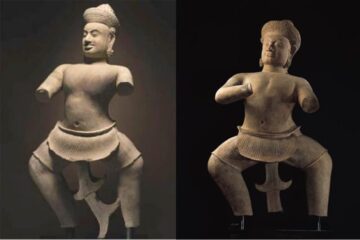
It was a humid evening in Bangkok in 1957, when a young British businessman, Douglas Latchford, found himself standing before a stone woman about two feet tall. She was a Khmer statue, carved by the people who built Angkor, and she was unlike anything he had ever seen. Latchford had been raised, like every properly educated Englishman of his generation, on Greece and Rome. He knew what a god was supposed to look like. You know: marble, symmetry, Apollo, and Athena. But this woman stirred “a desire he had never before experienced…” And he felt as if “he was looking at the human form reduced to its absolute essentials, somehow made more powerful in its simplicity.”
So, there you have it: the exact time and place—the moment of possession, if you will.
After taking out a bank loan so he could buy—and therefore possess—the statue, Latchford next began a deep dive into the history of the ancient Cambodian kingdoms. Without any specialist knowledge to speak of, he began reading, and then speaking to dealers and traveling to the sites themselves.
Perhaps every epic quest requires a guide. And Latchford’s was Jim Thompson, the American whom everyone in postwar Bangkok seemed to know: former OSS officer, savior of the Thai silk industry, collector, aesthete, and owner of what must have been one of the most seductive houses in Asia—a collection of old teak buildings assembled along a canal and filled with beautiful things. Thompson, too, had fallen for Khmer forms.
And here the story becomes interesting, because Thompson understood something that Latchford would soon understand as well: the distance between collector and dealer can be surprisingly short. A man buys an object because he loves it. Then he finds another he loves better. The first one is sold. Money appears. Another object becomes possible.
And voilà: the connoisseur and the dealer turn out to be the same man. Read more »