
by Leanne Ogasawara
It all started, as these things so often do, with love at first sight.
It was a humid evening in Bangkok in 1957, when a young British businessman, Douglas Latchford, found himself standing before a stone woman about two feet tall. She was a Khmer statue, carved by the people who built Angkor, and she was unlike anything he had ever seen. Latchford had been raised, like every properly educated Englishman of his generation, on Greece and Rome. He knew what a god was supposed to look like. You know: marble, symmetry, Apollo, and Athena. But this woman stirred “a desire he had never before experienced…” And he felt as if “he was looking at the human form reduced to its absolute essentials, somehow made more powerful in its simplicity.”
So, there you have it: the exact time and place—the moment of possession, if you will.
After taking out a bank loan so he could buy—and therefore possess—the statue, Latchford next began a deep dive into the history of the ancient Cambodian kingdoms. Without any specialist knowledge to speak of, he began reading, and then speaking to dealers and traveling to the sites themselves.
Perhaps every epic quest requires a guide. And Latchford’s was Jim Thompson, the American whom everyone in postwar Bangkok seemed to know: former OSS officer, savior of the Thai silk industry, collector, aesthete, and owner of what must have been one of the most seductive houses in Asia—a collection of old teak buildings assembled along a canal and filled with beautiful things. Thompson, too, had fallen for Khmer forms.
And here the story becomes interesting, because Thompson understood something that Latchford would soon understand as well: the distance between collector and dealer can be surprisingly short. A man buys an object because he loves it. Then he finds another he loves better. The first one is sold. Money appears. Another object becomes possible.
And voilà: the connoisseur and the dealer turn out to be the same man.
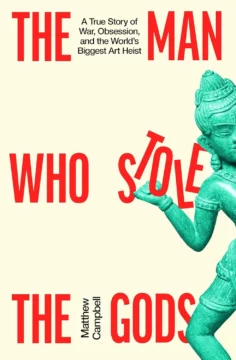 This is only the beginning of Douglas Latchford’s story, and by this point I was completely caught up in it and could not put it down. The Man Who Stole the Gods (2026), by Bloomberg Businessweek reporter Matthew Campbell, is exactly the kind of book I love most.
The book traces the way Latchford, a man born and raised in India during the Raj, spent half a century feeding looted Khmer sculpture to private collectors, auction houses, and museums, including the Metropolitan Museum of Art —all the while publishing lavish books that helped establish him as Cambodia’s great scholar and protector. Cambodia apparently agreed and awarded him with the Grand Cross of the Royal Order of Monisaraphon in 2008.
The US, however, indicted him for trafficking looted antiquities, but he died in 2020 in Bangkok before trial.
The book centers around the artifacts that made their way into the Met collection (and that museum comes off looking very poorly indeed), but I didn’t have to fly to New York to find Latchford’s footprints. I only had to drive down Colorado Boulevard, not a five-minute drive from my place here in Pasadena.
The Norton Simon Museum is a jewel of a private collection. I’ve loved it since I was young and have read that it has more masterpieces per square foot than any collection in the United States. But I have this memory of also reading that it has more stolen pieces per square foot as well. The museum’s namesake, the man with the money Mr. Norton Simon, had been buying art since the mid-1950s: Old Masters, Impressionists, Degas above all.
Then in the early 1970s, he discovered Asia. For Simon there was no Khmer goddess waiting for him across a Bangkok drawing room. But there was something equally magnetic: the Hollywood actress Jennifer Jones. Simon was her third husband and for their honeymoon they went to India, where he delighted in an ivory Mughal chess set.
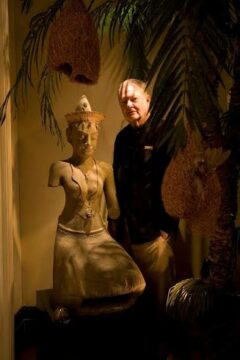 Then, as these things tend to happen, one object led to another. The resulting collection is wonderful. It occupies the lower level of the museum in warm, amber toned galleries with large picture windows looking out onto the garden. The rooms are filled with magnificent stone and bronze sculpture from India, Nepal and Southeast Asia. But some of these pieces have a murky provenance indeed.
In 1973, for example, he paid around $900,000 for a Chola bronze Shiva Nataraja that had been dug out of a farmer’s field in Sivapuram, in Tamil Nadu, decades earlier; the temple had been given a copy while the original quietly left the country. When a New York Times reporter called him about it, Simon did not hedge. “Hell, yes, it was smuggled,” he said. He went on to explain that he had spent some fifteen or sixteen million dollars on Asian art in the last two years, that most of it had been smuggled, and that he didn’t know whether it had been stolen. (He would later deny saying this).
India sued. The Nataraja eventually went home— It returned to Tamil Nadu in 1986 and is now kept in a strong-room at the Kapaleeswarar Temple in Chennai.
I distinctly remember seeing a different Nataraja in the museum when I was young. But I have much more vivid memories of another work of art—one that even now I sometimes see floating in front of me when I close my eyes at night. And this one leads us straight back into Latchford’s world.
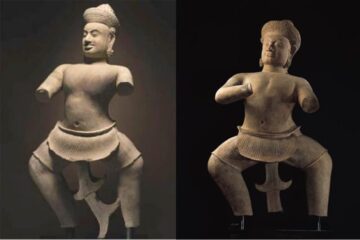
For nearly forty years a colossal tenth-century sandstone figure known as the Temple Wrestler stood in the Norton Simon’s Asian galleries. Bhima, hero of the Mahabharata was broad-chested, smiling faintly, his broken arms thrust forward as though he were still grappling with an invisible opponent. Except the opponent wasn’t imaginary.
At Prasat Chen, a temple at Koh Ker in Cambodia, Bhima had once faced another enormous wrestler, Duryodhana, in a great sculptural tableau. During Cambodia’s years of war and upheaval the figures were hacked from their pedestals and dispersed through the international art market. Duryodhana eventually turned up at Sotheby’s. Two kneeling attendants from the same temple wound up at the Metropolitan Museum. And Bhima came to Pasadena.
Bhima exerted such a strange power over my imagination. I did not know who he was then, or where he had come from, or that somewhere in Cambodia his feet were still attached to a ruined pedestal! I only knew that he seemed extraordinarily alive to me. He had the kind of presence that made everything else in the room disappear.
You can read about this kind of possession again and again—from Chatwin’s Utz to Evan S. Connell’s The Connoisseur—and of course Latchford and Jim Thompson give us the real-life versions.
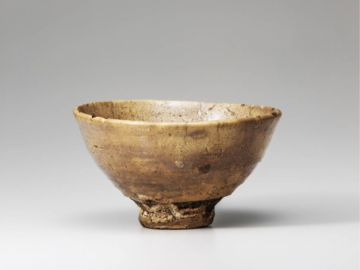
Part of that seduction, I think, comes from craftsmanship. My years studying tea ceremony in Japan changed the way I look at art and objects. The longer I studied, the more important skill and mastery came to feel: the hand, the material, the almost absurd accumulation of knowledge required to make something well. Whatever else such things may be—sacred, ceremonial, beautiful—they are also astonishing feats of technical mastery.
But tea ceremony taught me something else. These objects are not quite finished when the craftsman puts down his tools. A tea bowl becomes something different when it is taken in two hands, turned, drunk from, admired and passed to the next guest. In other words, their meaning resides partly in use—in a living chain of gestures, knowledge and memory.
Some objects, like the Bhima— just like some of the most famous teabowls in Japan— seem almost to vibrate with life.
And that transformation interests me almost as much as the theft itself. Something embedded in one world of ritual and memory becomes, in another, Khmer art. Then perhaps an antiquity. Or a masterpiece. Eventually it is sitting in a Manhattan living room, a museum gallery or, perhaps worst of all, a warehouse in Geneva. It is very sad to think of the way these objects move from being something more like living entities, sometimes considered divine embedded in cultures and communities to being things on shelves, possessions of the wealthy— and, yes, loot
But back to the Bhima. Norton Simon bought him in 1976 from William H. Wolff, a well-known New York dealer in Asian antiquities who maintained what he called a network of “scouts” abroad. It’s not clear whether Latchford personally sold this particular statue to Wolff, although he did sell the Duryodhana to Wolff. By now, though, the larger pattern is hard to miss. Sculptures from the same ravaged temple complex traveled through Latchford and other international dealers before appearing in American museums and private collections.
And then there is this extraordinary detail: Bhima himself appeared in Adoration and Glory, one of the sumptuous books on Khmer art written by the scholar Emma Bunker and Douglas Latchford himself. The books helped make Latchford look like Cambodia’s great connoisseur and protector. But in this case the photograph helped undo the whole story.
Matthew Campbell, in his book, tells the history of the feet that once belonged to the statue and how a British-Italian conservator working at Koh Ker noticed them still standing on a vandalized pedestal and matched them to the legless statue pictured in Bunker and Latchford’s book. Later archaeological work reconstructed the larger scene: Bhima had stood opposite Duryodhana, surrounded by other figures from the Mahabharata. These were not mysterious sculptures that had floated anonymously onto the art market. They had a home and companions. And they also had feet still waiting back in Cambodia!
 You just can’t make this stuff up. Latchford actually had two obsessions: not only was he enthralled by the Khmer statues but he also had a thing for Thai bodybuilders, whose physique perhaps recalled the perfection of his beloved Khmer statuary. In Bangkok he was a big supporter of these athletes and there are many photographs of the bodybuilders posing alongside Khmer statues or wearing looted royal gold jewelry.
The Norton Simon finally returned Bhima to Cambodia in 2014 as a “gift.” Now he can be found in the National Museum in Phnom Penh. For decades the statue I loved in Pasadena was missing its feet—and I never noticed or thought anything about it. I’d love to go visit him there reunited into the tableau for which he was originally conceived, next to the Duryodhana, surrounded by other figures from the Mahabharata.
In the end, Campbell does not describe Latchford as a man who merely discovered a profitable commodity. He believes Latchford genuinely loved these things.
Of course he did.
The greatest collectors always do.
But at what point does the intoxication turn into theft? Men like Latchford and Thompson could be utterly enamored of the beauty and art of their adopted homelands while somehow believing themselves better caretakers of that art and culture than the people who made it. Latchford, not surprisingly, actually claimed this saying that the statues were better off with him, since Cambodia had much bigger issues to deal with after decades of chaos and civil war. He would also claim himself a believer in reincarnation and that he’d once been a Khmer king and so these statues had once belonged to him anyway…
Highly recommended: The Man Who Stole the Gods: A True Story of War, Obsession, and a Global Art Conspiracy, by Matthew Campbell
Notes:
1.
The first time I saw Jim Thompson’s exquisite home in Bangkok, I was around twenty-one. I could not believe the place was real. Located along a canal in Bangkok, the home was composed of six teak houses, most of them nineteenth-century buildings, brought down from Ayutthaya. If I could build a perfect home, this would be it. Filled with art, where gardens come right into the rooms, it is a perfect place to appreciate moon-viewing and insect song. Like Latchford, Thompson was like a character in a novel. Even his mysterious ending is novelistic, when in March 1967, traveling in the Cameron Highlands of Malaysia, he went out for a walk and vanished. No body. No answer. The house stayed exactly where he left it. It is a museum now.
2.
I read The Man Who Stole the Gods right after finishing National Book Award longlisted novel, Valeria Luiselli’s Beginning Middle End, and I could not stop setting the two books side by side. In Luiselli’s novel, the narrator’s grandmother, Nanna, disguises herself as a man in the 1920s to work as a day laborer on the dig at the Villa Romana del Casale in Sicily. When she is found out and sent away, she pockets a small piece of mosaic: the head of Proteus. She carries it with her to Latin America, and it is passed down to her daughter. Proteus, of all gods. The old man of the sea who changes shape to avoid being caught, and who will tell you the truth only if you hold on to him through every transformation. Thompson and Latchford—what Protean figures, right?
3.
I really enjoyed taking a class with Stanford archaeologist Patrick Hunt called: Plundered art: nebuchadnezzar to nero to nazis and history of collection ethics. I learned so much about the long, long, long history of heritage crimes and looting. He graciously published this essay I wrote called, “Christopher Hitchens and the Korean Tea-bowl” on his site.
And here is something I wrote here all the way back in 2015! The Looty-Wallahs (Who Owns Antiquities?).
4.
Norton Simon, in that same New York Times article also said this: If it did some good, I would return it. If there were reason and probability that smuggling could be stopped, I would do it. It would do a lot to establish a constructive relationship between nations….Looting is a terribly destructive process. In cutting works out of temples, thieves mutilate them. Also, US Customs should not allow works into this country unless they have a total clearance from the countries of origin. If we could get such a clear-cut certification to stop smuggling, I would send it back. If not, I’ll probably keep the piece.
The museum is currently embroiled in another dispute over a Cranach in their collection.
5.
In a book by Carl Hoffman that I’ve written about in these pages before, The Last Wild Men of Borneo, there is an American middleman Michael Palmieri traveling deep into the forests of Borneo and figuring out what a village desperately needs—a generator, perhaps, or a new boat. He then trades them, walking away with an ancestral or sacred object that can later sell in Paris, London or New York for hundreds of thousands of dollars. Highly recommended reading.