
by Gary Borjesson
I’ve rarely regretted holding my tongue during a session. I’ve rarely regretted drawing out what’s on a patient’s mind instead of offering some (apparently) juicy insight or interpretation of my own. Holding myself back is sometimes a matter of willpower, but mostly a matter of art. The root of this art is the Socratic method.
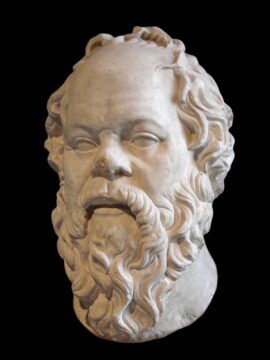
In broad terms, the Socratic method can be used to teach law and other technical subjects, but these aren’t psycho-therapeutic in the way that Socrates was, that Plato’s dialogues are, or that a psychotherapist is. Law professors are not examining a student’s unconscious feelings, thoughts, or beliefs. Rather, the student has taken in a teaching, and their grasp is tested by Socratic-style questioning. But Socrates and Plato themselves are concerned with making what’s latent in the mind conscious, as are psychoanalysts and other depth therapists.
Socrates distinguishes the deeper, more therapeutic potential of his method by calling himself a midwife. This ‘maieutic’ metaphor has become synonymous with his method, as the accompanying definition shows. I want to unpack the meaning of Socratic midwifery and how this is reflected in psychotherapeutic art. The parallels are naturally of interest to me, having spent the first half of my career as a philosophy professor before leaving academia to become a psychotherapist. But more than that, the wisdom folded into the metaphor of midwifery sheds light on how to pursue an aim shared by philosophy and psychotherapy: getting to know oneself. Read more »