
by Marie Snyder
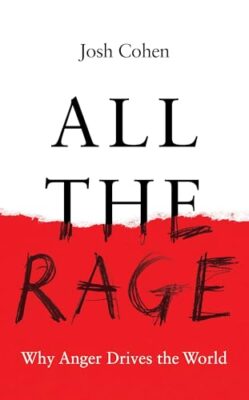 How can we possibly approach the world today without being in a constant stage of rage? Philosopher and psychoanalyst Josh Cohen’s All the Rage suggests how to make this feeling more useful to us. He writes from a range of perspectives, everything from political uprisings to the patients in his office, and from how rage plays out in the world to how it manifests in our own minds, all with a thread of climate change activism throughout. Ideas are illustrated with examples from fictional characters, historical figures, and his own family. It hardly seems possible to do all that in just 195 pages, yet the book is a thought-provoking and entertaining read, comfortably shifting from micro to macro issues to explore four kinds of rage.
SOME DEFINITIONS
In day-to-day conversations, we use “rage,” “anger,” and “aggression” almost interchangeably. We do the same for “emotion” and “feeling” and for “drive” and “instinct.” The book uses these terms more precisely, so a bit of a glossary might be useful. The order of events that occurs when we’re outraged becomes important. Cohen explains that aggression is often the way we respond directly to a stimulus, and anger is what happens after that first spark of action, when we choose to hold it back. He explains it succinctly in an interview with The Philosopher:
“Aggression is a kind of stimulus response. It’s what we do with a provocation, which might be an injury; it might be a humiliation, an insult of some kind, something that arouses us to retaliation. Aggression is the way that we get rid of that load of stimulus in action. … Anger is a way of holding on. Feelings are ways of holding on to stuff. When we can’t bear to feel something we instead discharge it in action. … Anger is something that you’re left with when action is unavailable to you or perhaps when you try to take the experience to a higher level, i.e. to maintain it in the consciousness as something to experience and process psychically rather than discharge in an action. That’s why psychoanalysis tends to think of anger as a human achievement.”
It’s not the case that we’re insulted, then feel anger, and then rationally decide to act or not act, even if it sometimes feels like that. Instead, the impetus to act is immediate following an enraging stimulus, and the restraint is what leads to the feeling of anger. I think that’s the idea. It’s counterintuitive to me, so it’s useful that it was repeated a few times in the book. Read more »