by Andrea Scrima
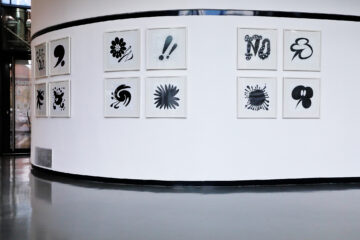
For the past ten years, Andrea Scrima has been working on a group of drawings entitled LOOPY LOONIES. The result is a visual vocabulary of splats, speech bubbles, animated letters, and other anthropomorphized figures that take contemporary comic and cartoon images and the violence imbedded in them as their point of departure. Against the backdrop of world political events of the past several years—war, pandemic, the ever-widening divisions in society—the drawings spell out words such as NO (an expression of dissent), EWWW (an expression of disgust), OWWW (an expression of pain), or EEEK (an expression of fear). The morally critical aspects of Scrima’s literary work take a new turn in her art and vice versa: a loss of words is countered first with visual and then with linguistic means. Out of this encounter, a series of texts ensue that explore topics such as the abuse of language, the difference between compassion and empathy, and the nature of moral contempt and disgust.
Part I of this project can be seen and read HERE
Part II of this project can be seen and read HERE
Part III of this project can be seen and read HERE
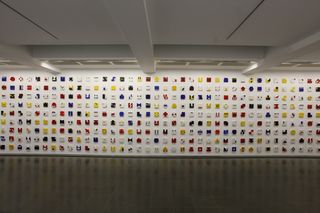
Images from the exhibition LOOPY LOONIES at Kunsthaus Graz, Austria, can be seen HERE
10. AWWW
I look at you and offer an encouraging smile: it’s an awkward moment. You tell me of your suffering and I feign compassion. I feel my face subtly shift as it transforms into its own mask: eyes slightly widened, brow furrowed, I gaze back at you in simulated empathy. Seated opposite me, you are stripped bare; you expose your weakness. Then something in you collects itself, grows cautious, alert suddenly to the spectacle of your unprotected state and your own vulnerable self and my detached vantage as I coolly view you. You excuse yourself, embarrassed; I assure you that there is no need for apologies.
We praise people for enduring their pain in silence; admiringly, we say that they never complain. But do we consider their loneliness as they spare us the obligation of expressing sympathy, of imagining ourselves in their place? Surely we wish no harm; surely our response is sincere: we would do anything to alleviate their suffering, or so we believe. We think of Schadenfreude as a despicable character trait. We wince at the sight of physical injury, the display of the self unraveled, unable to maintain its composure, its dignity and pride. But we are also curious, absorbed by an almost scientific interest. Finally, we give in to our fascination—so these are the symptoms of a body as it breaks down; these are the utterances of a mind as it falls apart. Safe in our perch of good health, we observe the soul in all its nakedness as it watches its future shrink before it, dissolve into the vanishing point of an unknown horizon. Read more »