
Carl Zimmer in The New York Times:
 The caterpillar of the monarch butterfly eats only milkweed, a poisonous plant that should kill it. The caterpillars thrive on the plant, even storing its toxins in their bodies as a defense against hungry birds. For decades, scientists have marveled at this adaptation. On Thursday, a team of researchers announced they had pinpointed the key evolutionary steps that led to it. Only three genetic mutations were necessary to turn the butterflies from vulnerable to resistant, the researchers reported in the journal Nature. They were able to introduce these mutations into fruit flies, and suddenly they were able to eat milkweed, too. Biologists hailed it as a tour-de-force that harnessed gene-editing technology to unscramble a series of mutations evolving in some species and then test them in yet another.
“The gold standard is to directly test mutations in the organism,” said Joseph W. Thornton, an evolutionary biologist at the University of Chicago. The new study “finally elevates our standards.” Insects began dining on plants over 400 million years ago, spurring the evolution of many botanical defenses, including harsh chemicals. Certain plants, including milkweed, make particularly nasty toxins known as cardiac glycosides. The right dose can stop a beating heart or disrupt the nervous system. For thousands of years, African hunters have put these poisons on the tips of arrows. Agatha Christie wrote a murder mystery featuring foxglove, which produces cardiac glycosides.
More here.
 Now, you may be thinking, “Fuck those guys and the private jets they rode in on.” Fair enough. But here’s the thing: those guys are already fucked. Really. They worked like hell to get where they are—and they’ve got access to more wealth than 99.999 percent of the human beings who have ever lived—but they’re still not where they think they need to be. Without a fundamental change in the way they approach their lives, they’ll never reach their ever-receding goals. And if the futility of their situation ever dawns on them like a dark sunrise, they’re unlikely to receive a lot of sympathy from their friends and family.
 Since at least the Great Recession a decade ago, borrowers, activists and others have been building a case that erasing debt acquired during students college years is a matter of economic justice. More recently, researchers have found that canceling some or all of the nation’s outstanding student debt has the potential to boost gross domestic product, narrow the widening racial wealth gap and liberate millions of Americans from a financial albatross that previous generations never had to contend with.
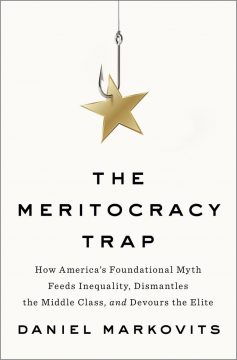 In 1958, sociologist Michael Young wrote a dark satire called The Rise of the Meritocracy. The term “meritocracy” was Young’s own coining, and he chose it to denote a new aristocracy based on expertise and test-taking instead of breeding and titles. In Young’s book, set in 2034, Britain is forced to evolve by international economic competition. The elevation of IQ over birth first serves as a democratizing force championed by socialists, but ultimately results in a rigid caste system. The state uses universal testing to identify and elevate meritocrats, leaving most of England’s citizens poor and demoralized, without even a legitimate grievance, since, after all, who could argue that the wise should not rule? Eventually, a populist movement emerges. The story ends in bloody revolt and the assassination of the fictional author before he can review his page proofs.
 Affective computing systems are being developed to recognize, interpret, and process human experiences and emotions. They all rely on extensive human behavioral data, captured by various kinds of hardware and processed by an array of sophisticated machine learning software applications.
 Twelve years, or so the scientists told us in 2018, which means now we are down to eleven. That’s how long we have to pull back from the brink of climate catastrophe by constraining global warming to a maximum of 1.5 degrees Celsius. Eleven years to prevent the annihilation of coral reefs, greater melting of the permafrost, and species apocalypse, along with the most dire consequences for human civilization as we know it. Food shortages, forest fires, droughts and monsoons, intensified war and conflict, billions of refugees—we have barely begun to conceive of the range of dystopian futures looming on the horizon.
 ONE OF THE GREAT PERVERSITIES
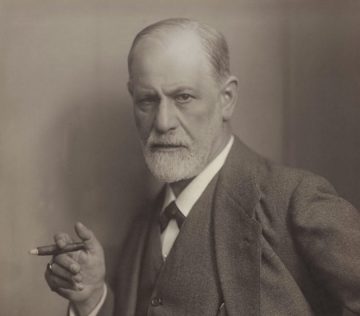 It would be hard to overestimate the significance of Freud’s The Ego and the Id for psychoanalytic theory and practice. This landmark essay has also enjoyed a robust extra-analytic life, giving the rest of us both a useful terminology and a readily apprehended model of the mind’s workings. The ego, id, and superego (the last two terms made their debut in The Ego and the Id) are now inescapably part of popular culture and learned discourse, political commentary and everyday talk.
 Y
Y In Kirkpatrick’s work, Sartre appears far more in need of Beauvoir than Beauvoir is of him. In his later life in particular, it is hard to see him as anything other than pathetic: ruined by alcohol and amphetamines, throwing himself down the intellectual dead-end of Maoism, still skirt-chasing even after several strokes. Much of what is considered to be Sartre’s unique contribution to philosophy and ethics turns out – on consultation of Beauvoir’s letters, diaries and published work – to have started with her.
 The most exciting thing about science is that it can ferry humanity into the unknown. The scientific method, as a mode of observation piloted by humans for generations, has probed outer space, the depths of the oceans, and the inner reaches of cells, molecules, and atoms—our amazing brains at the helm. Never satisfied, the three-pound, skull-encased lump of flesh strains to know more, discover more, solve more. And the universe obliges. Unimaginably vast swaths of space lie unexplored; most of the ocean floor remains a mystery; and new insights into the functioning of cells and the nature of subatomic matter emerge on an almost daily basis.
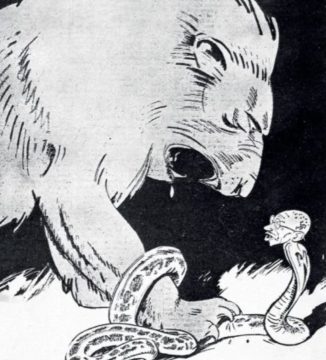 If Gandhi lives today it is because of his enemies, who seem unable to let go of his memory. The Mahatma’s followers have turned him into a saint whose teachings can safely be ignored-as the words of a superior being to be admired from afar.