
Hannah Ongley in Document:
 Entering Red Bull Arts Detroit, housed in the cavernous basement of the old Eckhardt & Becker Brewery in Eastern Market, you’re lured toward the main exhibition space by a pink fluorescent glow. The curious light emanates from a neon sign by the multidisciplinary Detroit artist Tiff Massey, one of Red Bull’s three artists in residence for the program’s first cycle of 2019, reading, “Bitch don’t touch MY HAIR!!” Written in cursive font and followed by exactly two exclamation points, it’s both foreboding and inviting, an entryway into Massey’s world. Massey, who holds an MFA in metalsmithing from Cranbrook Academy of Art, has exhibited in international galleries across Europe, but she’s adamant about who she creates for: black women. The centerpiece of her Red Bull Arts Detroit exhibition is a shrine-like display of 22 hairstyles, each braided and beaded in the same splendid shade of gold, and walled in on either side by distorted black-and-white photographs from an African-American hair salon, which feature primarily caucasian models. On an adjacent wall is a row of oversized pink barrettes repurposing another aspect of Detroit’s history: big manufacturing. “Craftsmanship is first,” Massey tells curator Laura Raicovich in the following conversation. “I want you to be seduced by the work. Whether it’s the colors, or the form, or whatever.”
Raicovich, through her work as a curator and author, is also a fearless advocate for equity in the historically exclusive art world. She resigned from her position as director of the Queens Museum at the beginning of last year, after riling more conservative board members with progressive initiatives including increased access for the local immigrant community.
More here.

 Nine months can make a person, or remake her. In October, 1997,
  Why organisms began having sex, rather than simply reproducing asexually as life did for billions of years—and still does, in the case of single-celled organisms and some plants and fungi—is a bit of a mystery. Sexual reproduction evolved around a billion years ago or more, despite the additional energy required and the seeming hinderance of needing to find a suitable mate. Prevailing theories hold that sex became the dominant form of reproduction due to the benefits of greater genetic diversity, allowing offspring to adapt to changing environments and keeping species one step ahead of parasites that evolved to plague the parents.
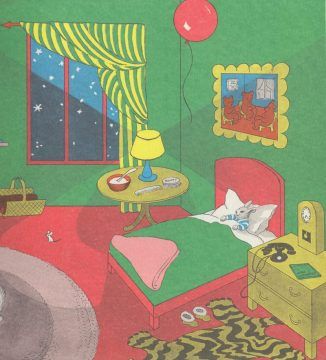 Something unsettling resides at the heart of the most beloved books for very young children—that is, the literature for illiterates. This note is a belated attempt to grapple with the horror of infinite regression as it manifests in certain of these works, and perhaps to sound the alarm for parent-caretaker voice-over providers who are too sleep-deprived to notice what’s actually going on.
 In 1990, using the name Smog, the singer and songwriter Bill Callahan released his début album, “Sewn to the Sky.” It’s a discordant, inscrutable, and periodically frustrating collection of mostly instrumental, low-fidelity noise, and contains few hints of the lucid and tender folk music that he would be making almost thirty years later. In 1991, Callahan signed with Drag City, a Chicago-based independent record label that specializes in oddball rock and roll. He began collaborating with the producers Jim O’Rourke, who was later a member of
  There is no concise answer to the question ‘what is Bauhaus?’ First it was a school with a specific curriculum in art and design. Later, it became a style and a movement and a look (geometric, elegant, spare, modern) that could be found to greater and lesser degrees in art, craft and architecture all over the world. But in retrospect, I think it is fair to say that Bauhaus was always an attempt to fuse the craft and aesthetic ideas of a pre-modern age with the realities of 20th century industry and technology. Bauhaus wanted to find out how materials like concrete and steel and glass could be beautiful and could be shaped and designed in such a way as to serve the aesthetic needs of humankind. In this, Bauhaus was very much in the spirit of the movements that preceded it, like Arts and Crafts and Art Nouveau. But Bauhaus went further than any of those movements in its embrace of what we now think of as the Modern with a big ‘M’. Some would say it went too far.
 Israeli physicists think they have confirmed one of the late Stephen Hawking’s most famous predictions by creating the sonic equivalent of a black hole out of an exotic superfluid of ultra-cold atoms. Jeff Steinhauer and colleagues at the Israel Institute of Technology (Technion) described these intriguing experimental results in
  The debate over meritocracy has been intensifying. Is it a good thing? A bad thing? Do we want it or don’t we?
 Editors’ note: This is the third installment in a new series, “Op-Eds From the Future,” in which science fiction authors, futurists, philosophers and scientists write Op-Eds that they imagine we might read 10, 20 or even 100 years from now. The challenges they predict are imaginary — for now — but their arguments illuminate the urgent questions of today and prepare us for tomorrow. The opinion piece below is a work of fiction.
 It’s a source of great irony and outrage that the Turkish authorities have decided to investigate
  About a year ago, some—but not all—of the mice in
  Unlike talk of, say, badgers or ermine, talk of beavers seems always to be the overture to a joke. So powerful is the infection of the cloud of its strange humor that the beaver seems at least in part to blame for the widespread habit, among certain unkind Americans, of smirking at the mere mention of Canada. Nor is it the vulgar euphemism, common in North American English and immortalized in Les Claypool’s heartfelt ode, “
 It’s fun to spend time thinking about how other people should behave, but fortunately we also have an inner voice that keeps offering opinions about how we should behave ourselves: our conscience. Where did that come from? Today’s guest, Patricia Churchland, is a philosopher and neuroscientist, one of the founders of the subfield of “neurophilosophy.” We dig into the neuroscience of it all, especially how neurochemicals like
  Noam Chomsky: There have been changes, even before the recent shift you mention. Both parties shifted to the right during the neoliberal years: the mainstream Democrats became something like the former moderate Republicans, and the Republicans drifted virtually off the spectrum. There’s merit, I think, in the observation by Thomas Mann and Norman Ornstein that increasingly since the Newt Gingrich years—and strikingly in Mitch McConnell’s Senate—the Republican Party has become a “radical insurgency” that is largely abandoning normal parliamentary politics. That shift—which predates Donald Trump—has created a substantial gap between the two parties. In the media it’s often called “polarization,” but that’s hardly an accurate description.