
Category: Recommended Reading
The Terrifying Power of a Single Book
Brendan Simms at Literary Hub:
 Incarceration gave Hitler a chance to read more widely and gather his thoughts. One of his main preoccupations in Landsberg was the United States, which he was coming to regard as the model state and society, perhaps even more so than the British Empire. He “devoured” the memoirs of a returned German emigrant to the United States. “One should take America as a model,” he proclaimed.
Hess wrote that Hitler was captivated by Henry Ford’s methods of production which made automobiles available to the “broad mass” of the people. This appears to have been the genesis of the Volkswagen. Hitler envisaged that the automobile would further serve as “the small man’s means of transport into nature—as in America.” He also planned to apply methods of mass production to housing, and experimented with designs for a Volkshaus for families with three to five children which would have five rooms and a bathroom with a garage in large terraced settlements.
more here.
On Thomas Mann’s Sense of Humor
Jeffrey Meyers at The New Criterion:
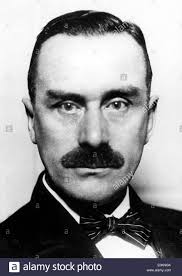 Thomas Mann’s reputation as a difficult, ponderous, heavyweight novelist, and the erudite allusions, serious subject matter, and philosophical themes of The Magic Mountain (1924) have led readers to ignore the comic and satiric tone that enlivens his morbid novel. His method is very different from the somber and solemn way most authors—like Tolstoy, Gide, and Solzhenitsyn—write about disease and death. Mann’s dark comedy, tinged with fear and disgust, takes place in the luxurious remote enclosed society of the International Sanatorium Berghof. He indicates the magic of the place with a witty game of recurring numbers. The young, naïve Hans Castorp, who leaves his ordinary life in Hamburg to visit his tubercular cousin Joachim Ziemssen, generates much of the comedy. Hans gradually progresses from incomprehension to knowledge and to eager acceptance of the distorted medical, social, and sexual customs on the magic mountain.
Hans lives with a cast of bizarre characters who, monstrously perverted by illness and egoism, engage in frenetic sexual activity or carry their intellectual disputes to extremes of aggression. Mann satirizes, in the vivid portraits of Dr. Behrens and the psychiatrist Dr. Krokowski, the mingling of science, mysticism, and financial greed in the medical profession. Comedy lightens the mood of the novel and enables the moribundi to endure their agony in the “Chamber of Horrors.”
more here.
Jesus, Mary, and Mary
Elizabeth Bruenig at the NYRB:

Thus the inviolable and pure Mary sees her reflection in an inviolable and pure Church—theoretically. It’s perhaps no surprise that Catholics (and here I should say that I am one) are especially protective of Mary’s virtue in a period of shattering sexual scandal. We are moderns; our faith is fragile, beset on all sides by relentless demystification, skepticism, and the accumulation of shame for the Church’s wrongdoings. Mockery and vulgar insults are as effective as any of these, because they arrive as messengers of modernity, sending up superstitions of the past: Could such a person as Mary have really existed, and what sort of fool would think so? When we protect her from disparagement or doubt, we also protect ourselves.
Medieval Christians (at least those of East Anglia during the late Middle Ages) felt less compunction on this front, argues Emma Maggie Solberg in her provocatively titled Virgin Whore, which explores a time, place, and literary tradition in which slights to Mary’s modesty arrived not as risks to the faith but as part of popular piety.
more here.
Delhi’s Toxic Sky
Alan Taylor in The Atlantic:
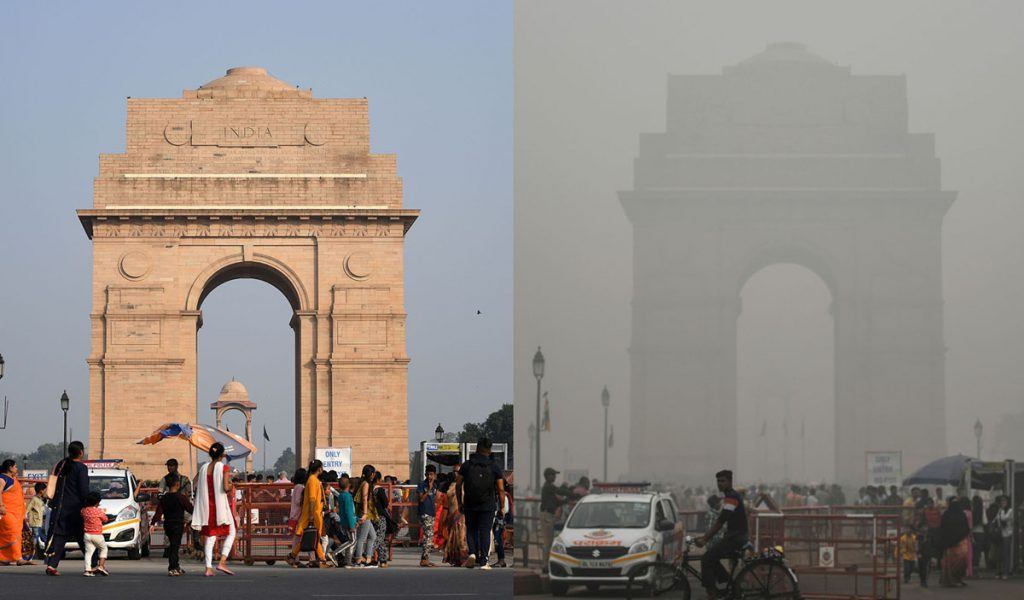
Millions of people in Delhi, India, and neighboring states are struggling to cope with eye-watering smog that has settled on the region—creating some of the worst air quality in years. Government authorities have declared a public-health emergency, closing schools, halting construction, and restricting cars to an “odd-even” system, based on their license plates, to try to halve the number of vehicles on the roads. The toxic stew filling the air comes from a combination of vehicular and industrial emissions and smoke from the seasonal burning of rice-paddy stubble on farms in nearby states.
Is Death Reversible?
Christopher Koch in Scientific American:
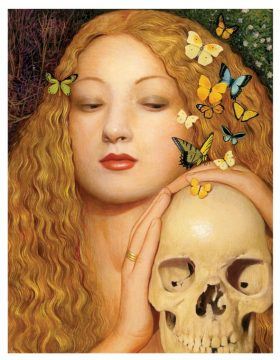 You will die, sooner or later. We all will. For everything that has a beginning has an end, an ineluctable consequence of the second law of thermodynamics. Few of us like to think about this troubling fact. But once birthed, the thought of oblivion can’t be completely erased. It lurks in the unconscious shadows, ready to burst forth. In my case, it was only as a mature man that I became fully mortal. I had wasted an entire evening playing an addictive, first-person shooter video game—running through subterranean halls, flooded corridors, nightmarishly turning tunnels, and empty plazas under a foreign sun, firing my weapons at hordes of aliens relentlessly pursuing me. I went to bed, easily falling asleep but awoke abruptly a few hours later. Abstract knowledge had turned to felt reality—I was going to die! Not right there and then but eventually.
Evolution equipped our species with powerful defense mechanisms to deal with this foreknowledge—in particular, psychological suppression and religion. The former prevents us from consciously acknowledging or dwelling on such uncomfortable truths while the latter reassures us by promising never-ending life in a Christian heaven, an eternal cycle of Buddhist reincarnations or an uploading of our mind to the Cloud, the 21st-century equivalent of rapture for nerds. Death has no such dominion over nonhuman animals. Although they can grieve for dead offspring and companions, there is no credible evidence that apes, dogs, crows and bees have minds sufficiently self-aware to be troubled by the insight that one day they will be no more. Thus, these defense mechanisms must have arisen in recent hominin evolution, in less than 10 million years.
More here.
Sunday, November 3, 2019
The personal diet has become not only a cult, it has become a political statement
James McWilliams in The Hedgehog Review:
 In the summer of 2016, James and Becca Reed, a lower-income couple living in Austin, Texas, decided it was time to save their lives. The Reeds, married more than twenty-five years, had become morbidly obese, diabetic, and depressed. They were taking a combined thirty-two medications. Only in their early fifties, they had arrived at this condition via a well-trod path: They ate their way into it. They did no more than consume what the American food industry not only offers in abundance—salt, starch, and sweetness—but also encourages us to eat.
As nearly 40 percent of the adult US population can attest, it doesn’t take a lot of time, effort, or expense for the consequences of the American way of eating to add up.1 A steady diet of processed and fast food, oversized restaurant meals, and “favorited” takeout options can quickly make the average American a victim of the growing obesity epidemic. Considering that the Reeds live paycheck to paycheck, and given what we know about the strong link between economic disadvantage and poor eating choices, I was especially intrigued when a friend, who knew James and Becca from church, told me about this really interesting couple getting ready to reclaim their health in a dramatic way.
With disarming generosity, the Reeds opened their lives to me as they undertook their mission.
More here.
The socialization of intelligence: A talk by Seth Lloyd
Seth Lloyd at Edge:
 We haven’t talked about the socialization of intelligence very much. We talked a lot about intelligence as being individual human things, yet the thing that distinguishes humans from other animals is our possession of human language, which allows us both to think and communicate in ways that other animals don’t appear to be able to. This gives us a cooperative power as a global organism, which is causing lots of trouble. If I were another species, I’d be pretty damn pissed off right now. What makes human beings effective is not their individual intelligences, though there are many very intelligent people in this room, but their communal intelligence.
More here.
Sean Carroll’s Mindscape Podcast: Katie Mack on How the Universe Will End
Sean Carroll in Preposterous Universe:
Cosmologists are always talking excitedly about the Big Bang and all the cool stuff that happened in the 14 billion years between then and now. But what about the future? We don’t know for sure, but we know enough about the laws of physics to sketch out several plausible scenarios for what the future of our universe will hold. Katie Mack is a cosmologist who is writing a book about the end of the universe. We talk about the possibilities of a Big Crunch (and potential Big Bounce), a gentle cooling off where the universe gradually grows silent, and of course the prospect of a dramatic phase transition, otherwise known as the “bubble of quantum death.” Which would make a great name for a band, I think we can all agree.
More here.
Zadie Smith Experiments With Short Fiction
Rebecca Makkai in the New York Times:
 To consider yourself well versed in contemporary literature without reading short stories is to visit the Eiffel Tower and say you’ve seen Europe. Not only would monumental writers be missing from your literary tour, but entire angles and moves and structures of which the novel, in its bulk, is incapable. The quirky neighborhood, the narrow cobblestone alley, the stray cats and small museums and the store that sells only butter.
Since the publication of “White Teeth” in 2000, readers have known Zadie Smith as a novelist of tremendous scope, a maximalist with a global eye and mind. Those who’ve been paying attention have also caught her stories along the way in our better magazines and journals — stories that until recently have, for the most part, followed a linear narrative, taking advantage of the shorter form but not its more eccentric powers.
Some of these more traditional stories have landed in Smith’s first collection, “Grand Union,” and while still brilliant on the level of the sentence, the paragraph, the often hilarious skewering of humanity, they’re the least successful ones here, sour notes in a collection in which the best pieces achieve something less narrative and closer to brilliance.
More here.
Jessye Norman (1945 – 2019)
Sunday Poem
Bull Song
For me there was no audience
no brass music either,
only wet dust, the cheers
buzzing at me like flies,
like flies roaring.
I stood dizzied
with sun and anger,
neck muscle cut,
blood falling from the gouged shoulder.
Who brought me here
to fight against walls and blankets
and the gods with sinews of red and silver
who flutter and evade?
I turn, flies rise and settle,
I exit, dragged, a bale
of lump flesh.
The gods are awarded
the useless parts of my body.
For them this finish,
this death of mine is a game:
not the fact or act
but the grace with which they disguise it
justify them.
by Margaret Atwood
from The Poetry Foundation
Kadri Gopalnath (1949 – 2019)
Ed Clark (1926 – 2019)
How Trump Reshaped the Presidency in Over 11,000 Tweets
Shear et al in The New York Times:
 In the Oval Office, an annoyed President Trump ended an argument he was having with his aides. He reached into a drawer, took out his iPhone and threw it on top of the historic Resolute Desk:
“Do you want me to settle this right now?”
There was no missing Mr. Trump’s threat that day in early 2017, the aides recalled. With a tweet, he could fling a directive to the world, and there was nothing they could do about it.
When Mr. Trump entered office, Twitter was a political tool that had helped get him elected and a digital howitzer that he relished firing. In the years since, he has fully integrated Twitter into the very fabric of his administration, reshaping the nature of the presidency and presidential power. After Turkey invaded northern Syria this past month, he crafted his response not only in White House meetings but also in a series of contradictory tweets. This summer, he announced increased tariffs on $300 billion worth of Chinese goods, using a tweet to deepen tensions between the two countries. And in March, Mr. Trump cast aside more than 50 years of American policy, tweeting his recognition of Israel’s sovereignty in the Golan Heights. He openly delighted in the reaction he provoked.
“Boom. I press it,” Mr. Trump recalled months later at a White House conference attended by conservative social media personalities, “and, within two seconds, ‘We have breaking news.’”
Early on, top aides wanted to restrain the president’s Twitter habit, even considering asking the company to impose a 15-minute delay on Mr. Trump’s messages. But 11,390 presidential tweets later, many administration officials and lawmakers embrace his Twitter obsession, flocking to his social media chief with suggestions. Policy meetings are hijacked when Mr. Trump gets an idea for a tweet, drawing in cabinet members and others for wordsmithing. And as a president often at war with his own bureaucracy, he deploys Twitter to break through logjams, overrule or humiliate recalcitrant advisers and pre-empt his staff.
“He needs to tweet like we need to eat,” Kellyanne Conway, his White House counselor, said in an interview.
More here.
Can You Overdose on Happiness?
Lone Frank in Nautilus:
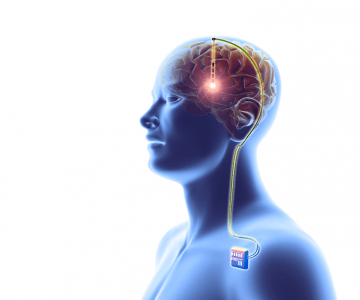 It is a good question, but I was a little surprised to see it as the title of a research paper in a medical journal: “How Happy Is Too Happy?” Yet there it was in a publication from 2012. The article was written by two Germans and an American, and they were grappling with the issue of how we should deal with the possibility of manipulating people’s moods and feeling of happiness through brain stimulation. If you have direct access to the reward system and can turn the feeling of euphoria up or down, who decides what the level should be? The doctors or the person whose brain is on the line?
The authors were asking this question because of a patient who wanted to decide the matter for himself: a 33-year-old German man who had been suffering for many years from severe obsessive-compulsive disorder and generalized anxiety syndrome. A few years earlier, the doctors had implanted electrodes in a central part of his reward system—namely, the nucleus accumbens. The stimulation had worked rather well on his symptoms, but now it was time to change the stimulator battery. This demanded a small surgical procedure since the stimulator was nestled under the skin just below the clavicle. The bulge in the shape of a small rounded Zippo lighter with the top off had to be opened. The patient went to the emergency room at a hospital in Tübingen to get everything fixed. There, they called in a neurologist named Matthis Synofzik to set the stimulator in a way that optimized its parameters. The two worked keenly on the task, and Synofzik experimented with settings from 1 to 5 volts. At each setting, he asked the patient to describe his feeling of well-being, his anxiety level, and his feeling of inner tension. The patient replied on a scale from 1 to 10.
The two began with a single volt. Not much happened. The patient’s well-being or “happiness level” was around 2, while his anxiety was up at 8. With a single volt more, the happiness level crawled up to 3, and his anxiety fell to 6. That was better but still nothing to write home about. At 4 volts, on the other hand, the picture was entirely different. The patient now described a feeling of happiness all the way up to the maximum of 10 and a total absence of anxiety.
More here.
Saturday, November 2, 2019
‘My Mother Laughs’ by Chantal Akerman
Lauren Elkin at The Guardian:
 In a scene in No Home Movie (2015), the last film from the celebrated film director Chantal Akerman, which is a documentary of her elderly mother’s daily life as she recovers from an operation, Akerman says while they are eating dinner: “In Judaism a child doesn’t have to love his parents, but he does have to respect them. Which is a very good idea!” she adds, waving her knife in the air. Her mother, Natalia, laughs.
Her mother laughs often, Akerman recalls in her memoir, in which the present day seems to be about a year before the film was made. “Often she laughs in the middle of her moans.” “I listen to her laugh,” Akerman writes. “She laughs over nothing. But this nothing means a lot. She even laughs in the morning sometimes … I like the sound her laugh makes. She sleeps a lot, but she laughs. She enjoys herself. Then she sleeps.”
more here.
A New Biography of Janis Joplin
Dwight Garner at The New York Times:
 Had she not died at 27 of an accidental heroin overdose, Janis Joplin would be 76 — two years younger than Paul Simon and four years younger than Mavis Staples. Singers with scorched voices sometimes settle more deeply into them. (Have you heard the most recent Marianne Faithfull album?) One wonders at the body of recordings Joplin might have made.
A new biography, “Janis,” by the music writer Holly George-Warren, performs a service by stripping away a lot of the noise around Joplin — cackling and bawdy, she was America’s first female rock star and Haight-Ashbury’s self-destructive pinup girl — and telling her story simply and well, with some of the tone and flavor of a good novel.
This is fundamentally an Eisenhower-era misfit story, and there are a lot of those. But Joplin’s story has a special freight of pain in it. Before it embraced her, Texas turned her into a pariah.
more here.
The Legacy of Arthur Farwell
Sudip Bose at The American Scholar:
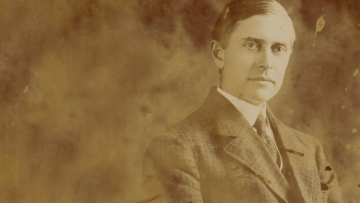 Farwell’s music would lose many of these Romantic characteristics after his first journey to the West, undertaken in the autumn of 1903. He explored pueblos and Indian reservations, gazing in wonder at the sublime beauty of the desert—to Farwell, a love of Native American cultures was inseparable from a veneration of the land. Indeed, his first sight of the Grand Canyon put him in a rapturous state: “I sat there watching the lights and shadows play and change over the strange distances and depths of this wonderworld,” he later recalled, “and heard the unwritten symphonies of the ages past and the ages to come.” (Half a century later, the Sonoran Desert would similarly inspire Elliott Carter, who came away from a year’s sojourn in Arizona with one of his first masterpieces, the String Quartet No. 1.)
In 1904, Farwell traveled to Southern California, where he lived for a time with the anthropologist Charles Lummis. During this period, Farwell transcribed hundreds of Native American songs, primarily of the Cahuilla people, and composed some of his most popular pieces.
more here.
Why Central Banks Need to Step Up on Global Warming
 Adam Tooze in Foreign Policy:
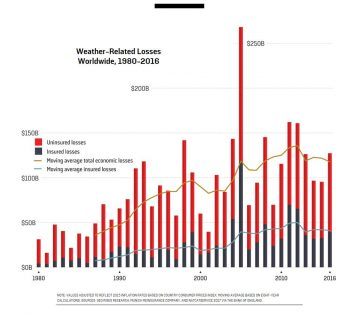
As [Mark] Carney laid it out back in 2015, three types of risk could strike the financial system: losses in the insurance system, climate change liability, and the problem of stranded assets.
The insurance system is the economy’s shock absorber. Its role is to spread the impact of losses from those immediately affected to those with the wherewithal to bear the shock. In good times, the insurers earn handsome returns for accepting this risk. They cover their own liabilities by taking out reinsurance, further spreading the losses.
It is a highly effective system and enormous in scale. Property and casualty insurance (as distinct from life and health insurance) generates global premiums in excess of $1.5 trillion a year. The business is profitable so long as the risks remain within familiar limits and largely uncorrelated with each other. But that is precisely what climate change has called into question. As Carney put it in 2015, as a result of climate change, “the tail risks of today” will be “the catastrophic norms of the future.” Since the 1980s, the scale of weather-related insurance losses has risen fivefold to about $55 billion a year. Uninsured losses are twice as much again.
In theory, the costs due to this shift in risk profiles should be capable of being contained within the insurance sector itself. But as the fate of AIG made painfully apparent in 2008, insurance firms are key nodes in the global financial system. The money accumulated by the insurers is reinvested in money markets, banks, and other funds. Nine major insurers are listed as globally systemically important by the Financial Stability Board. They are too big to fail.
More here. Also see this response by Tooze to the Bundesbank’s reaction to his piece.