
David G. Stork in The MIT Press Reader:
 Last month at the San Francisco Museum of Modern Art I saw “2001: A Space Odyssey” on the big screen for my 47th time. The fact that this masterpiece remains on nearly every relevant list of “top ten films” and is shown and discussed over a half-century after its 1968 release is a testament to the cultural achievement of its director Stanley Kubrick, writer Arthur C. Clarke, and their team of expert filmmakers.
As with each viewing, I discovered or appreciated new details. But three iconic scenes — HAL’s silent murder of astronaut Frank Poole in the vacuum of outer space, HAL’s silent medical murder of the three hibernating crewmen, and the poignant sorrowful “death” of HAL — prompted deeper reflection, this time about the ethical conundrums of murder by a machine and of a machine. In the past few years experimental autonomous cars have led to the death of pedestrians and passengers alike. AI-powered bots, meanwhile, are infecting networks and influencing national elections. Elon Musk, Stephen Hawking, Sam Harris, and many other leading AI researchers have sounded the alarm: Unchecked, they say, AI may progress beyond our control and pose significant dangers to society.
And what about the converse: humans “killing” future computers by disconnection?
More here.
 Computers can now drive cars, beat world champions at board games like chess and Go, and even write prose. The revolution in artificial intelligence stems in large part from the power of one particular kind of artificial neural network, whose design is inspired by the connected layers of neurons in the mammalian visual cortex. These “convolutional neural networks” (CNNs) have proved surprisingly adept at learning patterns in two-dimensional data — especially in computer vision tasks like recognizing handwritten words and objects in digital images.
 We are witnessing
 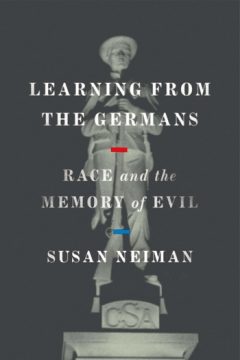 Neiman’s book comprises two parts. The first is dedicated to the historical underpinnings of the German reckoning with Nazism and the Holocaust beginning in the early ’60s, with television broadcasts of the Eichmann and Frankfurt Auschwitz trials, which led a younger generation to ask, for seemingly the first time, about the complacency and complicity of teachers, politicians, and above all fathers. (“Being German in my generation,” the author Carolin Emcke, born in 1967, tells Neiman, “means distrusting yourself.”) Learning from the Germans narrates the subsequent political and cultural evolution, including Willy Brandt’s 1970 Kniefall in penance to the victims of the Warsaw Ghetto Uprising, the Historians Debate of the 1980s, and the 2003–2005 construction of Peter Eisenman’s Holocaust Memorial, a site Neiman dislikes for the vagueness of its abstract form but whose gestation was admittedly long and difficult. Reunification posed a particular set of challenges to how Nazism and the Holocaust were publicly remembered; she contrasts the record of the former East Germany with that of West Germany and largely defends the avowed antifascist state from the charge that it failed to address the German past with anything comparable to Western efforts. Three decades after reunification, the extremist AfD party explicitly frames what it calls a “guilt cult” and threatens the success of the postwar project. Yet no other country (at least in Europe or North America) has made anything like the strides Germany has toward facing the legacy of national evils, whether colonialism in Britain and France or slavery and Jim Crow in America. Only in 2009 did the US Senate approve a resolution apologizing to black Americans for slavery.
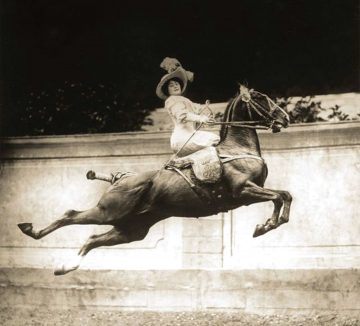 The glamour of both types of horsewoman was impeccable, their skill and bravery vertiginous. These long-dead performers became celebrities to me, fleshed out beyond the Impressionist postcards: Elvira Guerra, the first woman to compete against men at the Olympics in 1900; Caroline Loyo, “the diva of the crop” whose black eyes and disciplinaire riding brought the Jockey Club boys to the Paris circuses; and Suzanne Valadon, the acrobat of Toulouse-Lautrec’s paintings who went on to be an artist herself after an injury cost her her career in the ring.
 WHEN I WAS
 The thought-provoking Israeli documentary “Advocate,” from the directors Rachel Leah Jones and Philippe Bellaïche, opens with its subject, the human-rights lawyer Lea Tsemel, making her way resolutely toward the elevators at the district court in Tel Aviv. A short and solidly built woman in her seventies, with a mop of dark hair and kohl-rimmed eyes, Tsemel is on her way to the courthouse’s detention cells to meet with a client. “Is it going down?” she asks as she approaches the elevator’s nearly closed doors, before sticking her leg between them and muscling her way in. “Lea, what will become of you? When will you mend your ways?” a man inside the elevator asks her. “Who, me? I’m a lost cause,” she answers.
 As the full extent of the devastation of the Holocaust became apparent, a Polish Jew whose entire family had been killed,
  On a Sunday night, exactly 22 weeks after the protests against an extradition bill had begun on June 9, prize-winning Pakistani journalist and novelist Mohammed Hanif checked into his room at Robert Black College, on the University of Hong Kong campus. Until then, the city’s social unrest had usually been confined to weekends; but, two days earlier, Chow Tsz-lok, a student from the Hong Kong University of Science and Technology, had died in unexplained circumstances while police were dispersing a crowd with tear gas. The Monday morning after Hanif’s arrival, a traffic policeman shot a protester at 7.20am during disturbances in Sai Wan Ho. Matters escalated.
 In 2019, short-term weather fluctuations in the Indian Ocean—the
 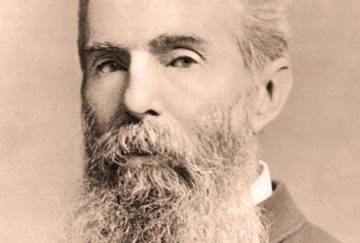 The Library of America edition of Herman Melville’s Complete Poems collects, for the first time, all of Melville’s known poetry. This includes collections published during his lifetime and reviewed widely, such as Battle-Pieces (1866), completed in the aftermath of the Civil War. In addition, the book collects work largely unknown by—and unavailable to—general readers until now. This latter category includes the epic poem Clarel (1876), notable both for being the longest American poem to date, and for having most of its first edition burned by the publisher to clear out warehouse space. Library of America is billing the Complete Poems as a resuscitation of one of the United States’ greatest nineteenth-century poets, establishing Melville within the company of Walt Whitman and Emily Dickinson. But while the collection has the potential to change popular understanding of the kind of writer Melville was, the pleasures of reading Melville as a poet are ambiguous, as is the urge to classify him as great.
 I
I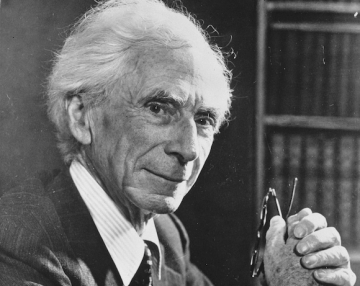 In philosophical circles, there are two Bertrand Russells, only one of whom died 50 years ago. The first is the short-lived genius philosopher of 1897-1913, whose groundbreaking work on logic shaped the analytic tradition which dominated Anglo-American philosophy during the 20th century. The second is the longer-lived public intellectual and campaigner of 1914-1970, known to a wider audience for his popular books such as Why I Am Not a Christian, Marriage and Morals and A History of Western Philosophy.
 It sounds like a miracle, but no great technological leaps were required. In a commercial lab on the outskirts of Helsinki, I watched scientists turn water into food. Through a porthole in a metal tank, I could see a yellow froth churning. It’s a primordial soup of bacteria, taken from the soil and multiplied in the laboratory, using hydrogen extracted from water as its energy source. When the froth was siphoned through a tangle of pipes and squirted on to heated rollers, it turned into a rich yellow flour.
 What happens in the leadup to war is that government officials make claims about the enemy, and then those claims appear in newspapers (“U.S. officials say Saddam poses an imminent threat”) and then in the public consciousness, the “U.S. officials say” part disappears, so that the claim is taken for reality without ever really being scrutinized. This happens because newspapers are incredibly irresponsible and believe that so long as you attach “Experts say” or “President says” to a claim, you are off the hook when people end up believing it, because all you did was relay the fact that a person said a thing, you didn’t say it was true. This is the approach the New York Times