
The Editors of The New England Journal of Medicine:
 Covid-19 has created a crisis throughout the world. This crisis has produced a test of leadership. With no good options to combat a novel pathogen, countries were forced to make hard choices about how to respond. Here in the United States, our leaders have failed that test. They have taken a crisis and turned it into a tragedy. The magnitude of this failure is astonishing.
…The response of our nation’s leaders has been consistently inadequate. The federal government has largely abandoned disease control to the states. Governors have varied in their responses, not so much by party as by competence. But whatever their competence, governors do not have the tools that Washington controls. Instead of using those tools, the federal government has undermined them. The Centers for Disease Control and Prevention, which was the world’s leading disease response organization, has been eviscerated and has suffered dramatic testing and policy failures. The National Institutes of Health have played a key role in vaccine development but have been excluded from much crucial government decision making. And the Food and Drug Administration has been shamefully politicized,3 appearing to respond to pressure from the administration rather than scientific evidence. Our current leaders have undercut trust in science and in government,4 causing damage that will certainly outlast them. Instead of relying on expertise, the administration has turned to uninformed “opinion leaders” and charlatans who obscure the truth and facilitate the promulgation of outright lies.
More here.
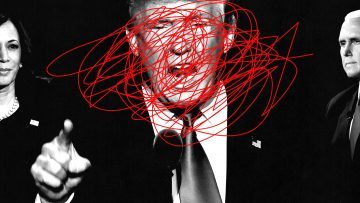 In perhaps the most chaotic week of a chaotic presidency, what was most surprising about tonight’s vice-presidential debate was how oddly normal it felt.
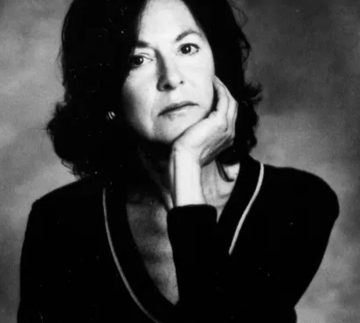 The poet Louise Glück has become the first American woman to win the Nobel prize for literature in 27 years, cited for “her unmistakable poetic voice that with austere beauty makes individual existence universal”.
 At the first debate between Joe Biden and Donald Trump, Biden refused to say whether he’d expand the Supreme Court if Republicans confirm Barrett, insisting that the issue is a “distraction.” He’s wrong. Broaching the conversation about systemic reform after the election will be too late. And the coming Supreme Court term, which begins Monday, reflects just some of what’s at stake, this week, this month, and in the months ahead. The debate about structural changes to the court can’t wait until a hypothetical future in which everything has settled down. That future has already vanished.
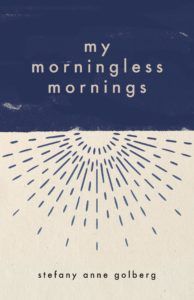 Even when ruminating upon dream diaries, werewolves, and vampires, Golberg’s erudition imbues her childlike wonder with a preacher’s certitude. She finds analogies across cultures and languages, weaving centuries-old philosophies into her personal examination of late-night gloom and early-morning revelation. There’s a selective nature to her surveys, some of which take the form of art and literary criticism. But the essays build upon successive themes, Golberg’s metaphors compounding and accreting into a more solid, ambitious exploration of identity. Who are we, these essays ask, and when are we most ourselves? “I suppose this was Jung’s point all along, that the dreamworld is not separate from the everyday world,” she considers, “that we enact our dreams in daily life as we enact our daily life in dreams, and that to divide these parts of ourselves — the sleeping self and the wide-awake self — makes us incomplete.” These analyses make approachable essays even for readers not steeped in the work of Japanese novelists and nineteenth-century painters.
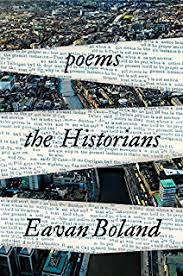 Steadily, poem by poem and book by book, Eavan worked her way into the heart of darkness, not in the Conradian sense of course, but into the centre of those marginal, penumbral zones outside the spotlight of what was “officially” deemed worthy of being remembered. Hers was a double journey ‑ the poet finding her way into the self-granted warrant of her craft, the citizen struggling for the vindication of women, for a more amplified and more truthful narrative of Ireland. Her method was her purpose: in confronting exclusion, in the historical sense, she simultaneously chose to examine her own path into permission, into the poem, ever-present to herself, always questioning her step-by-step progress into her own gathering experience of making. And at the same time, not as a polemicist but as a citizen, she was attempting to formulate, or reformulate, a more ample and truthful vision of Ireland. By the time she had arrived at the pared back landscapes and poemscapes of Outside History and Against Love Poetry, it seems to me that she had succeeded in fusing her double quest: she had found a way to speak plainly of and for all those whom history had cast aside, a neglect, often deliberate, that was both political and moral; and at the same time she had found in herself a voice she could finally consider adequate to her subject and to the unforgiving demands of her craft.
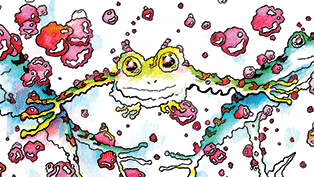 Ever since Charles Darwin taught us that life is constantly driven to change by myriad pressures—that species are not static, but are constantly morphing—biologists have debated how fast those changes can occur. The discovery of the genome a century after Darwin published On the Origin of Species seemed to demarcate an upper limit. Animals could evolve only as fast as advantageous genes could arise and spread, and as existing genomes could be reshuffled through sexual reproduction. But then came “epigenetics”: Some adaptation could occur more quickly, without changing genes themselves, but by altering how existing genes translated into living flesh. Rosenberg and others are proposing an even quicker process—organisms can adapt rapidly by switching their symbiotic microbes. The very quality that makes pandemics so terrifying—rapid contagion—may also drive mass adaptation.
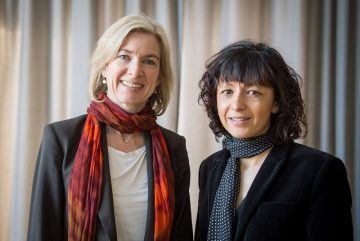 It’s CRISPR. Two scientists who pioneered the revolutionary gene-editing technology are the winners of this year’s Nobel Prize in Chemistry. The Nobel Committee’s selection of Emmanuelle Charpentier, now at the Max Planck Unit for the Science of Pathogens in Berlin, and Jennifer Doudna, at the University of California, Berkeley, puts to rest years of speculation as to who would be recognized for their work developing the CRISPR–Cas9 gene-editing tools. The technology has swept through labs worldwide and has countless applications: researchers hope to use it to alter human genes to eliminate diseases, create hardier plants, wipe out pathogens and more.
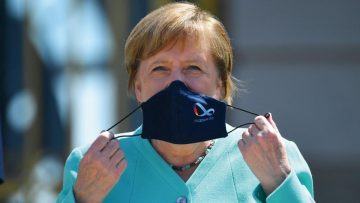 Thirty years after the seismic shift in world history of 1989-90 with the collapse of communism, the sudden eruption of life-changing events could be another watershed. This will be decided in the next few months—in Brussels and in Berlin too.
 Evolution is a messy business, involving as it does selection pressures, mutations, genetic drift, and the effects of random external interventions. So in the end, how much of it is predictable, and how much is in the hands of chance? Today we’re thrilled to have as a guest my evil (but more respectable, by most measures) twin, the biologist Sean B. Carroll. Sean is both a leader of the modern
 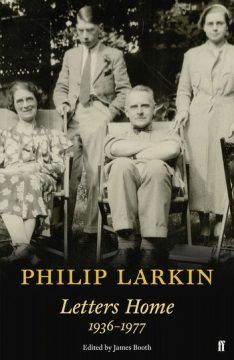 Did Larkin’s parents fuck him up? According to his sister Catherine (“Kitty”), ten years his senior, both parents “worshipped” Philip. All the same, they have undoubtedly been demonized—sometimes by the poet himself. There were the sour references he made to his childhood in his poetry (“a forgotten boredom”), and then there was his adamantine bachelor’s decision not to marry, seemingly because he did not want to replicate what appears to have been an unhappy parental union. More damning facts have emerged since Larkin died in 1985 at the age of sixty-three, a much-admired and influential figure who had turned down the position of poet laureate a year earlier. These include his father Sydney’s blithe admiration for Nazi Germany, as evidenced by his observing on the first page of his twenty-volume diary (!!) that “those who had visited Germany were much impressed by the good government and order of the country as by the cleanliness and good behavior of the people,” as well as his unrepentant anti-Semitism. As for his mother Eva, Andrew Motion’s 1993 biography of Larkin describes her as “indispensable but infuriating,” like some grating housemaid. Larkin himself characterizes her in a letter to Monica Jones, the longest-running of his several lovers, as “nervy, cowardly, obsessional, boring, grumbling, irritating, self pitying” before going on to amend his portrait: “on the other hand, she’s kind, timid, unselfish, loving.”
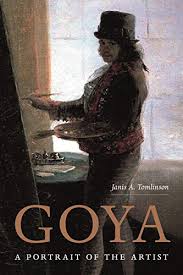 Francisco Goya y Lucientes was a mass of contradictions. He was a liberal, initially sympathetic to the French Revolution, who liked nothing better than to go hunting with successive absolutist monarchs of Spain. He was deputy director of the Royal Academy in Madrid, yet believed that traditional academic training was useless, insisting that ‘there are no rules in Painting’ and the ‘servile obligation of making all study or follow the same path is a great impediment for the Young’.
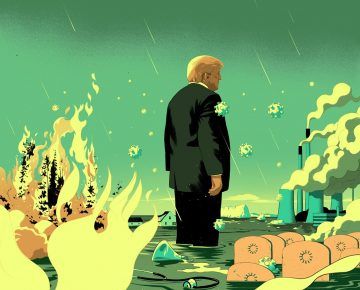 People packed in by the thousands, many dressed in red, white and blue and carrying signs reading “Four more years” and “Make America Great Again”. They came out during a global pandemic to make a statement, and that’s precisely why they assembled shoulder-to-shoulder without masks in a windowless warehouse, creating an ideal environment for the coronavirus to spread. US President Donald Trump’s rally in Henderson, Nevada, on 13 September contravened state health rules, which limit public gatherings to 50 people and require proper social distancing. Trump knew it, and later flaunted the fact that the state authorities failed to stop him. Since the beginning of the pandemic, the president has behaved the same way and refused to follow basic health guidelines at the White House, which is now at the centre of an ongoing outbreak. As of 5 October, the president was in a hospital and was receiving experimental treatments.
 “Any mans death diminishes me,”