Baskin and Lipkin in The Point:
Michael Lipkin
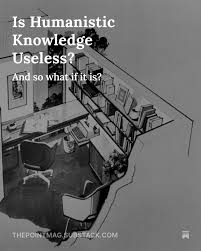 I’m going to roll up my sleeves and attempt a dirty, but I think necessary, job. I’m going to try to defend the humanities, or at least humanities scholarship, as it exists in its current form. I should say, before I do, that my road to something like a permanent job in the humanities has been a winding one. I remember, as a graduate student, being driven absolutely insane by how sanguine my professors were about our discipline. They were trying to reassure me, I think. But they succeeded only in making me envy and then resent them. So, to you, the reader, I say: wherever you’ve been, I’ve been there, too. I know the adjunct life. I know precarity. I know indifference. I know downright hostility. I’ve taught at diploma mills and in the Ivy League and everything in between. I understand.
More here.
Enjoying the content on 3QD? Help keep us going by donating now.
 As far back as 1980, the American philosopher
  F
F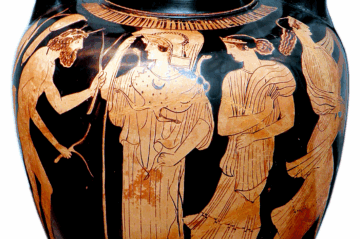 I learned to drive in the parking lot of what was then called the A&P supermarket, which marked the turnoff to a house my family owned then, by a cove and across from a small harbor. The idea was that my father would teach me. During the summers I spent a good deal of time alone with my father on a nineteen-foot sailboat called the Nausicaa. In the Odyssey, Nausicaa, the daughter of King Alcinous and Queen Arete, is washing clothes by an inlet on the island of Phaeacia, near where Odysseus, after a shipwreck, has washed ashore. When he appears, roused from slumber by the splash in a tidepool engineered by the goddess Athena, Nausicaa’s startled handmaidens flee, but “Alcinous’ daughter held fast, for Athena planted courage within her heart.”
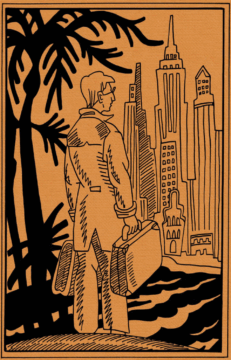 These books were born in Western Europe and North America at the confluence of imperial expansion, mass literacy and the rise of the translation industry, popular periodicals and book serialisation. They owed their existence to the arrival of boys as a separate – and increasingly profitable – segment of the book-reading public. Robert Louis Stevenson described Treasure Island as “a story for boys”; Haggard, his imitator and competitor, offered King Solomon’s Mines “to boys and to those who are boys at heart”.
 When millions of people suddenly couldn’t load familiar websites and apps during the
 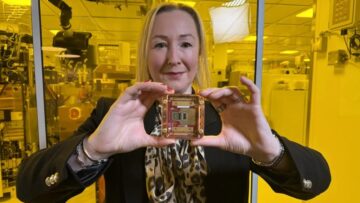 There’s an old adage among tech journalists like me – you can either explain quantum accurately, or in a way that people understand, but you can’t do both. That’s because quantum mechanics – a strange and partly theoretical branch of physics – is a fiendishly difficult concept to get your head around. It involves tiny particles behaving in weird ways. And this odd activity has opened up the potential of a whole new world of scientific super power. Its mind-boggling complexity is probably a factor in why quantum has ended up with a lower profile than tech’s current rockstar – artificial intelligence (AI). This is despite a steady stream of recent big quantum
  t’s ancient history now, but when Zohran Mamdani first entertained the notion of running for mayor, he imagined himself running against Eric Adams. It was 2021, and Adams had just won a squeaker of a primary, convincing New Yorkers that what they needed in the post-COVID moment was a swaggering ex-cop who believed in good old-fashioned law and order. This summer, while I was reporting a
  O
O T
T
 Zohran Mamdani, as most readers know by now, is the son of a filmmaker, Mira Nair. His parents met while she was working on Mississippi Masala (1992); his father, Mahmood Mamdani, is a professor of international affairs and anthropology who had lived through the events from the 1970s described in the film.
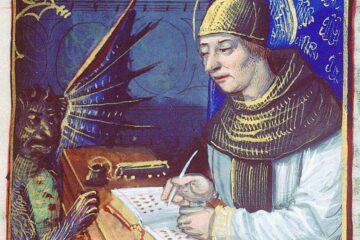 Of all the sins that might damn your soul for eternity, mumbling is probably pretty far down the list. Still, in medieval Europe, there was a demon for that: