
Pamela Erans in VQR:
The enormous attention to Elena Ferrante’s Neapolitan quartet—first the books published in the US between 2012 and 2015 and then the HBO series that has so far covered the first two titles, My Brilliant Friend and The Story of a New Name—has obscured the fact that in Ferrante’s novelistic output as a whole, female friendship has not been a primary theme. The three intense and at times phantasmagorical novels she published before the Neapolitan quartet dealt with friendship almost not at all. Troubling Love (1992) is about the relationship between a middle-aged woman and her recently deceased mother; in The Days of Abandonment (2002) a mother of two young children is abruptly left by her husband; and while The Lost Daughter (2006) concerns two women who meet on a beach vacation, it has more to do with the narrator’s odd, impulsive theft of a doll beloved by the other woman’s daughter. Messy familial bonds have been the focus of Ferrante’s work: bonds between grown daughters and their mothers, mothers and their young children, and women and their husbands. She is interested in intimacy and betrayal, merging and separation, the peril of togetherness on the one hand and solitude on the other. Either losing oneself in another or remaining too distant can threaten the stability of her first-person, female narrators. Above all, in Ferrante’s novels, close relationships, whether hostile or loving, never truly end.
All three of Ferrante’s pre-quartet novels involve a small number of significant characters and take place in highly compressed periods of time.
More here.

 Imagine two people with exactly the same innate abilities, but one is born into a wealthy family and the other is born into poverty. Or two people born into similar circumstances, but one is paralyzed in a freak accident in childhood while the other grows up in perfect health. Is this fair? We live in a society that values some kind of “equality” — “All men are created equal” — without ever quite specifying what we mean. Elizabeth Anderson is a leading philosopher of equality, and we talk about what really matters about this notion. This leads to down-to-earth issues about employment and the work ethic, and how it all ties into modern capitalism. We end up agreeing that a leisure society would be great, but at the moment there’s plenty of work to be done.
 Even though China and Russia started inoculating their citizens last year before publishing the efficacy results from their phase 3 clinical trials, which inevitably raised legitimate concerns, these vaccines have since been proven safe and efficient. The medical journal The Lancet published in February results from late-stage trials showing that Sputnik V, the Russian vaccine, has an efficacy rate of 91.6 percent. At least twenty-five countries around the world, meanwhile, have approved and are administering Sinopharm, one of the Chinese vaccines, with seemingly successful results.
 But Robinson’s Christianity manifests as more than a formal approach to experience—the particulars of her belief do matter, and they serve as a foundation for the representation of American racism in the Gilead novels. With John Calvin, she shares the conviction that there is “a visionary quality to all experience” and that God animates, at every moment, all of creation. This endows that creation with immanence and revelatory potential. She believes in the existence of souls, mysterious and unaccountable and equal, which profoundly influences how she engages the material reality of racist institutions and social practices. She believes, like Calvin and the contemporary Black theologian Reggie L. Williams, that each encounter with another person is an encounter with an image of God, in effect God himself, thus placing an immense weight on the treatment of others, surpassing even the Golden Rule. Even if a man is trying to kill you, “you owe him everything.” As Calvin does, she believes that each encounter with another person is a question that God is asking of you. In a recent lecture, she described one of God’s goals for creation—which, by implication, should be a human goal—as “human flourishing.” “Flourishing” is a startling word. Its pursuit demands far more than tolerance, or even civic equality: it demands a passionate devotion to others, regardless of your connections through family, country, race or religion. For her, good and evil are relational, social—not solely internal matters. Christianity, she has said, is an ethic, not an identity.
 IN THE ANTIC TALE that opens The Cheerful Scapegoat, Wayne Koestenbaum’s book of self-described “fables,” a woman named Crocus, like the flower, arrives at a house party wearing a checkered frock designed by the Abstract Expressionist Adolph Gottlieb. She cowers in the entrance, vacillating over whether to enter or not. She phones her doctor, a man whom she refers to as the “miscreant-confessor,” who entreats her to be social. Inside, Crocus accompanies a “fashionable mortician” to a bedroom where she happens upon a fully clothed woman lying atop a fully clothed man. Observing something “unformed and infantile” about the man’s features, Crocus is overcome by a feeling of revulsion, “as if she were looking at a Chardin painting for the first time and were not comprehending her ecstasy—a conundrum which forced Crocus to shove her rapture into a different medicine-cabinet, a hiding-place christened ‘Disgust.’” From this point on, any attempt to pithily encapsulate what happens is doomed.
 Most contemporary union drives are ultimately about the past—about the contrast that they draw between the more even prosperity of previous decades and the jarring inequalities of the present. But one that will culminate on Monday, the deadline for nearly six thousand
  In January, French President Emmanuel Macron called the AstraZeneca–Oxford coronavirus vaccine “quasi-ineffective for people over 65”, on the day that the European Medicines Agency (EMA) recommended approving it. Kate Bingham, one of the architects of the UK vaccine-procurement programme, has since called the remarks “irresponsible”, because the vaccine has been recommended by regulators for use in people of all ages.
 Most of us think that knowledge starts with experience. You take yourself to know that you’re reading this article right now, and how do you know that? For starters, you might cite your visual experiences of looking at a screen, colourful experiences. And how do you get those? Well, sensory experiences come from our sensory organs and nervous system. From there, the mind might have to do some interpretative work to make sense of the sensory experiences, turning the lines and loops before you into letters, words and sentences. But you start from a kind of cognitive freebie: what’s ‘given’ to you in experience.
 The experiment measures the decays of B-hadrons, particles containing bottom quarks. Quarks make up the protons and neutrons inside every atomic nucleus, but those are “up” and “down” quarks. The bottom quark is one of their cousins, and is much heavier.
 On the day before the accident, Milad Salama could hardly contain his excitement for the kindergarten class trip. “Baba,” he said, addressing his father, Abed, “I want to buy food for the picnic tomorrow.” Abed took his five-and-a-half-year-old son to a nearby convenience store, buying him a bottle of the Israeli orange drink Tapuzina, a tube of Pringles, and a chocolate Kinder Egg, his favorite dessert.
 The presiding scientific genius of the Romantic age, when science had not yet been dispersed into specialties that rarely connect with one another, Alexander von Humboldt wanted to know everything, and came closer than any of his contemporaries to doing so. Except for Aristotle, no scientist before or since this German polymath can boast an intellect as universal in reach as his and as influential for the salient work of his time. His neglect today is unfortunate but instructive.
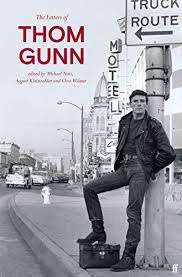 Some of the rawest moments come in early letters to Mike Kitay, Gunn’s lifelong partner, whom he met in 1952 when they were both undergraduates at Cambridge and whom he followed to the USA when Kitay returned there in 1954, after which Gunn felt able to come out. ‘We can lead rich lives together if we allow each other to, my beloved,’ Gunn writes to him in 1961. ‘Oh baby, please settle for me. I’ll never be your ideal, but you’ll never find your ideal on earth.’ It’s a letter written over the course of a week, with headings marking out the different days; it ends, ‘I can’t go on like this much longer. Please, my darling Mike.’ Gunn was largely a writer of tight, syllabic poetry who aimed for a lack of ‘central personality’; the directness and freedom of expression in letters such as these offer us a side of him we rarely, if ever, have seen before. By contrast, a letter written a few months later to the Faber editor Charles Monteith sees Gunn retreating behind a mask of business, discussing what would become a well-known combined edition of his work and that of Ted Hughes, eventually published in 1962 (the footnote reveals, interestingly, that Larkin was also to be included in the project, but his publisher at the time, the Marvell Press, said no).