https://www.youtube.com/watch?v=MHFrhIAj0ME&t=308s

https://www.youtube.com/watch?v=MHFrhIAj0ME&t=308s
George Scialabba at Commonweal:
 According to the late Christopher Lasch, the advent of mass production and the new relations of authority it introduced in every sphere of social life wrought a fateful change in the prevailing American character. Psychological maturation—as Lasch, relying on Freud, explicated it—depended crucially on face-to-face relations, on a rhythm and a scale that industrialism disrupted. The result was a weakened, malleable self, more easily regimented than its pre-industrial forebear, less able to withstand conformist pressures and bureaucratic manipulation—the antithesis of the rugged individualism that had undergirded the republican virtues.
In an important recent book, The Age of Acquiescence, the historian Steve Fraser deploys a similar argument to explain why, in contrast with the first Gilded Age, when America was wracked by furious anti-capitalist resistance, popular response in our time to the depredations of capitalism has been so feeble.
more here.
Mathew Lyons at Literary Review:
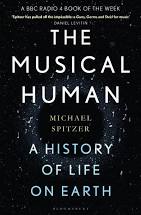 The first note known to have sounded on earth was an E natural. It was produced some 165 million years ago by a katydid (a kind of cricket) rubbing its wings together, a fact deduced by scientists from the remains of one of these insects, preserved in amber. Consider, too, the love life of the mosquito. When a male mosquito wishes to attract a mate, his wings buzz at a frequency of 600Hz, which is the equivalent of D natural. The normal pitch of the female’s wings is 400Hz, or G natural. Just prior to sex, however, male and female harmonise at 1200Hz, which is, as Michael Spitzer notes in his extraordinary new book, The Musical Human, ‘an ecstatic octave above the male’s D’. ‘Everything we sing’, Spitzer adds, ‘is just a footnote to that.’
Humans may be the supremely musical animal, but, with or without us, this is a musical planet. What makes us special? The answer is complex.
more here.
Tim Brennen in Psyche:
 We tested 100 participants twice on a range of tests: some took them first in summer and then winter, and some in the opposite order. Among the tasks, there was a test of pure speed (‘press this button as quickly as possible as soon as you see a circle in the middle of the screen’); a test of immediate memory for digits; a test of memory for words presented 10 minutes previously; the classic ‘Stroop test’ (that measures mental control); an alertness task; a face-recognition task; a time-estimation task; and a verbal fluency task. Most tests showed no difference in performance between summer and winter, and, of those that did, four out of five actually suggested a winter advantage. The ‘Arctic cognition’ paper, as we called it in 2000, was disseminated over the whole world and had its 15 minutes of fame in newspapers and magazines.
I moved on to other research topics, but last year, now working at the University of Oslo at a mere 59°N, I decided to revisit the science of human seasonality.
More here.
Steve Nadis in Quanta:
 Take a look at the numbers 294,001, 505,447 and 584,141. Notice anything special about them? You may recognize that they’re all prime — evenly divisible only by themselves and 1 — but these particular primes are even more unusual.
If you pick any single digit in any of those numbers and change it, the new number is composite, and hence no longer prime. Change the 1 in 294,001 to a 7, for instance, and the resulting number is divisible by 7; change it to a 9, and it’s divisible by 3.
Such numbers are called “digitally delicate primes,” and they’re a relatively recent mathematical invention. In 1978, the mathematician and prolific problem poser Murray Klamkin wondered if any numbers like this existed. His question got a quick response from one of the most prolific problem solvers of all time, Paul Erdős. He proved not only that they do exist, but also that there are an infinite number of them — a result that holds not just for base 10, but for any number system.
More here.
Robert Kuttner in American Prospect:
 For several decades, child advocates have tried to bring more public indignation to the scandal of extreme child poverty, and have pushed for the expansion of the Child Tax Credit. In recent years, some progressives have called for something that seemed even more utopian, a universal basic income.
Well, gentle reader, we just got both. And the brilliance is in the details.
The credit, which is really a family allowance run through the IRS, provides $3,000 a year for each child under 18, topped up to $3,600 for kids under six. So a family with three kids gets almost $10,000. As a point of reference, the average income of the bottom 20 percent of American households is about $14,000.
The new Child Tax Credit will cut the rate of child poverty in half, and will raise the total incomes of the bottom fifth of American families by 33 percent. I never expected to see something like this in my lifetime.
More here.
Quinn Latimer at Poetry Magazine:
 What is the matrix? Without resorting to pharmaceuticals in various chromatic registers—red, blue—and the versions of paranoid reality such pills might produce, it feels right to recall the ways this concept has been deployed in mediums neither cinematic nor far-right political. In the early 1990s, Kevin Young wrote in an essay about the poet N.H. Pritchard, “The concept of the matrix is that the matrix is the concept, or rather, the paradigm from which the poem gets produced.” That is, the matrix is abstract structure that, as the French literary theorist Michael Riffaterre writes in Semiotics of Poetry (1978), “becomes visible only in its variants, the ungrammaticalities.” For James Edward Smethurst, the matrix is the Black Arts Matrix of the late 20th century, as tracked in “Foreground and Underground: the Left, Nationalism, and the Origins of the Black Arts Matrix,” the first chapter in his treatise The Black Arts Movement: Literary Nationalism in the 1960s and 1970s (2005).
more here.
Jerry Saltz at New York Magazine:
 What’s so fantastic about seeing these paintings at the Frick Breuer is not only how close you can get to the work, now that it’s not surrounded with furniture and bric-a-brac. In the mansion, the Fragonards are installed — even swaddled and segregated — in a wonderful Rococo drawing room, with attendant panels over doors and next to windows. Here, the work is given pride of place on the fourth floor next to the gigantic trapezoidal window looking out over Madison Avenue. Up close and at eye level, the work is reborn as these huge heraldic thunderous paintings, visually vehement and emotionally commanding. I love them more than I ever have.
The original four pictures show narratives of flirtation, courtship, clandestine meeting, quixotic love, adventurousness, allure gone right and wrong.
more here.
Alice Robb in New Spectator:
 When the London-based neurologist Suzanne O’Sullivan flew to Sweden to visit a sick girl in a small town north-west of Stockholm, the child did not acknowledge her. Not when O’Sullivan entered her bedroom, or when she knelt down to introduce herself, or even when she examined her. Nola (not her real name) wasn’t trying to be rude. It had been more than a year since she had got out of bed, opened her eyes or moved at all. A feeding tube, taped to her cheek, kept her alive.
Yet her vital signs were normal; medical tests found nothing amiss. Nola was suffering from a mystery illness known as “resignation syndrome” that afflicts hundreds of children in Sweden. The first cases were officially documented in the early 2000s: children were falling into a sleep so deep that – for days, weeks, even years – they could not be roused. Whatever their parents tried, they did not respond. If the children were pulled into an upright position, they fell back, limp, like rag dolls. The children were sent to the hospital, where doctors performed every test they could think of. Cat scans and blood tests came back normal. EEGs showed brainwaves that zigged and zagged in a healthy pattern. Blood and urine analyses ruled out the possibility that they had been poisoned. The children’s physiology was normal, and their psychology was inaccessible; they were hardly able to fill out Rorschach tests or talk about their past. It was their unique social circumstances that gave clues into their condition. All of the children were refugees, and they had gone to bed during the long process of applying for asylum. When they fell asleep, they were facing deportation to countries they scarcely remembered, where their families had suffered severe trauma.
Nola and her family were members of the persecuted Yazidi minority. When they fled their home in rural Syria, Nola’s mother was facing death threats as a result of being assaulted by four men. They arrived in Sweden when Nola was a toddler – her age was estimated at around two and a half – and were granted temporary residency. (When O’Sullivan met her in 2018, Nola was thought to be about ten.) As their parents embarked on the lengthy journey towards permanent asylum, Nola and her siblings settled happily into their new home, becoming fluent in Swedish and making such close friends that, months after Nola stopped speaking, they continued to visit her at home. It was after receiving the news that their application had been refused – via a letter that Nola and her siblings had to translate for their parents – that she began to withdraw.
More here.
In the bowl of this world
Look at the rose of our passion, my friend
Even if we don’t eat together
Even if we don’t sit together
We can at least dream together, my friend
Even if we don’t drink together
Even if we are strangers
Let us consider the colour of our wine, my friend
The sun is setting on the lanes
The river is almost at my door
Let us examine our restless hearts, my friend
by Rifat Abbas
from Poetry Translation Center
Steve Paulson in Nautilus:
When he was a boy, Mark Solms obsessed over big existential questions. What happens when I die? What makes me who I am? He went on to study neuroscience but soon discovered that neuropsychology had no patience for such open-ended questions about the psyche. So Solms did something unheard of for a budding scientist. He reclaimed Freud as a founding father of neuroscience and launched a new field, neuropsychoanalysis. I reached Solms in Cape Town, South Africa, where he’s stayed during the COVID-19 lockdown. We talked about the brain-mind problem, the biases of neuropsychology and how a family trauma shaped the course of his life.
There are huge debates about the science of consciousness. Explaining the causal connection between brain and mind is one of the most difficult problems in all of science. On the one hand, there are the neurons and synaptic connections in the brain. And then there’s the immaterial world of thinking and feeling. It seems like they exist in two entirely separate domains. How do you approach this problem?
Subjective experience—consciousness—surely is part of nature because we are embodied creatures and we are experiencing subjects. So there are two ways in which you can look on the great problem you’ve just mentioned. You can either say it’s impossibly difficult to imagine how the physical organ becomes the experiencing subject, so they must belong to two different universes and therefore, the subjective experience is incomprehensible and outside of science. But it’s very hard for me to accept a view like that. The alternative is that it must somehow be possible to bridge that divide.
The major point of contention is whether consciousness can be reduced to the laws of physics or biology. The philosopher David Chalmers has speculated that consciousness is a fundamental property of nature that’s not reducible to any laws of nature.
I accept that, except for the word “fundamental.” I argue that consciousness is a property of nature, but it’s not a fundamental property. It’s quite easy to argue that there was a big bang very long ago and long after that, there was an emergence of life. If Chalmers’ view is that consciousness is a fundamental property of the universe, it must have preceded even the emergence of life. I know there are people who believe that. But as a scientist, when you look at the weight of the evidence, it’s just so much less plausible that there was already some sort of elementary form of consciousness even at the moment of the Big Bang. That’s basically the same as the idea of God. It’s not really grappling with the problem.
More here.
Rachel Love Nuwer in Undark:
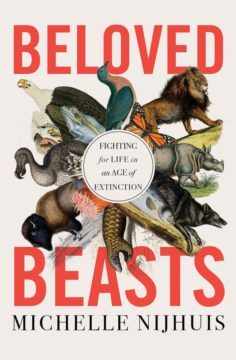 Today’s conservationists are taxed with protecting the living embodiments of tens of millions of years of nature’s creation, and they face unprecedented challenges for doing so — from climate change and habitat destruction to pollution and unsustainable wildlife trade. Given that extinction is the price for failure, there’s little forgiveness for error. Success requires balancing not just the complexities of species and habitats, but also of people and politics. With an estimated 1 million species now threatened with extinction, conservationists need all the help they can get.
Yet the past — a key repository of lessons hard learned through trial and error — is all too often forgotten or overlooked by conservation practitioners today. In “Beloved Beasts: Fighting for Life in an Age of Extinction,” journalist Michelle Nijhuis shows that history can help contextualize and guide modern conservation. Indeed, arguably it’s only in the last 200 years or so that a few scattered individuals began thinking seriously about the need to save species — and it’s only in the last 50 that conservation biology even emerged as a distinct field.
“Beloved Beasts” reads as a who’s who and greatest-moments survey of these developmental decades.
More here.
Marcus Chown in Prospect:
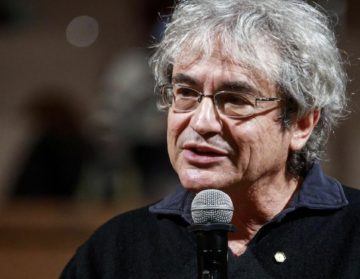 Rovelli has written a new book. Its title, Helgoland, refers to a barren island off the North Sea coast of Germany, where the 23-year-old physicist Werner Heisenberg (who would go on to work on the unrealised Nazi atomic bomb) retreated in June 1925. He was trying to make sense of recent atomic experiments, which had revealed an Alice in Wonderland submicroscopic realm where a single atom could be in two places at once; where events happened for no reason at all; and where atoms could influence each other instantaneously—even if on opposite sides of the universe.
Heisenberg’s breakthrough was to realise that, as far as atoms and their components are concerned, everything is interaction. Subatomic particles such as electrons and photons are not objects that exist independently of being prodded and poked, but merely the sum total of their interactions with the rest of the world. “Basically, physics confirmed what several philosophers over the centuries have suspected—that the world is a web of interactions and nothing exists independently of that web,” Rovelli tells me. “It is at the atomic and subatomic, or quantum, level that we confront this truth most dramatically.”
More here.
Seaver Wang in The New Atlantis:
 In the Himalayas and the Middle East, countries feud over water. In the African Sahel, farmers feud over cropland. In the melting Arctic, governments feud over seabed minerals. Climate change has provided bottomless inspiration for aspiring paperback novelists. But while thrillers must thrill and generals must fret, fears about the national security threats that climate change could present remain too vague to act on. The geopolitical reasons for a strong U.S. response to climate change lie not in what Americans might imagine about tomorrow’s world politics but in the global political relationships at stake today.
The imagined scenario goes something like this: The world fails to halt climate change in the coming decades and remains dependent on fossil fuels. A warming climate produces greater resource scarcity, leading to more frequent wars and mass displacement of people. Global crises over energy supplies threaten the U.S. economy and international treaties, and soldiers get pulled into resource wars to protect American interests and allies.
These visions of the future might make good ammunition for Hollywood, but they provide a far too narrow, distant, and pessimistic frame for climate change as a U.S. foreign policy issue.
More here.
Ted Chiang at The New Yorker:
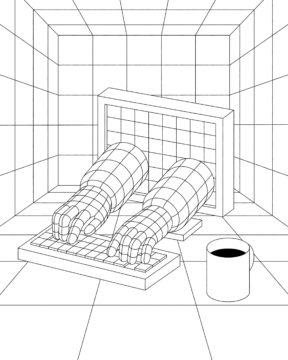 Some proponents of an intelligence explosion argue that it’s possible to increase a system’s intelligence without fully understanding how the system works. They imply that intelligent systems, such as the human brain or an A.I. program, have one or more hidden “intelligence knobs,” and that we only need to be smart enough to find the knobs. I’m not sure that we currently have many good candidates for these knobs, so it’s hard to evaluate the reasonableness of this idea. Perhaps the most commonly suggested way to “turn up” artificial intelligence is to increase the speed of the hardware on which a program runs. Some have said that, once we create software that is as intelligent as a human being, running the software on a faster computer will effectively create superhuman intelligence. Would this lead to an intelligence explosion?
more here.
Linda Colley at Literary Review:
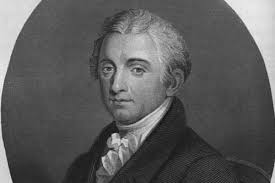 Morris’s writing took many forms. As well as maintaining a diary, he penned poems in multiple languages to the many women he seduced over the years in Europe and the United States (‘I know it to be wrong, but cannot help it’). He translated lines from Greek and Roman classics and produced pamphlets on finance and commerce. He also wrote the American constitution, quite literally. One of the fifty-odd delegates who met in Philadelphia over the summer of 1787 to draft this document, Morris chaired the constitutional convention’s ‘committee of style’ (the fact that a committee of this sort was judged desirable is suggestive). It was Morris, James Madison records, who was chiefly responsible for ‘the finish given to the style and arrangement’ of the American constitution. Most dramatically, it was he who replaced its initial matter-of-fact opening with one of the most influential phrases – and pieces of fiction – ever devised: ‘We the People of the United States…’
more here.