
Belen Fernandez at Aljazeera:
 As someone prone to panic attacks and spectacularly inept at dealing with adversity in life, I found it immensely comforting to have two Cuban feet in my face all night. I was also well aware that my visible fragility was less than endearing in a detention situation created in large part by my own nation – a situation from which, thanks to my passport privilege, I would inevitably be extricated with relatively minimal suffering.
While my fellow inmates could not fathom why the neurotic gringa was resisting return to the country they were risking their lives to reach, they charitably restricted their reactions to hysterical laughter at the ironic prospect of being deported to the US.
I would later learn that when my mother phoned the US embassy in Mexico, she was told that I would likely be held at Siglo XXI for at least two weeks, and that the US government could not intervene: “We cannot tell Mexico what to do.”
More here.
 E
E Greeks who have met Argentines, and Argentines who travel to Greece, often wax on strange parallels — on the discovery of inexplicable and unexpected similarities between peoples, like stumbling upon an enchanted mirror that mocks.
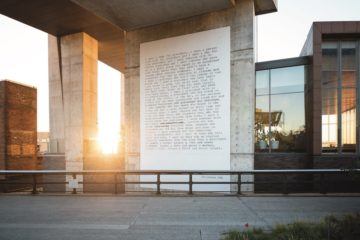 MANIFESTO IS THE FORM THAT EATS AND REPEATS ITSELF. Always layered and paradoxical, it comes disguised as nakedness, directness, aggression. An artwork aspiring to be a speech act—like a threat, a promise, a joke, a spell, a dare. You can’t help but thrill to language that imagines it can get something done. You also can’t help noticing the similar demands and condemnations that ring out across the decades and the centuries—something will be swept away or conjured into being, and it must happen right this moment. While appearing to invent itself ex nihilo, the manifesto grabs whatever magpie trinkets it can find, including those that drew the eye in earlier manifestos. This is a form that asks readers to suspend their disbelief, and so like any piece of theater, it trades on its own vulnerability, invites our complicity, as if only the quality of our attention protects it from reality’s brutal puncture. A manifesto is a public declaration of intent, a laying out of the writer’s views (shared, it’s implied, by at least some vanguard “we”) on how things are and how they should be altered. Once the province of institutional authority, decrees from church or state, the manifesto later flowered as a mode of presumption and dissent. You assume the writer stands outside the halls of power (or else, occasionally, chooses to pose and speak from there). Today the US government, for example, does not issue manifestos, lest it sound both hectoring and weak. The manifesto is inherently quixotic—spoiling for a fight it’s unlikely to win, insisting on an outcome it lacks the authority to ensure.
 Maeve Wallace has studied maternal health in the United States for more than a decade, and a grim statistic haunts her. Five years ago, she published a study showing that being pregnant or recently having had a baby nearly doubles a woman’s risk of being killed
 By June 1956, at the end of my first year as a research student, I had a set of chapters that looked as if they could form a dissertation. A substantial number of economists at various universities were work ing then on different ways of choosing between techniques of production. Some were particularly focused on maximising the total value of the output produced, whereas others wanted to maximise the surplus that was generated, and there were also some profit maximisers.
 Researchers from the University of Oxford and their partners have today reported findings from a Phase IIb trial of a candidate malaria vaccine, R21/Matrix-M, which demonstrated high-level efficacy of 77% over 12-months of follow-up.
 Sex and analytic philosophy are not promising bedfellows. But when it comes to feminist philosophy, it is no mere pun to say that sex is where the action is. The revival of this neglected feminist concern is principally owed to Amia Srinivasan, the 36-year-old star of Oxford philosophy and Chichele Professor of Social and Political Theory at All Souls College. Srinivasan began her career making influential contributions to formal epistemology and shot up the academic rungs; she has since found a public audience as a critic and essayist of remarkable precision and range. In her new essay collection, The Right to Sex, Srinivasan writes about consent, pornography and the ideological shaping of desire, attempting “to remake the political critique of sex for the 21st century.” Here, the political isn’t just personal; it’s intimate.
 Three ideas that are central to all Orwell’s subsequent, serious writing were formed in Spain. First, that socialism works. Second, that socialism works, but beware, for it can take an authoritarian turn. (Homage to Catalonia in part tells a similar story to Animal Farm ‑ the utopia betrayed from within when its leaders start to suit themselves.) Third, that those who betray lie brazenly, weaving an elaborate web of self-serving falsehood. “[I]n Spain,” wrote Orwell in the 1942 “Looking Back on the Spanish War”, “for the first time, I saw newspaper reports which did not bear any relation to the facts, not even the relationship which is implied in an ordinary lie. I saw great battles reported where there had been no fighting, and complete silence where hundreds of men had been killed … This kind of thing is frightening to me, because it often gives me the feeling that the very concept of objective truth is fading from the world.”
 So what should we do in such a predicament? We should above all avoid the common wisdom according to which the lesson of the ecological crises is that we are part of nature, not its center, so we have to change our way of life — limit our individualism, develop new solidarity, and accept our modest place among life on our planet. Or, as Judith Butler put it, “An inhabitable world for humans depends on a flourishing earth that does not have humans at its center. We oppose environmental toxins not only so that we humans can live and breathe without fear of being poisoned, but also because the water and the air must have lives that are not centered on our own.”
 Efforts to understand cardiac disease progression and develop therapeutic tissues that can repair the human heart are just a few areas of focus for the Feinberg research group at Carnegie Mellon University. The group’s latest dynamic model, created in partnership with collaborators in the Netherlands, mimics physiologic loads on engineering heart muscle tissues, yielding an unprecedented view of how genetics and mechanical forces contribute to heart muscle function.
 Unlike talk of, say, badgers or ermine, talk of beavers seems always to be the overture to a joke. So powerful is the infection of the cloud of its strange humor that the beaver is no doubt in part to blame for the widespread habit, among certain unkind Americans, of smirking at the mere mention of Canada. Nor is it the vulgar euphemism, common in North American English and immortalized in Les Claypool’s heartfelt ode, “
 We take for granted that an event in one part of the world cannot instantly affect what happens far away. This principle, which physicists call locality, was long regarded as a bedrock assumption about the laws of physics. So when Albert Einstein and two colleagues showed in 1935 that quantum mechanics permits “spooky action at a distance,” as Einstein put it, this feature of the theory seemed highly suspect. Physicists wondered whether quantum mechanics was missing something.