
Category: Recommended Reading
Saturday, October 9, 2021
Making a Living
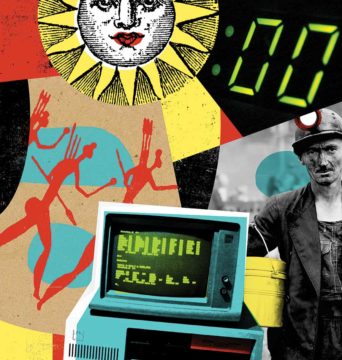 Aaron Benanav in The Nation (Illustration by Tim Robinson):
We have named the era of runaway climate change the “Anthropocene,” which tells you everything you need to know about how we understand our tragic nature. Human beings are apparently insatiable consuming machines; we are eating our way right through the biosphere. The term seems to suggest that the relentless expansion of the world economy, which the extraction and burning of fossil fuels has made possible, is hard-wired into our DNA. Seen from this perspective, attempting to reverse course on global warming is likely to be a fool’s errand. But is unending economic growth really a defining feature of what it means to be human?
For the longest part of our history, humans lived as hunter-gatherers who neither experienced economic growth nor worried about its absence. Instead of working many hours each day in order to acquire as much as possible, our nature—insofar as we have one—has been to do the minimum amount of work necessary to underwrite a good life.
This is the central claim of the South African anthropologist James Suzman’s new book, Work: A Deep History, From the Stone Age to the Age of Robots, in which he asks whether we might learn to live like our ancestors did—that is, to value free time over money. Answering that question takes him on a 300-millennium journey through humanity’s existence.
More here.
Coltrane’s New ‘Love Supreme’
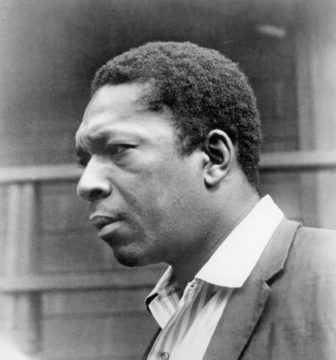
Adam Shatz in the NY Review of Books:
At a press conference in Tokyo in July 1966, a Japanese jazz critic asked John Coltrane what he would like to be in ten years. “I would like to be a saint,” he replied. Coltrane, who died the following July of liver cancer, at forty, reportedly laughed when he said this; but among his followers, he was already considered a spiritual leader, even a prophet. His reputation rested not merely on his musicianship, but on the example he set, the self-renunciation and good works required of every saint. Unlike the alto saxophonist Charlie Parker, who launched the bebop revolution with the trumpeter Dizzy Gillespie, Coltrane was not a fully formed virtuoso when he first emerged, but rather a committed and tireless student of the horn—a hardworking man who arrived at his sound through a practice regime of almost excruciating discipline. “He practiced like a man with no talent,” his friend the tenor saxophonist Benny Golson remembered. The saxophonist Archie Shepp, one of Coltrane’s many protégés, exaggerated only slightly when he remarked that he never saw him take the sax from his mouth. The trumpeter Miles Davis, in whose mid-Fifties quintet Coltrane first rose to prominence, made the same observation, though more in exasperation than worship.
Early in his career, Coltrane had succumbed to the temptations of the jazz life, but by 1957 he had kicked the habits of both needle and bottle, devoting himself to his music, and to God. The religion he embraced was ecumenical: an eclectic mixture of Christianity, Hinduism, Buddhism, and Sufi Islam—“I believe in all religions,” he said. Self-effacing and humble, he paid generous tribute to his influences—Lester Young, Ben Webster, Dexter Gordon, Sonny Rollins, John Gilmore—and helped younger musicians land contracts with his own label, Impulse Records. Coltrane, whose command of the tenor was unmatched (except, perhaps, by Rollins), even took lessons with free jazz artists like Ornette Coleman and Albert Ayler, whom other musicians of his stature derided as charlatans, adapting their innovations to his purposes. In his lifestyle, Coltrane stood apart for his indifference to the scene.
More here.
The Data Manipulation Scandal That Could Topple the Heads of the World Bank and IMF, Explained
 Justin Sandefur over at the Center for Global Development:
As the annual meetings of the World Bank and the International Monetary Fund kick off next week, the Bretton Woods institutions are mired in scandal. On September 15, the World Bank published an independent investigation led by former US Attorney for Washington D.C. Ronald Machen and the law firm WilmerHale into the involvement of senior World Bank management in data manipulation.
The report alleges Bank officials altered data to benefit both China and Saudi Arabia in its flagship Doing Business report, which ranks countries on their business regulations. The allegations cover incidents spanning the tenures of two World Bank presidents, Obama-nominee Jim Kim and Trump-nominee David Malpass, with a leading role for Kristalina Georgieva who now runs the IMF.
Major shareholders including the US and UK have expressed concern. The Economist magazine has called for Georgieva to step down, and numerous op-eds have stressed the damage to the Bank and the Fund’s credibility.
This saga requires all sides to set aside some ideological prejudices. Doing Business has been the darling of right-wing economists and business-oriented authoritarian governments for nearly two decades. Progressives cheered when the Bank temporarily suspended the index after the first audit reports of data manipulation emerged. Now as it looks like blame may fall on Kristalina Georgieva, who’s been pushing the Fund to do more on climate and more for developing countries, the tables have turned. Eminent progressive economists have labeled this “a coup attempt at the IMF” (Joe Stiglitz) due only to “anti-China hysteria” (Jeff Sachs); Georgieva has won the endorsement of 16 African finance ministers, while big-name conservative economists like Anne Krueger have called for her resignation.
Meanwhile, World Bank President David Malpass has virtually escaped scrutiny, deepening suspicions among Georgieva’s supporters that a plot is underway to scapegoat the progressive woman leading the Fund while Trump’s man at the Bank skates away.
More here.
How To Put The Genie Of Inflation Back Into The Bottle
 Yakov Feygin in Noema (image by Roman Bratschi for Noema Magazine):
As President Joe Biden’s administration and its progressive allies push to pass an ambitious social spending bill, moderate Democrats are worried. They point to rising prices and postulate that we are facing an era of high inflation. Wouldn’t more spending after an already large pandemic stimulus make matters worse?
Those voices should consider what John Maynard Keynes said in a 1933 letter to President Franklin D. Roosevelt during the worst year of the Great Depression. First, he argued, the president should boost consumer spending and convince businesses to get back to what they do best: making and selling things. Then, once things were up and running again, he could pursue economic reform to fix the systemic problems preventing the economy from meeting its potential. Then, as now, many conflated the ideas of “economic recovery” and “economic reform.” The purpose of economic recovery is to spend to prevent a crisis from spiraling. The purpose of reform is to spend so that we do not have these problems in the first place.
The U.S. economy is facing inflationary pressures not because of too much government spending but because, for almost two decades, there has not been enough. Our country simply does not have the kind of productive capacity that can create high, widespread growth without some inflation. We need to spend on building up that capacity so the economy can run at peak performance in normal times — and so it can be more resilient through future crises.
More here.
Sacrificing for the Climate
 David McDermott Hughes in Boston Review:
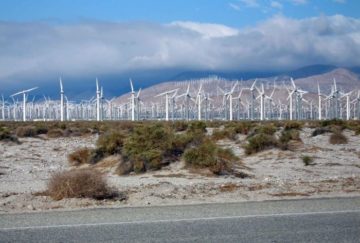
Renewable energy seems set to repeat many of the mistakes of fossil fuels. Though wind and solar power will not degrade the conditions for life on planet earth, the geography and corporate structure of these industries concentrate benefits and exclude communities in the style of Big Oil. The neighbors tend to notice—and to complain. So-called “renewable energy rebels” want a slice of revenues, or wind farms that are smaller or farther away. These “not-in-my-backyard” protests are delaying and blocking projects from Spain to Germany to the United States. To the extent that these movements succeed, they undercut the planet-saving ideal these technologies promised to all of us.
A Spanish village I will call Sereno, possibly the most turbine-surrounded community in the world, exemplifies this lesson. In 2006 residents rebelled against plans for hundreds of turbines to be installed only hundreds of meters from them. They anticipated ugly sights and sounds: ninety-meter steel towers and sixty-meter fiberglass blades bristling and pulsating above wheat and cattle. Their protest failed, but—alongside similar movements elsewhere and the economic crisis of southern Europe—it effectively slowed the construction of new turbines in the entire autonomous region of Andalusia. Meanwhile, the residents—with whom I shared many drinks while visiting as an anthropologist—nurse their old grudges and discover new ones: bird kill, the absence of jobs in turbine maintenance, lack of once-anticipated tourism jobs, and deals whereby landowners collect royalties from each wind turbine. Some of these problems can be solved: a wind commons, for example, would take power away from the handful of old families who control those wheat fields and pastures. The 800 landless residents of Sereno—many of whom are poor and technically squatters—might then collect revenue and support the energy transition. This is worth fighting for.
More here.
Michael Davies – The French Revolution
Anthony Veasna So’s Homage To The Cambodian Diaspora
Jane Hu at Bookforum:
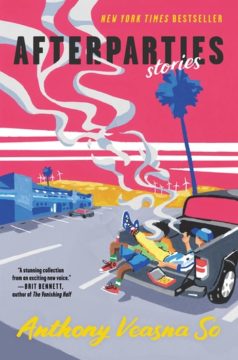 Afterparties is haunted by lateness, not only because it arrives after the premature death of its author, but also because it is a work of Cambodian American literature. “I very much feel that I come from a Cambodian-American world, not really an American one . . . so I find it important for my work to reflect that,” So said in a 2020 interview. In contrast to Asian American writing by those of Japanese, Chinese, and Korean descent (what So might refer to as “mainstream East Asians” in “The Shop”), Cambodian American writing is a relatively newer and more minor literature. (“We’re minorities within minorities,” goes So’s own self-description in his posthumous essay “Baby Yeah.”) There was a relative absence of Cambodian American communities until the late 1970s, following the genocide and the passage of the 1980 Refugee Act; there is now also a deficit of Cambodian writing and writers, because the Khmer Rouge annihilated Cambodian society by targeting its intellectuals and artists (libraries and schools were demolished, books burned, teachers murdered). The aftershocks of genocidal loss permeate the writing of the Cambodian diaspora, as the deliberate obliteration of their literature makes the work of contemporary writing both more necessary and difficult. For the children of Cambodian refugees, this work is even harder: How do you write the stories of those whose stories were systematically destroyed?
more here.
Julia Lovell’s Translation of “Monkey King”
Minjie Chen at the LARB:
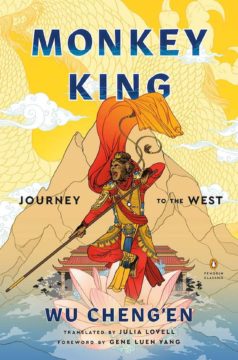 Third, Monkey King accentuates one of the major appeals of the novel — its humor — with embellishments made by the translator in three main ways: dialogue, the culture of the immortal society, and the technicality of magic. Monkey is nothing without his complete disregard for formality, even (or especially) as he interacts with those perching at the top of the deities’ hierarchical system. He evokes both childish innocence and rebellious boldness. The English edition takes this characteristic and runs with it, tweaking a word choice here and perfecting a repartee there, in line with the lighthearted tone of the original. I should mention also that Lovell excels at spicing up the insults exchanged between Monkey and his enemies. One of the spirits sent to subdue Monkey threatens his monkey kingdom, “The merest whisper of resistance and we’ll turn the lot of you into baboon butter” — you will not find “baboon butter” in the original version.
more here.
Saturday Poem
At the Bottom of the World
At the bottom of the world, two miles
below sea level, tubeworms boggle scientists,
clustered near hydrothermal vents, thriving on
deadly hydrogen sulfide. Here, too, the vampire fish,
echinoderms, giant isopods that won’t ever
feel the sun’s heat on their pill-buggy backs, the light
gulls need at least a glimpse of so they can
hassle a minnow from a pelican’s pouch.
It’s a great place to contemplate
Jesus and his myriad miracles—walking on water,
kersplatting the need for crutches, sidling up with
long-nosed chimeras, one swish of a dorsal fin fatal.
Michelangelo would feel at home here, for
no one who’s seen a coffin fish doubts God
opened his palm, pointed a finger, ap-
pointed Adam Creature of Shame, Creature of
Questions More Luminous than Any Star.
Remember when we looked to the heavens,
saw only the campfires of not-so-distant neighbors?
Today it’s HD 179949 and Gilese 581D—
unimaginably distant constellations and dwarfs, orbs
vying for habitability. Down here, it’s hardly less showy
where lanthanum & neodymium bubble from mud holes, where.
xenon nestles in deep-sea basalt. Bless it all, & bless us too,
young and old, bizarre and undeserving, all
zapped with the mystery of the sacred.
by Martha Silano
from the Echotheo Review
Hypochondria Is a Lot More Than Being Worried About Getting Sick
Paloma Nicoletti in Vice:
 Let’s talk about fear, health and why so many of us have decided that sitting in front of the computer googling symptoms is a sensible thing to do. Let’s talk about the evenings we’ve spent boring ourselves and our friends with all manner of internet-derived self-diagnoses. Let’s talk about hypochondria. We live in a world where certain words and concepts are bandied about daily despite many of us lacking a medical background to make sense of them. We link symptoms with illnesses and try to come up with solutions without consulting professionals. We tell ourselves and others stories about our bodies and our health and everything that’s going wrong with them.
That kind of health anxiety may have led to you being labelled — or labelling others — as a hypochondriac. But what exactly is hypochondria? What are its symptoms, and what, if anything, can we do about it? We asked Santiago Levín, president of the Association of Argentine Psychiatrists (AAP) to fill in the blanks.
Santiago Levín: Daily language can change the meaning of technical medical terms. Think about obsessive compulsive disorder, for example. You might often hear people labelling themselves as having OCD, when in reality they just exhibit a few tics, or perhaps some repetitive behaviour. Hypochondria, in a strict sense, isn’t just being a bit worried about your health. It isn’t being a bit scared of getting a serious illness. Neither is it a case of feeling worried about your health in the middle of a world-changing pandemic. Health anxiety in a situation like the one we’re living through is normal, appropriate, and expected.
More here.
In Netflix’s Squid Game, Debt Is a Double-Edged Sword
Morgan Ome in The Atlantic:
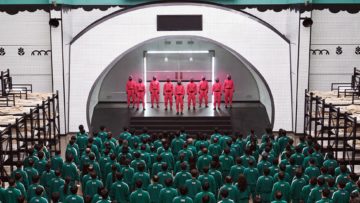 For the chance to escape severe debt, the characters in Netflix’s hugely popular survival drama Squid Game would risk anything, even death. Take the protagonist Seong Gi-hun. Unemployed, he spends his days in Seoul gambling on horse races and has signed away his organs as collateral to his creditors. His deficits, both financial and personal, hurt the people closest to him: He hasn’t paid child support or alimony to his ex-wife; he mooches off his elderly mother. On his daughter’s birthday, Gi-hun can afford to buy her only tteokbokki (spicy rice cakes) and a claw-machine toy. He has little left to lose.
In order to win back his dignity and family, Gi-hun accepts a mysterious offer to play a series of six traditional children’s games for the chance at winning millions of dollars (45.6 billion won, to be exact). He finds himself among 456 contestants who are also in extreme financial distress, including his childhood friend Cho Sang-woo, now a disreputable businessman; Abdul Ali, an undocumented worker from Pakistan; and Kang Sae-byeok, a North Korean refugee. At one point, Gi-hun says to Sang-woo, a graduate of the prestigious Seoul National University, “I was slow, crazy incompetent … But you’re with me in this place. Isn’t that interesting?” The messaging is not subtle: Anyone, whatever their background, can be humbled by debt. In this arena, every player has a supposedly equal opportunity at striking gold if they successfully complete the games, which have a bloody twist to them. But the show suggests that humans are constantly in a state of indebtedness to a cruel system—whether that’s a macabre competition or a punishing societal structure.
More here.
Friday, October 8, 2021
Spinoza’s God: Einstein believed in it, but what was it?
Alex Dean in Prospect:
 What do we think we know about Baruch Spinoza? We know he was one of the greatest philosophers of the Enlightenment: the Dutch thinker was a champion of free intellectual inquiry who broke new ground in metaphysics, epistemology and philosophy of mind. His magnum opus, the Ethics, put forward a system of breathtaking originality that is still celebrated today. We might know that he was a pioneer of the rationalist school that emerged in the 17th century. But more than any of this, most of us know something about his philosophy of religion: Spinoza’s writing is famously atheistic.
In his own day, Spinoza was branded a heretic and accused of trivialising God’s role in the universe and human affairs. Cast out of the Dutch Jewish community at the age of 23 for spouting “horrible heresies,” he opted for permanent outsider status by refusing to convert to Christianity. He disputed the existence of miracles and the afterlife and challenged the authority of the Bible. His Theologico-Political Treatise was condemned as “a book forged in hell… by the devil himself.” The Ethics was placed on the Catholic Church’s index of forbidden books.
More here.
Chasing a Beam of Light: Einstein’s Most Famous Thought Experiment
John D. Norton in his Goodies at the University of Pittsburg:
 Einstein recalled how, at the age of 16, he imagined chasing after a beam of light and that the thought experiment had played a memorable role in his development of special relativity. Famous as it is, it has proven difficult to understand just how the thought experiment delivers its results. It fails to generate serious problems for an ether based electrodynamics. I propose a new way to read it that fits it nicely into the stages of Einstein’s discovery of special relativity. It shows the untenability of an “emission” theory of light, an approach to electrodynamic theory that Einstein considered seriously and rejected prior to his breakthrough of 1905.
How could we be anything but charmed by the delightful story Einstein tells in his Autobiographical Notes of a striking thought he had at the age of 16?
More here.
Abdulrazak Gurnah wins the 2021 Nobel prize in literature
Alison Flood in The Guardian:
 The Nobel prize in literature has been awarded to the novelist Abdulrazak Gurnah, for his “uncompromising and compassionate penetration of the effects of colonialism and the fate of the refugee in the gulf between cultures and continents”.
Gurnah grew up on one of the islands of Zanzibar before fleeing persecution and arriving in England as a student in the 1960s. He has published 10 novels as well as a number of short stories. Anders Olsson, chair of the Nobel committee, said that the Gurnah’s novels – from his debut Memory of Departure, about a failed uprising, to his most recent, Afterlives – “recoil from stereotypical descriptions and open our gaze to a culturally diversified East Africa unfamiliar to many in other parts of the world”.
More here.
An Ode to my favorite “vegetable”
On ‘The Green Knight’
J.M. Tyree at Film Quarterly:
 Folk horror plays on myths as lure and nightmare, but The Green Knight is more focused on the radical otherness of the natural world. Lowery’s “horror-ized” version of Gawain’s quest, with its defamiliarizing photography of Ireland’s forests, bogs, and caves, creates a landscape that feels far from “natural.” It contains uncanny specters, eerie giants, haunted woods, talking foxes, and, of course, the story’s titular tree-like green weirdo who picks up his own head off the floor after Gawain severs it. Nature has grown tired of having axes driven into its neck and is now fighting back, threatening to destabilize the human world. These details feel redolent of what English horror writer Gary Budden calls “landscape punk,” an emergent aesthetic for weird fiction based on questioning the political meaning of home: “home to me is a bastard place, multi-cultural and multi-layered, mixed, impure.”
more here.
On Gregg Bordowitz’s Fast Trip, Long Drop
Hannah Gold at n+1:
 For a film about dying, the sick bodies hold their illnesses discreetly. There are no waning limbs, no unsightly fluids, no Kaposi sarcoma lesions. Perhaps this is a line of spectacle Bordowitz will not cross. The subjects seem healthy, for now. But there is a rupture in the final moments of the film, after the credits have rolled. It’s an outtake from the opening scene. “Death is the death of consciousness,” says Bordowitz, reclining in bed, pants-less. “I hope there’s nothing after this,” and then he breaks character and starts laughing, as does whoever is filming. But the laughter turns to coughing, Bordowitz can’t catch his breath. Is it the smoking? There’s an ashtray balanced on his SILENCE=DEATH T-shirt. Or is it the virus, breaking through the dam?
more here.
The Strange and Enchanted Life of Isidore Isou
Dennis Duncan at Literary Review:
 Nevertheless, when the Dadaist poet Tristan Tzara was buried at Montparnasse in the winter of 1963, Isou and his followers arrived uninvited at the cemetery and fought with the communists who had also come to pay their respects. As Isou began to make a speech, he was informed that Tzara’s family had wished for the funeral to pass in silence. Undeterred, he began to declaim a lettriste poem: ‘étli, tzara, jofué lochigran télebile sarkénidan.’
As Andrew Hussey puts it in his enthralling new biography, Isou is ‘grandiose, exasperating, self-regarding, brilliant, piercing and poetic, often all in the space of the same page’. Isou’s heroic period, however, occupied only a sliver of his life, a brief thrill of youthful self-confidence that lapsed precipitously into bitterness, petulance and a career churning out under-the-counter erotica with titles like Les Orgies d’un séducteur and Les Plaisirs d’une dépravée. In telling the whole story, Hussey is forced (and forces us) to endure the long, painful decline of a messianic narcissist, in and out of institutions, perceiving enemies on all sides and kicking out at them in bouts of hysterical autofiction.
more here.
Isidore Isou – Traité de Bave et d’éternité [Venom and Eternity]
https://www.youtube.com/watch?v=U_uukBCqVaY