Sam Dembling at n+1:
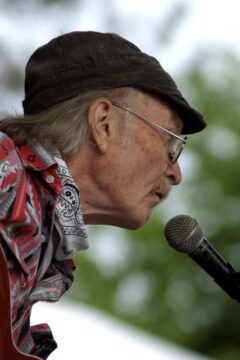 Michael Hurley, the godfather of freak folk, died in April. Now we have his last, posthumous album, which was released in September and offers a final occasion to look back at his contributions, always arriving slightly aslant, to folk music history. An outsider artist but no museum-room oddity, Hurley was an authentic American avant-gardist, like Emily Dickinson or Ornette Coleman. When I saw him at the Brooklyn Folk Festival last November he walked onstage to a hero’s welcome. The show was in a great dark church and those of us who didn’t arrive in time to fill the pews found space on the floor, sitting at his feet. Skeletal, serious, with a handkerchief around his neck and a pipefitter hat shading his eyes, Hurley sang out in a tremulous voice. A few times in the set he paused for a moment—Had he forgotten the words? I wondered—but only to summon some invisible inner current. He was funny, he was grim. On one song, Snock, as many called him, resembled a children’s entertainer, doing an a cappella impersonation of an owl with utter frankness. On another, “The End of the Road,” a wry confrontation with final things, he seemed to be chilly elegizing himself: “They’re chasing’ the fox and they’re runnin’ him ragged and he knows he gone wrong somewhere.” He was old, but the music was electric and his fans seemed to be younger than ever.
more here.
Enjoying the content on 3QD? Help keep us going by donating now.
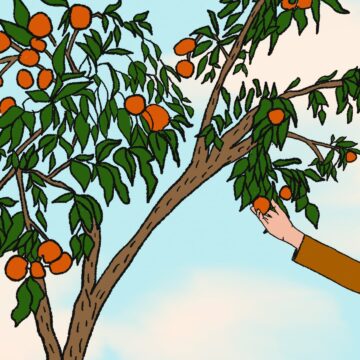 How can we stay happy in an age gone mad? It often feels as though all is unstable at the moment. Uncertainty dominates the economy. Our politics and planet are a mess. Scientific experts and government workers have been cast aside.
  Imagine that you are a cook, and you just made a cake in your kitchen. You’ve made a delicious cake, and you’d like to start a business making 1,000 of them a day. So you replicate your kitchen 1,000 times over—you buy 1,000 residential ovens, 1,000 standard mixing bowls, 1,000 bags of flour. And you hire 1,000 humans to follow your recipe, each making their own cake in the various kitchens you’ve built.
 With their bladed paws, wielded by a rippling mass of pure muscle, sharp eyes, agile reflexes, and crushing fanged jaws, lions are certainly not a predator most animals have any interest in messing with. Especially seeing as they also have the smarts to hunt in packs.
 I often hear about “skyrocketing” demand for electricity in countries like the United States (here’s
 First came the
  A
A A MAN LOOKS OVER A FENCE, SPYING. He notes the arrival of a Buick hardtop convertible. Parked now, the driver rolls the top down, using a new automatic mechanism, exposing the interior leather to the elements right at the wrong moment. The camera at first shows a magnificent three, who spill out as from a clown car: Jane Freilicher, Frank O’Hara, and John Ashbery. Then it lands on Jimmy Schuyler in the back, who, doubling as a porter, carries the luggage.
 In 1931, at the age of forty-one, Ludwig Wittgenstein mused in his diary that perhaps his name would live on only as the end point of Western philosophy—“like the name of the one who burnt down the library of Alexandria.” There probably was no such an arsonist. The books of ancient Alexandria seem to have perished mainly by rot and neglect, not in a single blaze.
 Social Text still exists.
 The four most advanced AI systems are