
David Wilson in Nautilus:
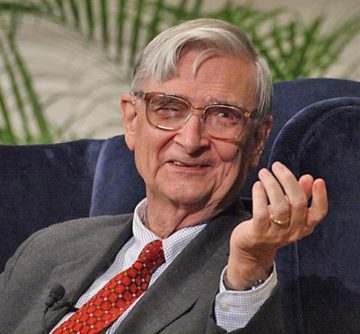
 I first met Edward O. Wilson in 1971 when I was a student in an ecology course at the Marine Biological Laboratory in Woods Hole, Massachusetts. Wilson, a famous Harvard professor, was sitting in on the student project reports. After I reported my experiments on food size selection in zooplankton, Wilson remarked, “That’s new, isn’t it?” I was so proud to have impressed the great E.O. Wilson that I have remembered his comment ever since!
Our next personal interaction came near the end of my graduate career at Michigan State University. I had constructed a mathematical model that provided support for the theory of group selection, which explains how altruism and other “for the good of the group” behaviors can evolve. This theory had been almost universally rejected by evolutionary biologists. Convinced of its importance, I wrote to Wilson asking if he would consider sponsoring it for the Proceedings of the National Academy of Sciences. He invited me to visit him at Harvard’s Museum of Comparative Zoology. After giving me a tour of his ant laboratory, he stood me in front of a blackboard, sat down in a chair, and said, “You have 30 minutes until my next appointment.”
I talked like an auctioneer, filling the board with my equations. Wilson was sufficiently intrigued to sponsor my article for PNAS after sending it out for review by two experts in theoretical biology. The article was published in 1975, the same year that Ed published his landmark book Sociobiology: The New Synthesis. The article became my Ph.D. thesis, which is probably the shortest in the history of evolutionary science (four pages).
Wilson, who passed away at the age of 92 on Dec. 26, 2021, is widely recognized as a giant of both the sciences and arts, which he worked to unify. He regarded the creative dimension of science as an artistic endeavor, and wrote beautifully for the public, resulting in two Pulitzer Prizes in nonfiction.
More here.
 The question that defined 2021 was perhaps the one Pontius Pilate, procurator of Judea, famously posed to Jesus in the Gospel of John: what is truth? Indeed, all the most debated issues of this dire year from vaccines to fake news were in the end about “verity”. Far beyond postmodernity, we appeared to have lost the shared set of values that constituted the mainframe of our societies in the past. This is not necessarily wrong. Philosophers Friedrich Nietzsche and Martin Heidegger pointed out how traditional values systems are undermined by too-rigid structures for history. These structures, whether scientific or economical, are always shaped by epochs and societies that determine their outcomes. So as we enter a new year, the question about truth becomes: who can we trust in 2022?
 One week ago,
  This blog started out a year ago as
  My very first period came to me like a stranger on a train. My parents and I were taking an overnight sleeper from Delhi to Bombay to visit my paternal grandmother. Because of a feud between her and my mother, Dadi and I had never met, but the stories I’d heard had already caused me to fear her more than anyone else in the world. Perhaps it was the dread of seeing her that sent my organs into overdrive, but sometime around the break of dawn I felt the urge to pee, and even though using a toilet on an Indian train is an exercise in an extreme form of Buddhist tolerance, I had my mother rush me there. I lifted my shirt, and from the folds of my ochre salwar, a blossoming field of red stared back.
 JUST AS MEDICAL
 In 1995, world-famous Russian mathematician Vladimir Igorevich Arnold proposed that a class of convex, homogeneous bodies, which, when resting on a flat surface have only one stable and only one unstable point of equilibrium, must exist. (In unstable equilibrium, the body will fall out of equilibrium no matter how you push it). A few years later in 2006, his idea was proven by Hungarian scientists, Gábor Domokos and Péter Várkonyi, by constructing a physical example. Meet Gömböc.
 Suppose we ask: where did spacetime itself arise from? Then we can go on turning the clock yet further back, into the truly ancient “
 On the acknowledgments page at the end of Homero Aridjis’s recently translated novel, Smyrna in Flames, the author admits:
 Individual experiences and suffering are, of course, at the heart of the pandemic. But one way to understand what has happened is through putting those experiences together – and statistics are those personal stories writ large. And this pandemic has brought unprecedented demand to explain all the numbers that have been flying around.
 Polarization
  During her first year of college, Elaina Cosentino bought a fitness band and began walking 10,000 steps a day. Through a friendly competition with friends, she kept it up for four years. But during her first semester of graduate school, her routine changed and she fell out of the habit. Then her mother passed away between her first and second semesters, and it “truly took everything out of me to just get up and go to class,” says Cosentino, a physical therapist. “I did go for an occasional mind-clearing walk every now and then during that time, as walking was something familiar to me and I always loved the way I felt afterwards.”
 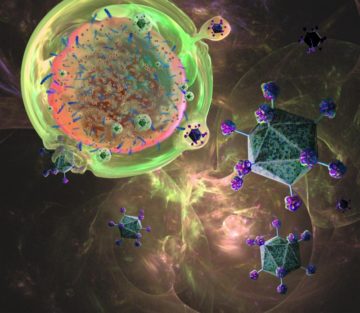 It seemed like a very promising cancer immunotherapy lead. CHO Pharma, in Taiwan, had discovered that it was possible to target solid tumours with an antibody against a cell-surface glycolipid called SSEA-4.
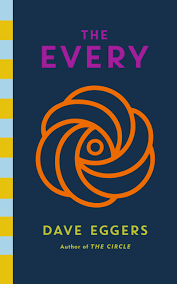 Eggers is hardly a systems novelist: his literary sensibilities, like his career, tend toward the monomaniacal. His writing in the past two decades has involved a suspiciously prolific series of smug morality tales fictionalizing or nonfictionalizing real people—a heroic Sudanese refugee, a heroic Yemeni coffee importer later accused of racketeering, Donald Trump—as well as novels about loners in perilous circumstances. He has also written children’s books, left-of-center comedic op-eds, and articles for the New Yorker about human rights and how much he loves wine. But evident throughout his literary output, as in his incoherent and self-congratulatory apparatus of publishing programs, bookselling platforms, and children’s literacy programs, is an ongoing fascination with epic, world-conquering ambition. The characters in A Heartbreaking Work of Staggering Genius, I was embarrassed to reread, are “sure that we are on to something epochal . . . sure that we speak for others, that we speak for millions”; in his 2006 foreword to Infinite Jest, Eggers lingers, enviously and, I think, not un-Bezosishly, on Wallace’s all-seeing book as an example of the “human possibility [for] leaps in science and athletics and art and thought.”