
Michael Marshall in Nature:
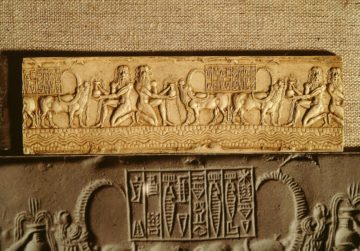 The missing earthworms were a sign. As archaeologist Harvey Weiss and his colleagues excavated a site in northeast Syria, they found a buried layer of wind-blown silt so barren there was hardly any evidence of earthworms at work during that ancient era. Something drastic had happened thousands of years ago — something that choked the land with dust for decades, leaving a blanket of soil too inhospitable even for earthworms.
The drought hit in roughly 2200 BC, when the Akkadian Empire dominated what is now Syria and Iraq. By 2150 BC, the empire was no more. The central authority had disintegrated, and many people had voted with their feet, leaving the region. The overlap between an epic drought and the collapse of the Akkadian Empire was no mere coincidence, according to Weiss, an archaeologist at Yale University in New Haven, Connecticut. When he and his colleagues discovered the evidence of drought in the early 1990s, they proposed that the abrupt climate disruption had brought the ancient empire down1. This example has become a grim warning of how vulnerable complex societies can be to climate change.
More here.
 I was watching Oneohtrix Point Never in the related project of trying to figure out just what the heck exactly it is about The Weeknd, who released his most recent album, Dawn FM, a couple of weeks ago, and I have never quite been able to understand why I am both attracted to and repelled by everything that is The Weeknd. I say repelled because there is a kind of loosely held emptiness, a brazen cynicism and pure Pop indifference to the music of The Weeknd that often makes me feel frustrated both with The Weeknd (why do you have to be so glib?!?!) and then in some related way with myself and then also with nearly everything. But then when I listen to The Weeknd for a little longer I realize that he is also frustrated with himself, and by extension with me and also very much with more or less everything. His music is the music of that. And then somehow it is also at the same time the utmost in listenable and cherry-flavored fun-all-the-way-down meaningless Pop.
 Quiet, cautious, and insistent, Zhi was also highly qualified. He earned a PhD in physics from Leipzig University but declined a job offer in the United States in order to return to China. He taught at two Chinese universities and later helped to devise China’s landmark 12-year Plan for the Development of Science and Technology of 1956. It was a hopeful time for scientists and technicians who were deemed useful for their contributing roles in a state-guided socialist economy.
 A passage in Walt Whitman’s seminal 1855 work, Leaves of Grass, reads, “And do not call the tortoise unworthy because she is not / something else, / And the mocking bird in the swamp never studied the / gamut, yet trills pretty well to me.” Another reads, “For me the man that is proud and feels how it stings to be / slighted, / For me the sweetheart and the old maid…for me / mothers and the mothers of mothers, / For me lips that have smiled, eyes that have shed tears, / For me children and the begetters of children.”
 The euro’s primary purpose was to facilitate integration by eliminating the cost of currency conversions and, more importantly, the risk of destabilizing devaluations. Europeans were promised that it would encourage cross-border trade. Living standards would converge. The business cycle would be dampened. It would bring greater price stability. And intra-eurozone investment would yield faster productivity growth overall and convergent growth between member countries. In short, the euro would underpin the benign Germanization of Europe.
 What all this comes down to, then, is that Berger accepts a priori a militant and often staggeringly vulgarized brand of Marxism from which all his judgments about art derive, in language anyway. (Since we are never allowed to view the actual procedure by which Berger judges that one painting is “subjective” or “decadent” and another not—this would involve defining Marxist terminology in visual terms—we can say no more than this.) Furthermore, when Berger finds himself in a position that, even to the layman, is pretty obviously untenable, he is prepared to deny its apparent meaning and then reintroduce the untenable notion through the loaded use of supposedly neutral or descriptive words—such as “improvement” in the above example. My fundamental objection is not that Berger begins from a position of accepting Marxist theory. In the world we live in more and more critics of art may be expected to start from similar political premises. But what is imperative is that the critic define his terms; that he show with sensitivity and logical rigor the usefulness and, if possible, the necessity of employing Marxist concepts and terminology. Unless he can do this his judgments will reveal nothing more than the strength of his bias and the slovenliness of his mind: they can say nothing about the works of art in question.
 Not long after we began dating, my now wife, Christine, and I started making up stories about the child we might have.
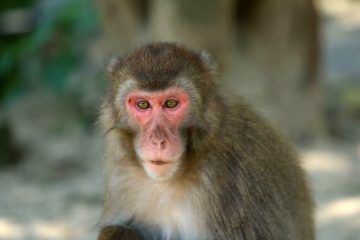 Smashing the patriarchy in the human world has been easier said than done. But last year, a 9-year-old female Japanese macaque in a reserve in southern Japan showed humans how it’s done by violently overthrowing the alpha male of her troop to become its first female leader in the reserve’s 70-year history. The macaque, named Yakei, presides over a troop of 677 monkeys in Takasakiyama Natural Zoological Garden, which was established as a reserve for monkeys in 1952. There are two troops on the island reserve, and they spend most of their time roaming the forested mountain at its center. They also make daily visits to a park at the base of the mountain, where the staff provides food. Since the reserve opened, its staff has kept tabs on the romantic and political struggles of its simian residents.
 One of the primary sticking points that prevents me from being a Marxist, even as I think Marxist analysis is the most illuminating framework we have for making sense of history and economics, is that I could never abide the idea of false consciousness. Another way of putting this is that Marxism is pretty adequate for the study of history and economics, utterly inadequate for anthropology, which I tend to care about most of all, and for which I think an anarchist lens is most revealing. Do you really want to tell a Nuer herdsman that the cattle-centric cosmology he uses to understand his place in the world is just an artefact of ideology, flowing from the relations of labor that prevail in his society and of which he remains ignorant? Wouldn’t it perhaps be more interesting to see what happens when you take his word for it, about what a cow is, for example, and how cows relate to human beings? And if you are willing to approach a Nuer herdsman in this way, why not also a concitoyen of yours who thinks Nascar is the ultimate thrill, or a lower-bourgeois French person who thinks no holiday meal is complete without pigs’ feet in aspic and who simply adores Johann Strauss’s “Blue Danube”?
 Hailed as the
  Last spring, prominent Big Tech critic Lina Khan became the new chair of the Federal Trade Commission (FTC)—an appointment widely seen as a coup for progressive reform. In her confirmation hearing, she characterized the agency’s overarching goal in terms of “fair competition.” This choice of emphasis is significant for understanding the antitrust reform project of which Khan is a leader. At its core, the project is a policy paradigm aimed at creating fair markets—markets characterized by socially beneficial competition, fair prices, and decent wages.
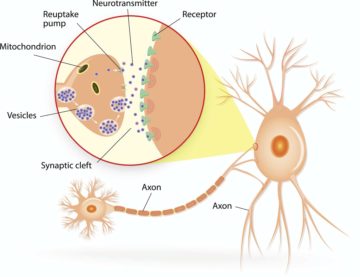 Previously, researchers focused on
 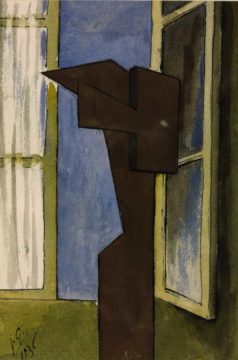 Forster began writing Maurice in 1913, when the British Empire governed nearly a quarter of the earth’s population and the question of nostalgia was beside the point. Forster was thirty-four, eighteen years had passed since
 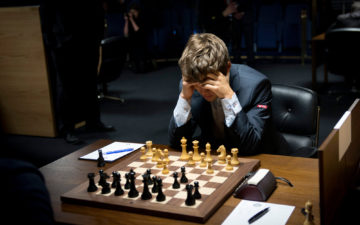 Arriving at the chess board is like entering an eagerly anticipated party. All my old friends are there: the royal couple, their associates, the reassuringly straight lines of noble infantry. I adjust them, ensuring that they are optimally located in the centre of their starting squares, an anxious fidgeting and tactile caress. I know these pieces, and care about them. They are my responsibility. And I’m grateful to my opponent for obliging me to treat them well on pain of death.