
From Harvard Magazine:
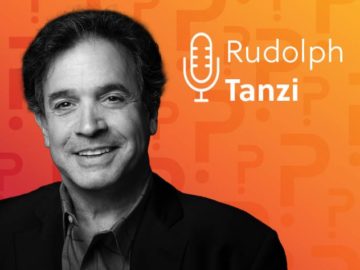 Harvard Medical School professor of neurology Rudolph Tanzi discusses how lifestyle choices can help maintain brain health during a person’s lifespan. Topics include Alzheimer’s disease and other kinds of dementia, the role of genetics and environment in health, and the importance of sleep, exercise, and diet in controlling neuroinflammation.
Jonathan Shaw: And how much of age-related cognitive decline is attributable to genetics, and how much to things that we could control potentially?
Rudolph Tanzi: It’s interesting, you know, this is what I wrote about in “Super Genes.” And I actually did congressional testimony on it, based on the books that I wrote, which was kind of interesting. And what I told them was, look, if you look at age-related diseases, like heart disease, Alzheimer’s, etc., you see a similar pattern. About 5 percent of the genes involved have very hard-hitting mutations—mutations that guarantee the disease, and usually with early onset. And usually those disease genes where you can’t do anything about them—they’re you know, they’re the rare ones—also tell you about the events that pathologically happen earliest in the disease. So, for example, you know, Brown and Goldstein won the Nobel Prize for finding a family with a rare mutation that gave them high cholesterol. And based on that, they proposed cholesterol had something to do with heart disease. And the first genes we found, you know, when I was a student at Harvard, for my doctoral thesis, I found the first Alzheimer’s gene. I named it amyloid precursor protein, APP, because it makes amyloid. And the mutations in that gene cause a rare form of early-onset Alzheimer’s with certainty, by making too much amyloid in the brain. And just like cholesterol, now we know amyloid is something that occurs in the brain a decade or two or three before symptoms. That’s when you have to hit it, just like cholesterol, you can’t wait to need to bypass to hit it. You have to hit it earlier. So it’s very analogous. Now, if you look at the other genetics of age-related diseases, the other 95 percent, you have genes with variations and mutations that predispose you to the disease, others that actually protect you from the disease, but none of them with certainty, at least not within a normal lifespan. So, you know, if you look at the early-onset Alzheimer genes we found that, you know, have mutations that guarantee the disease by 60 years old. Well, when lifespan was 50, those didn’t guarantee disease because you didn’t live long enough. And so some of the mutations we know now that predispose you to increased risk for late-onset Alzheimer’s, like the APOE4 variant is most common, you know, maybe when lifespan is 120 years old, that will be called completely penetrant. It’s going to guarantee the disease because you live long enough. So whenever you think about, does a gene mutation guarantee a disease? You have to think about how long you live, because some might just take longer to give you the disease. But based on how long we live right now, only 5 percent of Alzheimer’s genes guarantee the disease, 95 percent only predispose, which means lifestyle has a lot to do with avoiding this disease, which is why I wrote my books, which is why we have the McCance Center, because we want to teach people how to do their best to try to avoid this disease with lifestyle.
More here.
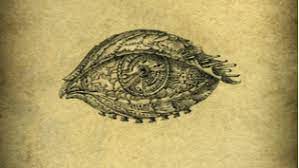 I have a childhood memory of looking in the bathroom mirror, and for the first time realizing that my experience at that precise moment—the experience of being me—would at some point come to an end, and that “I” would die. I must have been about 8 or 9 years old, and like all early memories this one too is unreliable. But perhaps it was at this moment that I also realized that if my consciousness could end, then it must depend in some way on the stuff I was made of—on the physical materiality of my body and my brain. It seems to me that I’ve been grappling with this mystery, in one way or another, ever since.
 Only two of the following three cultures are, as far as we know, real. In 2022, perhaps, I will reveal which of them I made up.
 The preliminary data about omicron and vaccines is
  French far-right pundit Éric Zemmour recently launched his presidential campaign with a
  On December 15, 2011, Comet Lovejoy plunged through the sun’s corona
  I
I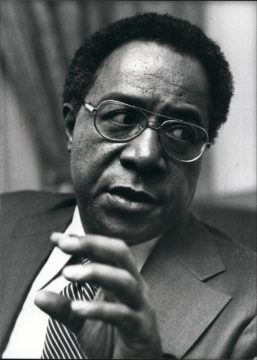 In 1959, long before his books “The Autobiography of Malcolm X” and “Roots” made him famous, an aspiring writer named Alex Haley, fresh out of the Coast Guard, wrote to six prominent Black writers in Greenwich Village for pointers on how to break into publishing. Only James Baldwin replied, showing up at Haley’s place unannounced one afternoon and chatting with him. Haley was eternally grateful for such generous encouragement from the distinguished author.
 Raphaële Chappe in Late Light:
 Herman Mark Schwartz in American Affairs Journal:
 Ian Hesketh in Aeon:
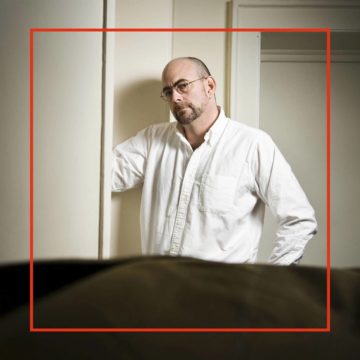 Marco Roth in Tablet:
 Throughout much of human history, famine, pestilence, and war have sent people seeking the comforts of religion. From the religious processions of Europe during the fourteenth-century Black Plague to the sharp
  What is the matter with the Democrats? On one level, the answer is simple. Voters with college degrees are
 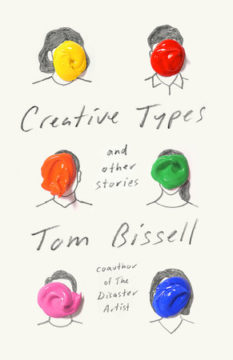 This kind of career serenity prayer led to Bissell’s biggest breakthrough: “