
From Nature:
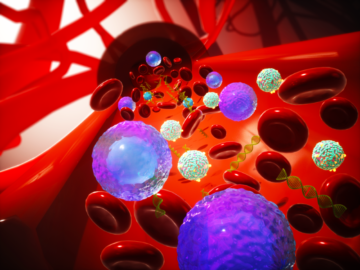 “We’ve known for many years that there is tumour-related material in the blood stream,” says Minetta C. Liu. “We just didn’t have the technologies to detect it with enough sensitivity for it to be meaningful.”
Liu, a medical oncologist and cancer investigator at the Mayo Clinic in Rochester, Minnesota, is one of a growing number of researchers advancing liquid biopsies as tools to understand cancer biology. The analyses of biomarkers in body fluids offers a minimally invasive and easily repeatable way to detect cancer-associated changes in the genome, epigenome, transcriptome and proteome. The wealth of information that can be obtained from material in blood and urine is opening new avenues for both research and disease monitoring.
In recent years, investigators have greatly improved the detection of many cancer biomarkers in liquid biopsies. Tests based on these biomarkers could, one day, do more than simply identify the presence of a tumour. They could help identify its location, stage, progression, and response to therapies, representing a paradigm shift in cancer diagnosis and management.
In research, the saying goes, extraordinary claims require extraordinary evidence. Where are those working on liquid biopsies placing their focus?
More here.
 To comfort friends discouraged by their writing pace, you could offer them this:
 Human beings, unlike all the other animals, hate animal bodies, especially their own. Not all human beings, not all the time. Leopold Bloom, pleased by the taste of urine, and, later, by the smell of his own shit rising up to his nostrils in the outhouse (“He read on, pleased by his own rising smell”), is a rare and significant exception, to whom I shall return. But most people’s daily lives are dominated by arts of concealing embodiment and its signs. The first of those disguises is, of course, clothing. But also deodorant, mouthwash, nose-hair clipping, waxing, perfume, dieting, cosmetic surgery — the list goes on and on. In 1732, in his poem “The Lady’s Dressing Room,” Jonathan Swift imagines a lover who believes his beloved to be some sort of angelic sprite, above mere bodily things. Now he is allowed into her empty boudoir. There he discovers all sorts of disgusting remnants: sweaty laundry; combs containing “A paste of composition rare, Sweat, dandruff, powder, lead, and hair”; a basin containing “the scrapings of her teeth and gums”; towels soiled with dirt, sweat, and earwax; snotty handkerchiefs; stockings exuding the perfume of “stinking toes”; tweezers to remove chin-hairs; and at last underwear bearing the unmistakable marks and smells of excrement. “Disgusted Strephon stole away/Repeating in his amorous fits,/Oh! Celia, Ceila, Celia shits!”
 Denial of Omicron being serious suits an exhausted community who just wish life could go back to 2019. Omicron may be half as deadly as Delta, but Delta was twice as deadly as the 2020 virus. Importantly, the WHO assesses the risk of Omicron as high and reiterates that adequate data on severity in unvaccinated people is not yet available. Even if hospitalisation, admissions to intensive care and death rates are half that of Delta, daily case numbers are 20-30 times higher – and projected to get to 200 times higher. A tsunami of cases will result in large hospitalisation numbers. It is already overwhelming health systems, which common colds and seasonal flu don’t. Nor do they result in ambulance wait times of hours for life-threatening conditions. In addition, a tsunami of absenteeism in the workplace will worsen current shortages, supply chain disruptions and even critical infrastructure such as power. The ACTU has called for an urgent raft of measures to address the workforce crisis.
 Before arriving in Glasgow,
 FLORENCE, Ariz.—Tonight, deep in the Arizona desert, thousands of people chanted for Donald Trump. They had braved the wind for hours—some waited the entire day—just to get a glimpse of the defeated former president. And when he finally appeared on stage, as Lee Greenwood played from the loudspeakers, the crowd roared as though Trump were still the commander-in-chief. To many of them, he is. “I ran twice and we won twice,” Trump told his fans. “This crowd is a massive symbol of what took place, because people are hungry for the truth. They want their country back.”
 On Wednesday, in the hours after Ronnie Spector’s family announced her passing from cancer at seventy-eight, I played, on loop, her cover of the Johnny Thunders punk anthem “You Can’t Put Your Arms Around a Memory.” Recorded for
  I
I  “I
“I  One of the greatest physicists of the last century, Paul Dirac, had no use for emotions. “My life is mainly concerned with facts, not feelings,” he declared. He loved his emotion-free existence, or so it seemed, until he met a vivacious woman who was his exact opposite — impulsive and ardent. She became his wife and not only made him a happy man but also dramatically changed his personality. He became a feeling human being, which in turn affected his science. Yes, physics! If being logical and rational were all that mattered, we wouldn’t need actual physicists. The job could be done by computers. Later in life, Dirac became so convinced that knowledge needs to be combined with intuitions, crazy hunches and irrational perseverance that whenever he was asked about the secret to his success, he stressed that one needs to be guided above all by one’s emotions.
 Zora Neale Hurston’s best-known sentence, judging by its appearance on coffee mugs and refrigerator magnets, is this one: “No, I do not weep at the world — I am too busy sharpening my oyster knife.”
 A couple of months ago, when I gave a talk about my forthcoming book
 Silicon Valley has no shortage of big ideas for transportation. In their vision of the future, we’ll hail driverless pods to go short distances – we may even be whisked into a network of underground tunnels that will supposedly get us to our destinations more quickly – and for intercity travel, we’ll switch to pods in vacuum tubes that will shoot us to our destination at 760 miles (1,220 km) per hour.