
Nic Johnson and Robert Manduca in the Boston Review:
 On or around 1939 debates about international political economy changed. Over the course of the Cold War, economic nationalism—the attempt to use the state to advance a country’s economic interests—was crowded out of official discourse by two competing universalisms, communism on one side and liberalism on the other. Over the last few decades, however, this opposition has been scrambled. First Marxist universalism failed; the Sino-Soviet split fractured the communist project before the USSR collapsed altogether. Then, after a brief period in the sun on the international stage, liberal universalism too began to falter in a declining arc from Iraq and the Global Financial Crisis to Donald Trump’s victory on an “America First” platform.
In the wake of these declensions, two political economic developments have muddied the earlier Cold War waters. In October last year the Biden administration announced that it would leave tariffs on two-thirds of Chinese exports intact. This came as a surprise for those who were hoping that Trump administration policies were pathological aberrations. Trade wars, it seems, have come to enjoy bipartisan support, in the unlikeliest of places—the ostensible headquarters of neoliberal globalization.
More here.
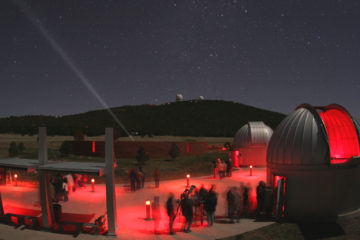 For more than a half-century, America has been a world leader in space, from the space race of the 1960s to the shuttle to numerous deep space probes. But this leadership has often been reluctant — and in tension with a public that has been at best ambivalent and at worst outright opposed to endeavors to explore the universe. Many Americans have little interest in space and would prefer to spend money
  On a rainy afternoon in mid-April, the singer and songwriter Angel Olsen steered a Subaru through Asheville, North Carolina, while a cardboard box of VHS tapes clattered in the back seat. Olsen, who is thirty-five, had recently excavated them from her childhood home, in St. Louis. Some promised footage of significant events—“Angel’s Graduation,” “Angel’s First Day of Preschool”—and others were labelled “the pokemon” and “world premiere dark horizon.” After pulling up at a video-restoration shop, Olsen did some hasty sorting in the parking lot, trying to decide which tapes were worth dusting off with a tissue and which ones she could toss. Olsen, who was adopted when she was three years old, has spent much of the past two years figuring out what to hold on to and what to surrender. In 2021, her adoptive mother and father died two months apart (her mother, from heart failure, at age seventy-eight; her father, in his sleep, at eighty-nine), shortly after she realized and told them she was gay. Ever since, Olsen has been sifting through the material and psychological aftermath.
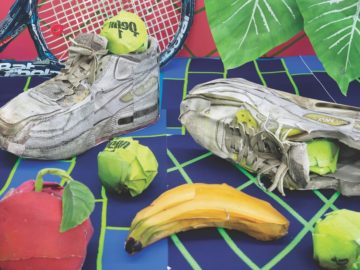 RICHARD WILLIAMS DEMANDS GLORY. The pursuit of glory is revised madness, the ambition of addicts, to get so high they collapse, and are forced to repeat the ascent as if for the first time. It’s preemptive repentance disguised as innocent yearning to win. You have to need vindication to need victory so desperately. Richard Williams is looking for redemption. In a scene from a 1990s video of Richard, father of tennis champions Venus and Serena Williams, we see him genuflecting on a tennis court in Compton, California, in front of a shopping cart full of tennis balls—the ground swells with them. He’s gathering the splayed balls and placing them into red plastic milk crates with the reverence of a praise dancer. What altar is this? A shrine of crumbling adobe, chalk, felt, and plastic. What utter fixation on the unglamorous, what risk of a dedication with no yield? What we know now turns the pathos in Richard’s gesture here into dramatic irony. The menial duties of this father intent on training his daughters to be the best athletes in the world will be redeemed. He will not kneel and scour the ground for these fuzzy green chess pieces in vain.
 FOR THE PAST DECADE,
 Jokes, sarcasm and humor require understanding the subtleties of language and human behavior. When a comedian says something sarcastic or controversial, usually the audience can discern the tone and know it’s more of an exaggeration, something that’s learned from years of human interaction.
 In all of physical law, there’s arguably no principle more sacrosanct than the second law of thermodynamics — the notion that entropy, a measure of disorder, will always stay the same or increase. “If someone points out to you that your pet theory of the universe is in disagreement with Maxwell’s equations — then so much the worse for Maxwell’s equations,” wrote the British astrophysicist Arthur Eddington in his 1928 book The Nature of the Physical World. “If it is found to be contradicted by observation — well, these experimentalists do bungle things sometimes. But if your theory is found to be against the second law of thermodynamics I can give you no hope; there is nothing for it but to collapse in deepest humiliation.” No violation of this law has ever been observed, nor is any expected.
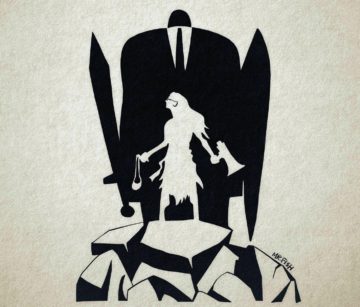 Seattle City Councilmember Kshama Sawant and the
  THE CARTHAGINIANS WERE
 On 4 March, Christopher Jackson tweeted that he was leaving the University of Manchester, UK, to work at Jacobs, a scientific-consulting firm with headquarters in Dallas, Texas. Jackson, a prominent geoscientist, is part of a growing wave of researchers using the #leavingacademia hashtag when announcing their resignations from higher education. Like many, his discontent festered in part owing to increasing teaching demands and pressure to win grants amid lip-service-level support during the COVID-19 pandemic.
 Doocot or dookit is the Scottish term for a dovecote or columbarium; a structure built to nest and breed domesticated pigeons. Some doo men keep their champion pigeons in doocots cut into attic spaces or adapted garden sheds, but on the schemes I lived on, we had neither attics nor gardens, and so the men who wanted to keep pigeons built their lofts out on any piece of unclaimed ground. Aesthetically they have little in common with the traditional stone dovecotes you might find on the grounds of a manor house. The doocots I remember were monolithic towers, twenty feet tall, and they were built from salvaged materials: old Formica tabletops, screwed to corrugated iron and offcuts of MDF. It gave most doocots a rickety charm, which the men tried to disguise by painting the whole thing a uniform colour.
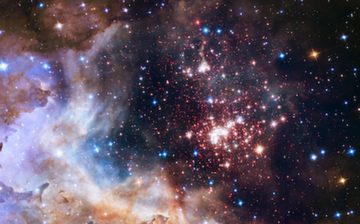 In an afterword to Far from the Light of Heaven, Thompson asks himself if he’s writing space opera — “a conversation my editor, my agent, my cat and I had many times” — and if so, what would the tropes of that subgenre bring to his work. As a practicing psychiatrist who somehow manages another full-time career as a novelist, Thompson has shared
  A chasm divides our view of human knowledge and human nature. According to the logic of the chasm, facts are the province of experimental science, while values are the domain of religion and art; the body (and brain) is the machinery studied by scientists, while the mind is a quasi-mystical reality to be understood by direct subjective experience; reason is the faculty that produces knowledge, while emotion generates art; STEM is one kind of education, and the liberal arts are wholly other.
 Zarqa Nawaz: When my memoir, Laughing All the Way to the Mosque, didn’t make it to the New York Times Best Seller list, I became a little cynical towards life. It was 2014 and ISIS had just emerged and was dominating the headlines. Muslims are forever fighting the PR war when it comes to their image. Political pundits were opining that radical Islamic jihadists were the norm in Muslim culture. I knew there was a deeper story behind ISIS, especially from the one the media was portraying. I started doing research and the novel began to emerge—a bitter writer, reeling from professional failure, gets embroiled in an ISIS like group and a series of unfortunate events ensue.