
Susan Stamberg on NPR:
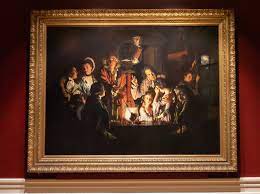 Two beloved paintings have swapped locations for a while. One went from California to London; the other, from London to California. No passports were involved. But the two museums where the paintings are housed — the Huntington Art Museum near Los Angeles, and London’s National Gallery — are welcoming visitors to see these masterpieces. The best known is a portrait of a rosy-cheeked fellow, maybe 15 years old, in a blue satiny suit with matching blue bows on his shoes.
A British fellow, he’d spent a century in the Huntington, near Pasadena, Calif. When he first left London back in 1921, 90,000 people came to say goodbye. Some wept. Still, he’s had a good run at the Huntington, the star of the museum. “It’s the one thing everybody wants to see,” says the Huntington’s director, Christina Nielsen. And maybe take home images of him, for souvenirs. “There are lamps, pepper grinders, ashtrays,” she says. Thomas Gainsborough’s 1770 painting has been reproduced on all kinds of tchotchkes. And why not? The kid’s adorable, and getting a nice welcome back in England. “Blue Boy, right now, is wowing London audiences,” according to Nielsen.
Meanwhile the National Gallery in London loaned the Huntington one of their most popular 18th century paintings: Joseph Wright of Derby’s massive 1768 work, An Experiment on a Bird in the Air Pump. A mad “scientist” — probably a traveling lecturer — with a flowing red robe and glowing long, white hair holds up a big glass bubble. There’s a beautiful white bird inside the bubble. A lid makes the bubble airtight. The experimenter turns the crank on a vacuum pump that’s attached to the jar — stay with me. He pumps out the air. The bird looks distressed.
More here.
 Today’s ‘stack will principally involve “housekeeping”. I said explicitly a week ago that the war in Ukraine has left me literally speechless, and I meant it. I was able to squeeze out some speech a week ago nonetheless, mostly by soldering together various fragments already written, by descending into mean-spiritedness in a vain effort to be funny, by “just saying whatever”. I can’t rely on the strategy of gonzo bricolage week to week, and so today I can only confess the stubborn silence of my “inner voice”, the homunculus who lives inside me and, when things are going right, dictates what I have to say.
 In a foundational
 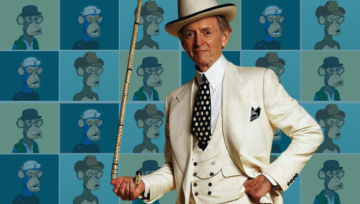 We are approaching the first anniversary of a landmark event in the art world. Although it seemed shockingly new last year, it represents the culmination of a trajectory described by Wolfe half a century ago: the de-materialization of art. On March 11th, 2021, a momentous auction was held by Christie’s. It was a dramatic departure from precedent, partly because
 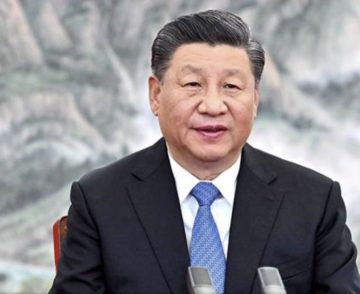 China can take the initiative in three key areas. For starters, Chinese President Xi Jinping should call for an emergency summit of G20 leaders, focused on achieving an immediate and unconditional ceasefire in this conflict and developing an agenda for a negotiated peace. The G20 is now the recognized forum for global action in the midst of crisis, having galvanized support among the world’s leading economies in
 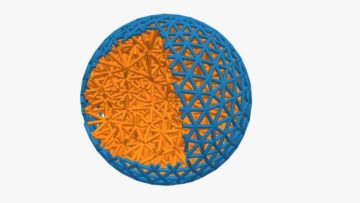 Physicists have discovered a new way to coat soft robots in materials that allow them to move and function in a more purposeful way. The research, led by the UK’s University of Bath, is described today in Science Advances. Authors of the study believe their breakthrough modeling on ‘active matter’ could mark a turning point in the design of robots. With further development of the concept, it may be possible to determine the shape, movement and behavior of a soft solid not by its natural elasticity but by human-controlled activity on its
  Nobody is talking about the blame that must be shouldered by the German government for the crisis and humanitarian disaster in Ukraine.
 Esfandyar Batmanghelidj in War on the Rocks:
 Ron Ivey in American Affairs Journal:
 I
I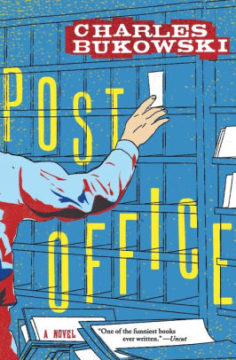 HALF A CENTURY AFTER the publication of Post Office (1971), how should we understand Charles Bukowski’s literary achievement? His publisher predicted that Bukowski would never reach a mainstream audience. And yet his books, including his poetry, have sold millions of copies in more than a dozen languages. Writing for The New Yorker in 2005, Adam Kirsch
  “Living in America during the Reagan years had the same disorientation as a texture dream,” writes David Wojnarowicz in
  One summer afternoon when I was 23 — this was in 1987 — I was twiddling the dial on the radio in the apartment I was subletting on 114th St. when I stumbled on a station that was unlike anything that I had ever heard before. They were in the middle of a story about the Appalachian Trail, profiling some of the people who were hiking its two thousand miles that year. The reporting was calm, patient, intelligent, allowing the subject to find its own shape, unfolding slowly, minute after minute, like the trail itself.