
Fred Pearce in Science:
 These are strange times for the Indigenous Nenets reindeer herders of northern Siberia. In their lands on the shores of the Arctic Ocean, bare tundra is thawing, bushes are sprouting, and willows that a generation ago struggled to reach knee height now grow 3 meters tall, hiding the reindeer. Surveys show the Nenets autonomous district, an area the size of Florida, now has four times as many trees as official inventories recorded in the 1980s. In some places the trees are advancing along a wide front, but in other places the gains are patchier, says forest ecologist Dmitry Schepaschenko of the International Institute for Applied Systems Analysis in Austria, who has mapped the greening of the Siberian tundra. “A few trees appear here and there, and some shrublike trees become higher.”
All around the Arctic Circle, trees are invading as the climate warms. In Norway, birch and pine are marching poleward, eclipsing the tundra. In Alaska, spruce are taking over from moss and lichen. Globally, recent research indicates forests are expanding along two-thirds of Earth’s 12,000-kilometer-long northern tree line—the point where forests give way to tundra—while receding along just 1% (see map, below).
More here.
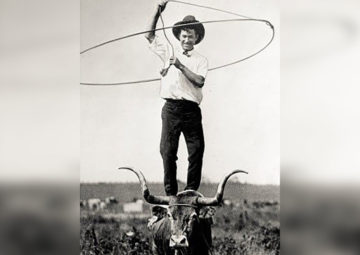 There is a scene in Fox’s 1930 comedy So This Is London in which Hiram Draper, played by Will Rogers, attempts to get a passport. When Hiram is unable to provide a birth certificate, the passport-office official inquires if he is an American citizen. Rogers, in his thick Oklahoman accent, responds: “I think I am. My folks are Indian. Both my mother and father had Cherokee blood in ’em. Born and raised in Indian Territory. Of course, I’m not one of these Americans whose ancestors come over on the Mayflower, but we met ’em when they landed.” It’s a great bit of comedy, a pre-Code jab pointing out an existential absurdity of America itself. It’s also a key to Rogers’s brand of humor and his positioning as a straight-talking outsider lodged in the eye of popular culture’s storm.
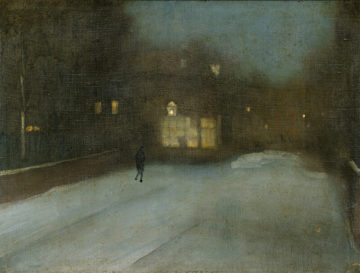 Howe’s latest book, London-rose: Beauty Will Save the World, is a strange, changeable artifact. As does much of her work, it luxuriates in formal and generic plasticity: it is not poetry, exactly, but nor is it precisely prose. London-rose might be more usefully regarded as a consortium of fragments—historical apocrypha, lists, philosophic and monastic citations, and other ephemera—which are loosely gathered in the folds of a skeletal plot concerning an unnamed and structurally anonymized female pencil pusher. Howe called 2020’s Night Philosophy her “last” book, and to give credit where it is due, London-rose isn’t technically “new.” The manuscript is traceable in some form to the early 1990s, the decade during which Howe was in the thick of a sequence of five novels she has said are as near to a personal biography as she wishes to get. (They were collected in an omnibus as Radical Love by Nightboat in 2006, and the last of them—Indivisible—is being reissued in tandem with the publication of London-rose.)
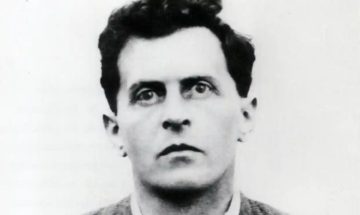 Ludwig Wittgenstein joined the army the day after his native Austria-Hungary declared war on Russia in August 1914. He had been serving for almost three months when he received word that his brother Paul, a concert pianist, had lost his right arm in battle. “Again and again,” he wrote in his notebook, “I have to think of poor Paul, who has so suddenly been deprived of his vocation! How terrible! What philosophical outlook would it take to overcome such a thing? Can it even happen except through suicide!”
 There are dozens of natural supplements that purport to treat anxiety. Most have a few small sketchy studies backing them up. Together, they form a big amorphous mass of claims that nobody has the patience to sift through or care about.
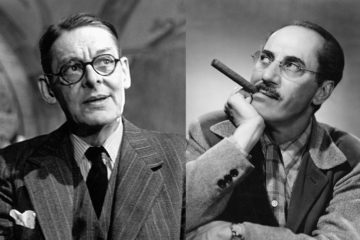 In 1961 a letter with a Royal Mail postmark arrived at 1083 North Hillcrest Road, Beverly Hills. Fan mail sent to this modernist estate amidst the California scrub were not uncommon. After all, it was the home of Julius “Groucho” Marx, the visionary leader of the fraternal comedic group. This particular note had a return address of 3 Kensington Court Gardens, a continent and an ocean away.
 S
S Andrew Yamakawa Elrod in Phenomenal World:
 I’m not at the Cannes Film Festival, but a few days ago the festival came to me, at a New York screening of a movie that premièred today at Cannes. The film is
  Last fall, I made my first visit to London since the start of the pandemic. A routine commuter flight from Europe felt like a great adventure, and once I’d jumped through the bureaucratic hoops, I was excited to arrive. But the city looked disappointingly unchanged after everything the world had gone through. The only thing that really shocked me was something I hadn’t expected: hearing people speaking English. After two years away from it, I had never felt so moved to encounter my own language.
 It was if he’d stepped, steaming, out of a Tom of Finland drawing. “My definition of tit for tat,” he wrote, is: “You lick my tattoo while I handle your nipple.”