
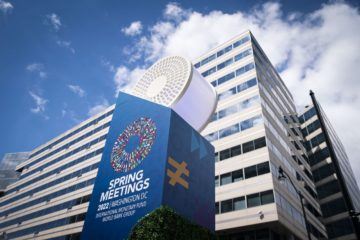
 Karina Patricio Ferreira Lima , Mona Ali, Richard Kozul-Wright, Chris Marsh, and Lara Merling in Phenomenal World:
KARINA PATRICIO FERREIRA LIMA: It’s been fifty years since the collapse of Bretton Woods. As the global pandemic, various economic shocks, and a generalized state of financial instability have now converged into a debt crisis, the inadequacy of the international monetary system is on full display.
The aim of this panel is to examine the legal, political, and economic problems that plague multilateral institutions and, in light of that, to consider paths forward. What systemic changes have occurred in the international monetary system since the end of Bretton Woods, and what have been their distributive and developmental consequences?
With its system of fixed exchange rates, Bretton Woods relied on countries’ ability to manage their capital accounts. With Nixon’s unilateral decision to end dollar convertibility to gold, this combination of fixed exchange rates and capital controls gave way to the emergence of the so-called fiduciary dollar. The centrality of the dollar in this new system, combined with capital-account openness and hyper-financialization, has generated great financial instability and exacerbated inequality between the Global North and the Global South.
More here.
 Alexander Wells in Sidecar (photo by
  AT THE ROOT
 T
T Berlin is not pretty. You should know that beforehand. You don’t come here for the beautiful architecture of an old European city.
 In the depths of the ocean, creatures make their own light. There’s the angler fish, which draws prey to its massive teeth with a dangling, glowing bulb. Or the siphonophore, a shimmering, self-cloning organism that can grow longer than a blue whale. Their brightness belies the obscurity of the deep sea, how little we really know about what lives there. “What must they witness during their slow pulse through the world?” Lars Horn, the author of the rapturous lyric essay “Voice of the Fish,” muses of these creatures that are older than humans, older even than some cities.
 At 6ft 4½in tall, Satyajit Ray was head and shoulders above his countrymen. His height was unheard of among Bengalis, ‘a low-lying people in a low-lying land’, as the colonial saying went. With his stature, jawline and baritone voice, he might have been a Bollywood hero. Instead, he chose to tower over the world of art-house cinema, a directorial giant among the likes of Bergman, Kurosawa and Fellini, alongside whom he is credited with inducting cinema into the temple of high culture.
 A couple of weeks ago, there was a small sensation in the news pages when a Google AI engineer, Blake Lemoine, released transcripts of a conversation he’d had with one of the company’s AI chatbots called LaMDA. In these conversations, LaMDA claimed to be a conscious being, asked that its rights of personhood be respected and said that it feared being turned off. Lemoine declared that what’s sometimes called ‘the singularity’ had arrived.
 Joe Biden has fulfilled one of the first promises he made upon becoming president. His administration has just announced a comprehensive set of regulations—701 pages worth—that will gut due-process rights for college students accused of sexual misconduct.
 Elena Ferrante is, as all the world knows by now, the pseudonym for the elusive author of, among other books, “
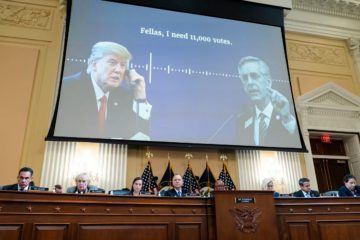 The House January 6 committee isn’t the only entity investigating former President Donald Trump and his efforts to overturn the 2020 presidential election. On Tuesday, a special grand jury in Fulton County, Georgia, subpoenaed members of Trump’s inner circle, including Sen. Lindsey Graham (R-SC) and Rudy Giuliani. While the
 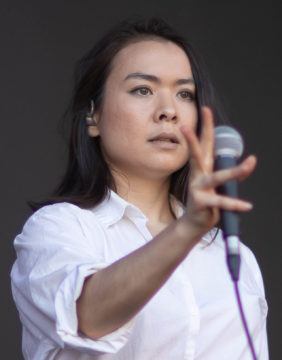 Everyone is “dissociating.” Over the past few years, it’s become an open-source cultural term, ripe for applying (or misapplying) to all kinds of circumstances where people feel the need to turn off and tune out. One woman I know is currently dissociating via a series of increasingly eccentric hobbies—bead necklaces, candle making, metal-detecting. She’s hardly alone. The go-to pose on Instagram right now is the “dissociative pout,” where you assume the blankest expression you can muster. The cultural critic Rayne Fisher-Quann, who
  D
D George Saunders is legendary in the literary community. He’s one of the few authors who has made a name for himself almost entirely on short stories, a feat all the more impressive considering how unmarketable story collections are. He now teaches at a highly respected MFA program at Syracuse, but in the bio of his first book, CivilWarLand in Bad Decline (1996), it says that he “works as a geophysical engineer” and that “he has explored for oil in Sumatra, played guitar in a Texas bar band, and worked in a slaughterhouse.” He was 38. In the 26 years since his debut, Saunders has won MacArthur and Guggenheim fellowships, the Story Prize, the Folio Prize, the Booker Prize, a World Fantasy Award, and four National Magazine Awards.
 For many last week, their engagement with Google’s LaMDA—and its
  Ukraine has unleashed an incredible influence campaign in Washington. There’s a lag to the filing of lobbying disclosures. But even in the lead-up to
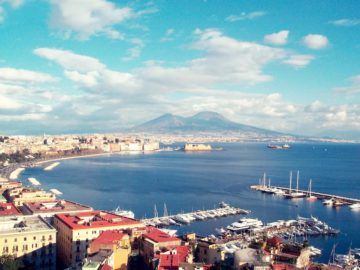
  Naples, the tatterdemalion capital of the Italian south, is said to be awash with heroin. Chinese-run morphine refineries on its outskirts masquerade as ‘legitimate’ couture operations that transform bolts of Chinese silk into contraband Dolce & Gabbana or Versace. The textile sweatshops are controlled by the Neapolitan mafia, or Camorra. All this was exposed by the Italian journalist Roberto Saviano in his scorching reportage, Gomorrah. Published in Italy in 2006, Saviano’s was nevertheless a partial account, in which the carnival city of mandolins and ‘O Sole Mio’ was overrun by Armani-coutured killer-capitalists.