
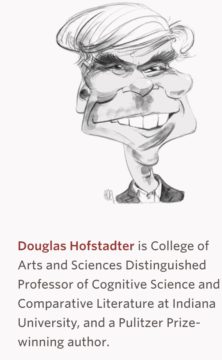
Douglas Hofstadter in Inference Review:
 Actually, until 1961, when I was 16, I’d never given any thought to Sweden at all, but everything shifted on a dime when my Dad shared the 1961 Nobel Prize in Physics. That December, our family flew to Stockholm for the ceremonies and it was unforgettable. Not only were the solemn, yet deeply joyous, festivities a once-in-a-lifetime occurrence, but I was powerfully struck by the classic European beauty of Stockholm in the midst of that romantically dark and snowy Scandinavian winter—such a clean and sophisticated city with its old-fashioned trams, its glittering neon signs, its colorful store windows, its elegant ladies and gentlemen, and, last but not least, its strange, alien language.
When, one day in the Grand Hôtel, which certainly lived up to its name, our family first laid eyes on my Dad’s Nobel diploma, colorfully and exquisitely hand-calligraphed in Swedish, I tried to make some sense of the citation—“För hans banbrytande undersökningar över elektronspridningen mot atomkärnor och därvid gjorda upptäckter rörande nuckleonernas struktur”—but I couldn’t do much with it. Although I knew a weensy bit of German, I didn’t know a word of any of its cousin languages, such as Swedish. And yet I instantly noticed something that looked odd; a tiny little thing that, to my eye, stuck out like a sore thumb. Even if you know zero Swedish, I urge you to try to spot the spot that was an eyesore to me. Hint: it’s just one word toward the end. And by the way, in English, what those italicized words mean is this: “For his pathbreaking investigations of electron-scattering from atomic nuclei, and for his discoveries, made thereby, concerning the structure of nucleons.”
More here.
 In 1977, Ken Olsen declared that ‘there is no reason for any individual to have a computer in his home.’ In 1995, Robert Metcalfe predicted in InfoWorld that the internet would go ‘spectacularly supernova’ and then collapse within a year. In 2000, the Daily Mail reported that the ‘Internet may be just a passing fad,’ adding that ‘predictions that the Internet would revolutionise the way society works have proved wildly inaccurate.’ Any day now, the millions of internet users would simply stop, either bored or frustrated, and rejoin the real world.
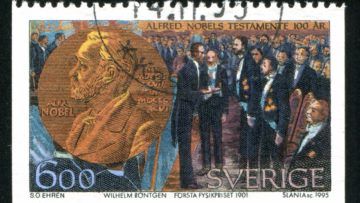 Nobel Prizes used to be awarded fairly quickly after the discovery, achievement, or event that prompted them. The instructions left by Alfred Nobel seemed to warrant this speed. However, this has occasionally led to awards for discoveries that later turned out to be bunk. Perhaps no case of this is clearer-cut than the 1926 prize in medicine, which was awarded “for [Fibiger’s] discovery of the Spiroptera carcinoma.”
 The House committee tasked with investigating the Jan. 6 attack on the Capitol made its closing arguments to the American public today and voted 9-0 to subpoena former President Donald Trump. They highlighted snippets from more than a million Secret Service communications in the days and hours leading up to the breach of the Capitol, bolstering their thesis that then-President Donald Trump had incited a mob and bears singular responsibility for the violence that ensued. “Armed and Ready, Mr. President!” read one snippet of intelligence presented in a Secret Service email on Dec. 24, 2020, about two weeks before the Jan. 6 joint session of Congress to formalize Joe Biden’s election victory.
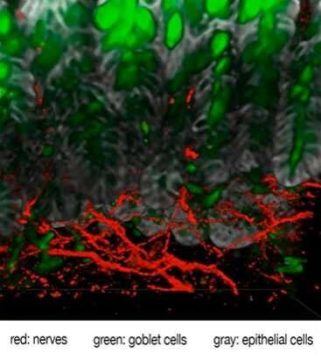 Pain has been long recognized as one of evolution’s most reliable tools to detect the presence of harm and signal that something is wrong—an alert system that tells us to pause and pay attention to our bodies. But what if
  Cihan Tugal in Sidecar:
 Samir Sonti and JW Mason in Phenomenal World:
 Ingrid Robeyns in Crooked Timber:
 This is a song that does no favors for anyone, and casts doubt on everything.
 In June 1794,
  Analytic philosophers avoided the subject of meaning in life till relatively recently. The standard explanation is that they associated it with the meaning of life question they considered bankrupt. But it’s surely also because the subject conflicts with some of the core tendencies of the analytic tradition. “What gives point to life?” is a sweeping question that invites the synoptic approach associated with continental philosophy, not the divide-and-conquer method favored by Anglo-Americans. The question also wears its angst on its sleeve, making it an awkward fit with the dispassionate mode employed in the mainstream academy.
 In Alysson Muotri’s laboratory, hundreds of miniature human brains, the size of sesame seeds, float in Petri dishes, sparking with electrical activity.
 In November of 1660, at Gresham College in London, an invisible college of learned men held their first meeting after 20 years of informal collaboration. They chose their coat of arms: the royal crown’s three lions of England set against a white backdrop. Their motto: “Nullius in verba,” or “take no one’s word for it.” Three years later, they received a charter from King Charles II and became what was and remains the world’s preeminent scientific institution: the Royal Society.