
Kayhan Valadbaygi in Phenomenal World:
At first glance, the strategic rationale for the US-Israeli offensive in Iran seems elusive. While President Trump has described the campaign in the familiar idiom of democratic liberation, promising to topple the Islamic Republic, Secretary of State Marco Rubio has presented it as a pre-emptive strike. Pentagon chief Pete Hegseth joined Rubio in claiming that the core objectives are the destruction of Iran’s nuclear and missile programs and the degradation of its naval capabilities—not exactly regime change, but counter-capability coercion.
Yet the US war aims should not be sought in the Trump administration’s official briefings but in the long-term changes in American statecraft. Since the early 2010s, Washington has increasingly pivoted away from large-scale occupations towards the use of airpower, financial instruments, diplomatic pressure, and targeted removals of key adversaries. It has sought to impose its will on other states while limiting the domestic and geopolitical costs associated with prolonged military presence, in what amounts to a model of remote political engineering.
The Venezuelan episode marked the culmination of this approach, demonstrating how a strike against an individual leader, combined with the application of intense external pressure, can create political change without the burdens of territorial control. This, it seems, is the same scenario that Washington would like to play out in Iran.
More here.
Enjoying the content on 3QD? Help keep us going by donating now.
 “Worship the Lord
 Just after midnight on New Year’s Day, Mahmood Mamdani sat on a bench in a disused subway station and watched as his son, Zohran Mamdani,
  All buildings everywhere are the same—the International Style.
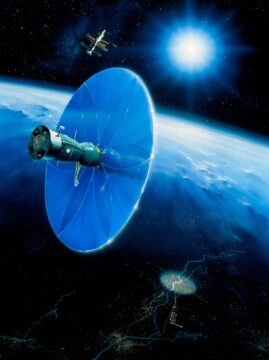 A start-up company wants to light up the night with 50,000 big mirrors orbiting Earth, bouncing sunlight to the night side of the planet to power solar farms after sunset, provide lighting for rescue workers and illuminate city streets, among other things.
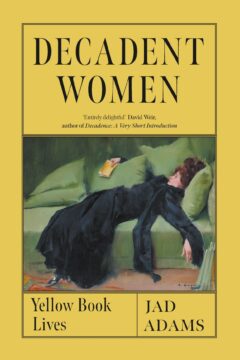 Jad Adams’s Decadent Women: Yellow Book Lives tells the story of the Yellow Book, a magazine that was “a force and famous” during the late nineteenth century in England. Here I quote writer-musician Elizabeth Pennell, who was associated with this magazine named for its signature hue. Scholars of Aestheticism and Decadence as well as historians and literary critics interested in late-Victorian culture more broadly have long recognized the centrality of this magazine for the period. Adams’s distinctive approach is to conceptualize his study of the Yellow Book as a group biography focused on the journal’s most courted contributor, the woman writer. In its best moments, this book brings a vibrant world to life, articulating in readable fashion the artistic and cultural mission that animated that world. Evelyn Sharp’s effusion—“I knew it was very heaven to be young when I came to London in the nineties”—captures the sense of novelty, wonder, and promise in the air that fueled the enterprise of this vanguard magazine. Aiming to people a world, Decadent Women explores the network of connections that sustained that world. Adams’s readers will learn about the lives and writings of individual authors, set in the intellectually vibrant milieu they inhabited. The first chapter of the book journeys back 130 years, focusing on the launch of the magazine in April 1894. We quickly come to appreciate the key involvement in the magazine of George Egerton, the “keynote” writer of the 1890s. We learn of the magazine’s backstory situated in early conversations among editor Henry Harland, publisher John Lane, and others.
 In 2023, mathematician Rafael Prieto-Curiel published a paper
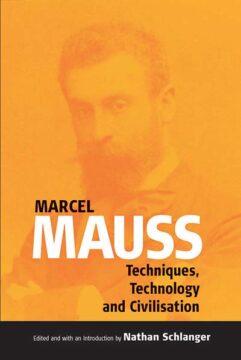 There is a problem that bathtubs pose to the designer, and ergonomics is one way in which designers have tried to address it. What constitutes the optimum bodily position in the bath? It seems that anthropologist Marcel Mauss might have been grappling with a related question in his 1934 essay “Techniques of the Body,” which envisioned a future, global “socio-psycho-biological study” of what might be called habits, gestures, and practices of the body. Sitting, standing, dancing, bathing, drinking — these habits enfold physiological, psychological, social, and sexual dimensions, at once natural and cultural, specific and vast. Read this way, Mauss anticipates a kind of social ergonomics, one that asks not only how bodies fit objects, but what bodies are doing and what kinds of social space they create.
 T
T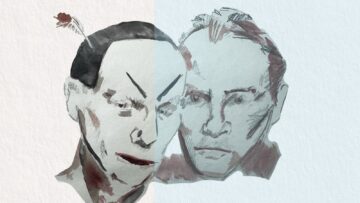 Before the author Klaus Mann was labeled a mongrel, a queer, a junkie, a communist, and in the curious judgment of the FBI, a “premature anti-Fascist,” he found himself tarred with perhaps the cruelest epithet of all: Dichterkind, they called him, the child of a poet. As with the celebrity offspring of our own era, the accident of his birth afforded the second of Thomas Mann’s six children — and the most keen to become a novelist himself — a measure of unearned fascination seasoned with resentment.
 Interest in an AI-driven approach to mathematics has been exponential, and many mathematicians have left traditional academic research to explore its potential. Recently, one group of distinguished mathematicians