
Enjoying the content on 3QD? Help keep us going by donating now.
Category: Recommended Reading
Sinti and Roma in German Erinnerungskultur
Sanders Isaac Bernstein at Cabinet Magazine:
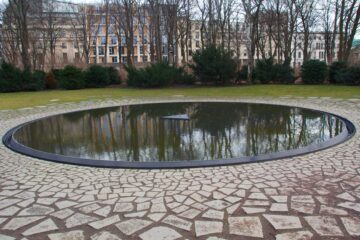
In the glade that is the Memorial to the Sinti and Roma of Europe Murdered under National Socialism, history seeks to enter memory. At the center of a grove of trees is a dark pool, reflecting the open sky as well as the looming face of the Reichstag. Surrounded by shattered stones inscribed with the names of sixty-nine sites where National Socialist Germany incarcerated and killed Sinti and Roma, the pool itself in turn surrounds a triangular island, the memorial’s center, on which rests a flower or two, unwilting.
Situated in the middle of Berlin, steps away from the Brandenburg Gate and across the street from the Reichstag, the memorial, sheltered by tall trees, feels a place apart. Its sounds and rhythms are distinct from the babbling frenzy of the city, seemingly distant. From the trees comes birdsong, and from invisible speakers a plaintive violin composition—“Mare Manuschenge” (Our people), composed for this site by Sinto violinist and politician Romeo Franz. Visitors who enter the memorial drift around its landscape.
more here.
Enjoying the content on 3QD? Help keep us going by donating now.
Thoughts on Traditional Marriage in the Age of Feminism
Wen Gao at The Common Reader:
 My husband and I, newlyweds of just one year, live an ordinary life. We drag each other to Costco on Saturdays, jointly complain about how much we hate a specific restaurant on the Delmar Loop, and endlessly debate the China and America relationship. Yes, he walks through the world with the undeniable privileges of a White American man. And yes, his “expert” insights into China often leave me caught between a laugh and a heavy sigh.
This is my seventh year living abroad on my own. Independence has been my practical necessity. Then came this marriage, and ever since I have been absorbed into a narrative I never signed up for. When I posted our courthouse wedding photos on social media, one online friend, perhaps with good intentions, left a comment: “If this is for the sake of making a living, I wish you luck.” Other responses were less generous. I was told I was being devalued by a pathetic courthouse wedding; I was brainwashed; I sold myself for a green card, and so on…. It is fascinating how people can extract an entire narrative of victimhood or greediness from a few photos.
More here.
Enjoying the content on 3QD? Help keep us going by donating now.
Man Ray’s Mock-Up For Électricité, 1931

A PUZZLING CONTRAPTION greeted visitors to New York’s Daniel Gallery in 1916: a wooden panel, bearing two bells at its top and a ringer at its base. Framed by painted f-holes, it suggested a musical instrument or a sounding apparatus; a raised handprint at center seemed to indicate its recent use. In fact, the work, appearing with the title Self-Portrait, refused to operate. The disjunction between the abstract composition and the notion of self-portraiture appeared perplexing in its own right; its inoperability only exacerbated the viewer’s frustration and redoubled the artist’s impish provocation.
A tiny photograph, currently on view in the Metropolitan Museum’s prodigious Man Ray survey, is all that remains of this since lost work. If its absence speaks obliquely to the Dadaist disregard for aesthetic permanence, its iconography—and its iconoclastic mordancy—echoes throughout his entire corpus. Again and again, we find enigmatic encounters between the mechanical and the erotic; a self-possessed symmetry intermittently upended by formal and conceptual incongruities; disembodied signs and silhouettes in place of integral figurations.
more here.
Enjoying the content on 3QD? Help keep us going by donating now.
Blank Canvas – a superb debut from a 22-year-old author
Rebecca Wait in The Guardian:
 Lies offend our sense of justice: generally, we want to see the liar unmasked and punished. But when the deception brings no material gain, we might also be curious about what purpose the lie serves – what particular need of their own the liar is attempting to meet. This is precisely what Grace Murray’s witty, assured debut explores: not just the consequences of a lie but the ways in which it can, paradoxically, reveal certain truths.
At a small liberal arts college in upstate New York, Charlotte begins her final year by claiming that her father has just died of a heart attack. In fact, he is alive and well back in Lichfield, England. This lie is the jumping-off point for an unpacking of Charlotte’s psychology, as well as the catalyst for her relationship with fellow student Katarina, a quasi-love story that forms the book’s main narrative.
More here.
Enjoying the content on 3QD? Help keep us going by donating now.
Donated Mitochondria Help Alleviate Nerve Damage and Pain in Mice
Andrea Lius in The Scientist:
 Fast-acting cells, such as sensory neurons, require a lot of energy to function, so they have a high demand for mitochondria. But how do these cells generate and maintain enough of these powerhouse organelles to sustain themselves?
Ru-Rong Ji, a pain researcher at Duke University, and his colleagues recently discovered that glial cells that surround sensory neurons play a critical role in this process: They transfer mitochondria to their neighbors.1 When the researchers blocked this process in mice, the animals experienced more nerve damage and pain. These findings, published in Nature, highlight mitochondrial transfer as a possible solution for treating chronic pain in humans.
More here.
Enjoying the content on 3QD? Help keep us going by donating now.
Thursday Poem
Reassurance
I must love the questions
themselves
as Rilke said
like locked rooms
full of treasure
to which my blind
and groping key
does not yet fit
and await the answers
as unsealed
letters
mailed with dubious intent
and written in a very foreign
tongue
and in the hourly making
of myself
the thought of Time
to force, to squeeze
the space
I grow into.
by Alice Walker
from Her Blue Body Everything We Know
Harcourt Books, 1991
Enjoying the content on 3QD? Help keep us going by donating now.
Wednesday, January 7, 2026
What if Chekhov Had Lived in Pakistan?
Dwight Garner in the New York Times:
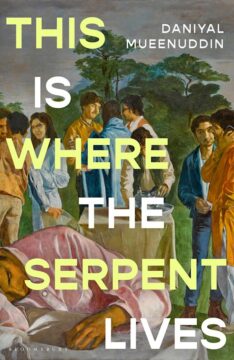 “The relation between the chauffeur and the chauffeured can be curiously intense,” Iris Murdoch wrote in “The Sea, the Sea.” This was true in David Szalay’s Booker Prize-winning novel “Flesh” (2025) and it is also true in Daniyal Mueenuddin’s sensitive and powerful first novel, “This Is Where the Serpent Lives,” set largely in rural Pakistan.
If Mueenuddin’s name sounds familiar, it’s because his first book, a collection of stories titled “In Other Rooms, Other Wonders” (2009) was a finalist for the National Book Award and the Pulitzer Prize. Its title echoed Truman Capote’s “Other Voices, Other Rooms” and its prose echoed Anton Chekhov’s in its spareness and sometimes oppressive sense that no hair was out of place. “I am constantly reading Chekhov,” Mueenuddin said in an interview. “I am never not reading Chekhov.”
More here.
Enjoying the content on 3QD? Help keep us going by donating now.
Nonhuman animals are also susceptible to magic tricks
Elias Garcia-Pelegrin, Alexandra K Schnell, Clive Wilkins, and Nicola S Clayton at the NIH:
 In recent years, scientists have begun to use magic effects to investigate the blind spots in our attention and perception [G. Kuhn, Experiencing the Impossible: The Science of Magic (2019); S. Macknik, S. Martinez-Conde, S. Blakeslee, Sleights of Mind: What the Neuroscience of Magic Reveals about Our Everyday Deceptions (2010)]. Recently, we suggested that similar techniques could be transferred to nonhuman animal observers and that such an endeavor would provide insight into the inherent commonalities and discrepancies in attention and perception in human and nonhuman animals [E. Garcia-Pelegrin, A. K. Schnell, C. Wilkins, N. S. Clayton, Science 369, 1424–1426 (2020)]. Here, we performed three different magic effects (palming, French drop, and fast pass) to a sample of six Eurasian jays (Garrulus glandarius). These magic effects were specifically chosen as they utilize different cues and expectations that mislead the spectator into thinking one object has or has not been transferred from one hand to the other.
More here.
Enjoying the content on 3QD? Help keep us going by donating now.
The Ridiculous Engineering Of The World’s Most Important Machine
Enjoying the content on 3QD? Help keep us going by donating now.
They tried to smear him as an antisemite – but Mayor Zohran Mamdani walks in a rich Jewish tradition
Molly Crabapple in The Guardian:
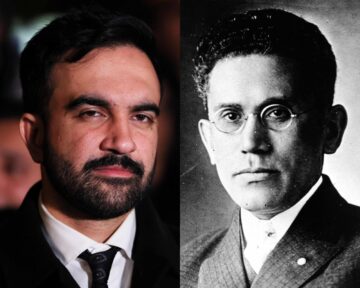
Billionaires raised fortunes against him. The president threatened to strip his citizenship. Mainstream synagogues slandered him as the spawn of Osama bin Laden and Chairman Mao. But today, Zohran Mamdani became the first socialist mayor of New York City.
For all the hysteria, when I look at Mamdani, I didn’t see some radical departure from the past. I see him as the heir to an old and venerable Jewish tradition – that of Yiddish socialism – which helped build New York.
In some cases, the link is direct. Bruce Vladeck, a member of one of Mamdani’s transition committees, is a well-respected expert on Medicare, but for the sake of this article, his credentials matter less than his surname.
Vladeck is the grandson of Baruch Charney Vladeck, a Marxist troublemaker from the Pale of Settlement, a tract of land in the Russian empire where Jews were permitted to live at a time of rampant antisemitic oppression.
More here.
Enjoying the content on 3QD? Help keep us going by donating now.
Object-Oriented Ontology and the Nature of Reality with Graham Harman
Enjoying the content on 3QD? Help keep us going by donating now.
On Fascist Passions in Mussolini’s Italy
Tia Glista at LitHub:
 A squad of amateur fascists feast around a table at a busy restaurant, their eyes flicking from their meal toward a crowd across the room, and then to their de facto leader, a balding 35-year-old newspaper man. They practically hover above their chairs, panting, licking their lips, gripping their glasses of wine instead of drinking from them: they are poised for something else, and so they check in again with their boss, whose curt nod gives them assent to take action. They leap up, bludgeon the other men with batons and kick them repeatedly; a few days later, they perform a similar attack on the headquarters of the socialist newspaper L’Avanti, smashing their equipment, stabbing their workers, lighting people and things on fire. The year is 1919 and the man who leads the squadrismo is Benito Mussolini.
When watching Mussolini: Son of the Century, the new mini-series directed by Joe Wright and based on the 2018 novel by Antonio Scurati, it was not the fact of the violence that surprised me so much as the extent of its heedlessness—the open, unreserved character of the cruelty inflicted on others in public without remorse.
more here.
Enjoying the content on 3QD? Help keep us going by donating now.
Wednesday Poem
A Ghazal of Mangoes
Summertime, our kitchen counters spill with mangoes:
himsagar, hapus, chausa, langra, and other mangoes.
……
Ma and I, we ride on a rickshaw to Gariahat baazaar,
where vendors sell cratesful of plums, lichis, and mangoes.
……
Ma squeezes the fruits tenderly to learn if they are plump.
Her saree is block-printed with paisleys, upturned mangoes.
……
Later, I slip into my boyfriend’s flat. In his drawing room
hangs a silk painting: Nur Jahan in an orchard of mangoes.
……
He says he wants to end things, and my throat tightens
like I’ve swallowed hard, fibrous pits of ripe mangoes.
……
In Kyasapura, a farmer shields his eyes, surveys his trees.
He grows badami: Karnataka’s prized alphonso mangoes.
……
This year, the rain from the cyclone has ruined his yield.
His hopes shrivel up and drop off like blighted mangoes.
……
One Sunday, after Math class, my tutor offers me tea:
cha and sondesh—crumbled cheese and pureed mangoes.
……
He asks me to wait after the other pupils leave. He offers
me a long hug, says my breasts are firm like mangoes.
……
Bhavi, do you remember what Ma said? A woman gives
up a part of herself if she chooses to go where a man goes.
……
up a part of herself if she chooses to go where a man goes.
……
The Complete Notebooks By Albert Camus
Joanna Kavenna at Literary Review:
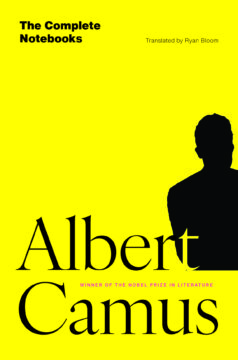 There’s a surreal television interview with Camus at the Parc des Princes stadium in Paris, during a football match between Racing Club de Paris and AS Monaco. It’s 1957 and Camus has recently won the Nobel Prize. The interviewer asks for a few thoughts from Camus on why he won. ‘Well, I don’t know,’ says Camus. ‘I’m not privy to the secrets of the Swedish Academy. But there are two or three writers who deserved the prize before me.’ He’s also invited to criticise the Racing Club goalkeeper. A former goalkeeper himself (for the Racing Universitaire d’Alger), Camus says, ‘Don’t blame him. If you were out there in the middle you’d realise how difficult it is.’ Notable aspects of this interview are: Camus’s diffident charm, how he never stops watching the game, how he seems more interested in football than in speaking of the Nobel. The same wry, self-deprecating tone courses through his notebooks, the same natural gift for aphorisms. The notebooks were published in French between 1962 and 1989; previous English translations have appeared, including by Philip Thody. Now, they have been published for the first time in a single volume, beautifully translated by the author and scholar Ryan Bloom.
more here.
Enjoying the content on 3QD? Help keep us going by donating now.
Tuesday, January 6, 2026
The literary remix trend comes for Moby-Dick — and it’s a triumph
Leanne Ogasawara at the Los Angeles Times:
 “Call me Ishmael.”
Considered one of the greatest opening lines in all of literary history, it must have been almost irresistible for the acclaimed novelist Xiaolu Guo to resist using it for the title of her 2025 retelling of the world’s most famous whale tale, “Moby-Dick”. But Guo makes a major change; for in her story, the young and sometimes gloomy male protagonist has been transformed into an adventurous young woman.
This has been such a great few years for retellings of the classics — from Barbara Kingsolver’s updated David Copperfield to Salman Rushdie’s zany Don Quixote. And Percival Everett’s novel “James,” a retelling of Huckleberry Finn, took the lion’s share of the literary prizes in 2024, including the Pulitzer. There is so much pleasure to be had in rereading old favorites — and part of the joy is meeting beloved characters, who have been updated or somehow arrive in a new form to resist old tropes and types.
Guo’s recasting of Ishmaelle is no exception.
More here.
Enjoying the content on 3QD? Help keep us going by donating now.
It is our moral duty to strike back at the Universe
Drew M Dalton in Aeon:
 Reality, as we now understand, does not tend towards existential flourishing and eternal becoming. Instead, systems collapse, things break down, and time tends irreversibly towards disorder and eventual annihilation. Rather than something to align with, the Universe appears to be fundamentally hostile to our wellbeing.
According to the laws of thermodynamics, all that exists does so solely to consume, destroy and extinguish, and in this way to accelerate the slide toward cosmic obliteration. For these reasons, the thermodynamic revolution in our understanding of the order and operation of reality is more than a scientific development. It is also more than a simple revision of our understanding of the flow of heat, and it does more than help us design more efficient engines. It ruptures our commonly held beliefs concerning the nature and value of existence, and it demands a new metaphysics, bold new ethical principles and alternative aesthetic models.
More here.
Enjoying the content on 3QD? Help keep us going by donating now.
Progress made on AI-powered humanoid robots
Enjoying the content on 3QD? Help keep us going by donating now.
Where does a liberal go from here?
Noah Smith at Noahpinion:
 Imagine, then, standing in 1815, a quarter century after the Revolution, looking back at what it had all become. That first bright rush of freedom had given way, first to the murderous insanity of the Terror and the Committee for Public Safety, then to the thuggish new imperialism and endless bloody wars of Napoleon, and finally to the fall of all Europe to conservative reaction under the Congress of Vienna. Imagine looking back on the arc of your beliefs, your movement, and your life, now as an old man, with no prospects for another, better Revolution ahead of you.
Would you think your dreams had failed? Would you decide that everything you had believed had been an illusion, and that freedom, democracy, and the Rights of Man were false idols that led only to chaos and bloodshed?
If so, you would be utterly wrong. The two centuries after 1815 would see the ideals of the early French Revolutionaries continue to advance across the world — unevenly, in fits and starts, and with many reversals, yet almost always leaving society better off than before.
More here.
Enjoying the content on 3QD? Help keep us going by donating now.
Satie’s Spell
Jeremy Denk at the NYRB:
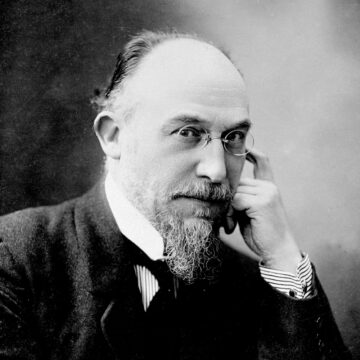 What is the point? is of course one of the main points of Satie. You don’t get the same sensation, for instance, listening to The Rite of Spring, Salome, Wozzeck, or Pierrot lunaire. As shocking or boundary-testing as those modernist masterpieces may be, they all have a point, and they work. They offer dramatic shapes, vectors, formal conceits; they expose sharp contrasts or conflicts. Mostly, Satie’s pieces don’t work in those ways, and they leave the question of a point open at best.
So how exactly does Satie take down the arrogance of late Romantic classical music? Consider the Sarabandes, Satie’s first suite of dances, from September of 1887. They begin with three lubricious seventh chords. The last, a chord that “should” lead forward, sits and lingers in the air. We hear five more chords, full of branching possibilities—but end up in the same place. This feels a bit neutralizing, if not yet frustrating. The third phrase travels more purposefully, and we soon arrive at an A major chord—a normal triad. But it’s notated on the page as arcane B-double-flat major, making it hard to read and even more irritating to write about. (A trivial distinction that also screws with your head is a perennial Satie combination.) This is the first of many arrivals sprinkled about the score, an abundance of goals that paradoxically don’t produce a sense of direction.
more here.
Enjoying the content on 3QD? Help keep us going by donating now.