Peter Conrad in The Guardian:
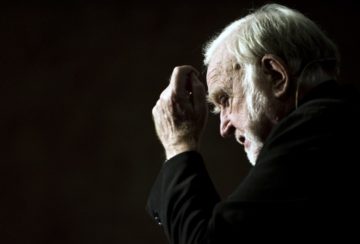
 Norman Mailer – when not boozily brawling, dosing himself with hallucinogenic drugs and serially fornicating – was a man with a sacred mission. He regarded himself as a prophet, bringing bad news to a society that had settled into consumerist complacency during the 1950s. Americans believe that they live in God’s own country; Mailer alerted them to “the possible existence of Satan”, who might be residing next door and quietly assembling a private arsenal for use on Judgment Day. Although Mailer looked up at the sky with “religious awe”, what he saw there was a mushroom-shaped cloud that he called “the last deity”. Humanity, he declared, was reeling towards self-destruction. Now that his centenary has arrived (he was born 31 January 1923), I dare anyone – and that includes Richard Bradford, the author of this sensationalised canter through his life – to say that he was wrong.
True, Mailer was an obnoxious loudmouth. In episodes that Bradford documents with slavering relish, he conducted literary disputes by butting his colleagues: “Once again words fail you,” drawled the coolly disdainful Gore Vidal after one such attack.
Domestically, Mailer was a wife-beater and almost a murderer: taunted as a “faggot” by the second of his six spouses, he stabbed her with a penknife at a drunken party, just missing her heart. After an early infatuation with President Kennedy, whose fatal ride through Dallas in an open car he applauded as a moment of existentialist bravado, his politics lurched towards fascism. He commended Hitler for providing Germans with an outlet for their “energies”, although – as a man who bragged about his own bulbous, fizzily fertile “cojones” and the indefatigable piston of his penis – he pitied the Führer for possessing only one testicle and having to rely on masturbation.
More here.
 It was an uncomfortable moment for people who perform colonoscopies. In October, a massive randomized clinical trial in Europe presented its initial results
 My exultant “Ha!” woke the library. I had just read Mihaly Csikszentmihalyi’s definition of “flow”—that magical feeling of getting so caught up in what you are doing that you lose track of where you are, what time it is, who might want something of you. I knew that feeling, and I craved it. Freed from space and time, oblivious to chores and deadlines, I could think and breathe and imagine. These bursts of oblivion drove everybody around me crazy, of course. I re-entered the world in a daze and had to scramble back into task-mind. But I came back refreshed and happy.
 In the four years since an experiment by disgraced scientist He Jiankui resulted in the
  Biologist Paul Ehrlich is one of the most discredited popular intellectuals in America. He’s so discredited that
  Soon after Kenneth Roth announced in April that he planned to step down as the head of Human Rights Watch, he was contacted by
  During the early stages of my father’s Alzheimer’s, when he still had lucid moments, I apologized to him for writing an autobiography many years earlier in which I flung open the gates of our troubled family life. He was already talking less at that point, but his eyes told me he understood. I thought of that moment when I read that Prince Harry, in his new memoir, wrote about his father, King Charles, getting between his battling sons and saying, “Please, boys, don’t make my final years a misery.” Time is an unpredictable thing. What will someone’s last memory be? I had the gift of time with my father, which allowed me to apologize, even though a disease hovered between us and clouded our communication. King Charles’s words reveal a man who is aware of his mortality and who would like his offspring to be aware of it as well.
 I belong to that portion of humanity—a minority on the planetary scale but a majority I think among my public—that spends a large part of its waking hours in a special world, a world made up of horizontal lines where the words follow one another one at a time, where every sentence and every paragraph occupies its set place: a world that can be very rich, maybe even richer than the nonwritten one, but that requires me to make a special adjustment to situate myself in it. When I leave the written world to find my place in the other, in what we usually call the world, made up of three dimensions and five senses, populated by billions of our kind, that to me is equivalent every time to repeating the trauma of birth, giving the shape of intelligible reality to a set of confused sensations, and choosing a strategy for confronting the unexpected without being destroyed.
 Zoé Samudzi in Jewish Currents:
 A conservative review of Kenan Malik’s Not So Black and White by Sohrab Amarhi in Unherd:
 Daniela Gabor and Ndongo Samba Sylla in Boston Review:
 Herman Mark Schwartz in Phenomenal World:
 Cormac McCarthy had provided me with a context, even a language, to internalize the things I saw and cannot unsee. Segments of human beings were stacked along the road between the smoking-bombed-out war machines.
 C
C