
“A 22-year-old Iranian woman died after being arrested for allegedly violating strict hijab rules — sparking protests against the Islamic Republic’s morality police.” —NY Post
Moan of the Mirror (Ahe Ayeneh)
Digging in the pit,
her family knew it was her
by her long hair.
O earth –
is this the same innocent body?
Is a woman only this pile of dirt?
She used to comb
the treasure of her hair,
and braid beyond the mirror frame
the wind of her thoughts.
She used to greet in the morning, ‘Salam!’
And her smile would pick a flower
from the reflection.
Lifting her hand to her temple
she would brush the night aside
to reveal
the sun in the mirror.
Her mind would wake on the rising day,
a rain of stars shaken loose
from the sky of her eyes,
then that sweet smile
would open a door through her reflection
onto the sun-garden of her soul.
Thieves have blinded the mirror
by stealing those eyes
from the sill of morning.
Oh you – burnt youth –
the ash of spring!
Your image has flown away from the empty mirror.
Holding the memory of your long hair
the mirror moans in the hanging dust of morning.
Birds in the garden sing for no reason.
This is no occasion for bloom.
by H.E. Sayeh
from Poetry International
Translated from the Farsi by
Chad Sweeney and Mojdeh Marashi
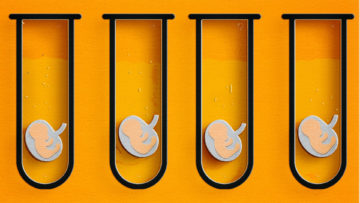 In August 2022, two research groups published papers in
 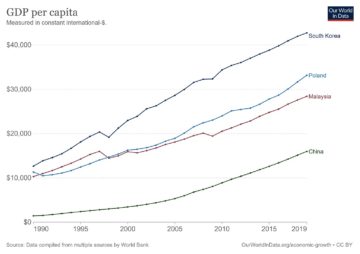 The generally acknowledged development champion of the modern world is South Korea. Joe Studwell, the author of
 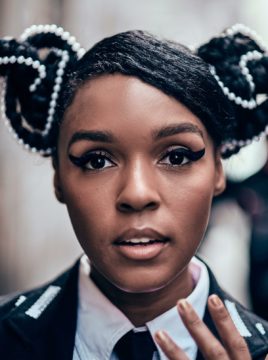 So who is Janelle Monáe? Since she emerged on the music scene, she’s been less a pop star than a world-builder, refracting herself through sci-fi and Afrofuturist imagery. Her first EP, “Metropolis: The Chase Suite,” from 2007, drew on Fritz Lang’s German Expressionist classic and cast Monáe as her android alter ego, Cindi Mayweather. With her tuxedos and protruding pompadours, she was a glam retro-futurist androgyne, and her three studio albums—“The ArchAndroid” (2010), “The Electric Lady” (2013), and “Dirty Computer” (2018)—leaned into her funk-robot persona. “I’m a cyber-girl without a face, a heart, or a mind,” she sang on one track. Monáe used Mayweather and other spinoff characters as metaphors for her sense of otherness, as a queer Black woman from Kansas City, Kansas. (In 2018, she came out as pansexual, and last April revealed herself to be nonbinary; she uses she/her or they/them pronouns but says that her preferred pronoun is “freeassmuthafucka.”) Monaé’s forty-eight-minute
  How does an Oxford academic follow up a prize-winning trade book, a newly researched biography of Geoffrey Chaucer? And, moreover, in lockdown, when archives and libraries are largely inaccessible? Marion Turner, the newly elected J R R Tolkien Professor of English Literature and Language at Oxford, has avoided ‘second-book syndrome’ with a breathtakingly simple idea: a biography of Chaucer’s most famous character, Dame Alison (or Alice), weaver, pilgrim, businesswoman and serial participant in the marriage market, better known as the Wife of Bath. Informative, clear-sighted, entertaining and as opinionated as its subject, Turner’s new book is a wonderful introduction to the lives of 14th-century women, The Canterbury Tales and the fascinating ways in which Alison has been read and misread since she first hoisted up her voluminous skirts to show her fine red stockings during the last decade of the 14th century.
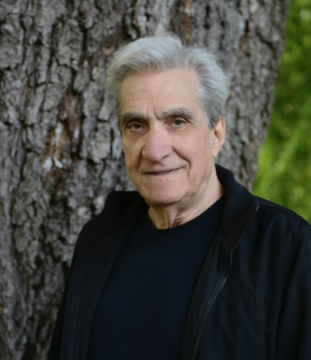
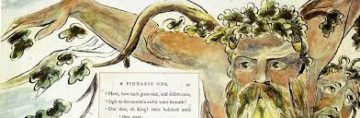 Something was in the water in Austin. In the 1960s, a gang of classics scholars and philosophy professors had rolled into town like bandits, the University of Texas their saloon: William Arrowsmith, chair of the Classics Department, who scandalized the academic humanities with a Harper’s Magazine essay titled “The Shame of the Graduate Schools,” arguing that “the humanists have betrayed the humanities” and that “an alarmingly high proportion of what is published in classics—and in other fields—is simply rubbish or trivia”; John Silber, promoted to dean of the College of Arts and Sciences just ten years after graduating from Yale, who promptly replaced twenty-two department heads, much to the ire of the university’s board; and a third, an unassuming former radio broadcaster from the United Kingdom with a knack for classical languages and only a master’s degree to his name.
 H
H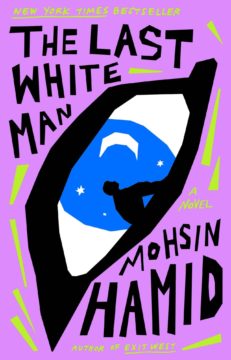 The anonymous setting of Mohsin Hamid’s 2022 novel The Last White Man brings with it a certain comfort. The British Pakistani author’s lack of specificity is purposeful: dropped into a nameless town in an unknown country, the reader has no cultural touchstones to grab onto, no societal baggage to carry. The blank slate leaves just one aspect to focus on, which Hamid homes in on with his first line: “One morning Anders, a white man, woke up to find he had turned a deep and undeniable brown.” This succinct statement of fact — a rarity in the novel — establishes the binary law of the land: you’re either white or dark, no in-between.
 When clinical trial data for the antiviral drug Paxlovid emerged in late 2021, physicians hailed its astonishing efficacy — a reduction of nearly 90% in the risk of severe COVID-19. But more than a year later, COVID-19 remains a leading cause of death in many countries, and not only in
  During the three decades that I headed Human Rights Watch, I recognized that we would never attract donors who wanted to exempt their favorite country from the objective application of international human rights principles. That is the price of respecting principles.
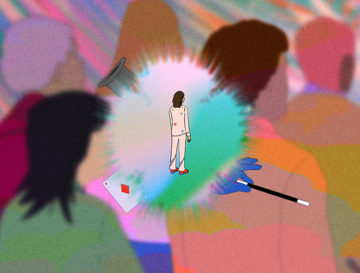 ILLUSION AND REALITY
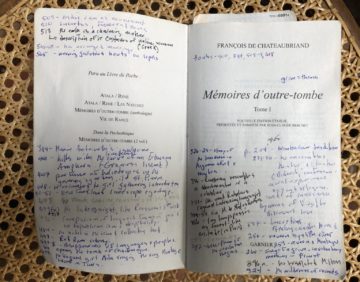 Chateaubriand says that the pleasures of youth revisited in memory are ruins seen by torchlight. I don’t know whether I’m the ruin or the torch.
 N
N