
Jesse Robertson in The Baffler:
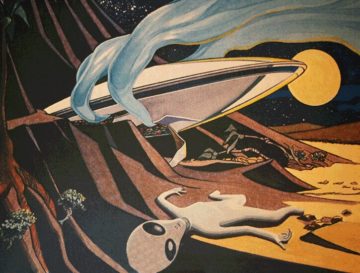 A CLASSIFIED REPORT from the Office of the Director of National Intelligence on “unidentified aerial phenomena” (UAP), or UFOs in Pentagon-speak, analyzed 366 sightings. It included videos shot by Reaper drones depicting anomalous orbs and close encounters between Navy F-18 fighter pilots and objects that defied the known laws of physics. Only half of them could be explained. Delivered to Congress on October 31, 2022, the briefing was a follow-up to the June 2021 “Preliminary Assessment: Unidentified Aerial Phenomena.” The takeaways were hazy at best, underscoring that UAP “may pose a challenge to U.S. national security” and that further investment in research and development was necessary. While these investigations seemed to mark a shift in the government’s willingness to take UFOs seriously, they were hardly the revelatory disclosure UFO enthusiasts had long pined after.
More here.
 In the 1970s and ’80s, many American Jews backed pro-Israel interest groups in Washington, D.C., which quickly gained resources and political influence. By the late 1990s most Jewish leaders not only embraced Israel for the country’s sake but also believed that supporting Israel was key to the survival of U.S. Jews—the largest diaspora Jewish community. Since 1967 Israel’s centrality to Jewish identity has only deepened. The most obvious manifestation is the Birthright program, which was launched in 1999 and has since brought more than 800,000 young American Jews on entirely free ten-day or two-week trips to Israel, with many of its participants visiting the country for the first time. This year the State of Israel celebrates its seventy-fifth anniversary, marking less than a century of existence during which the country has shifted profoundly. Israel is now the most powerful state in the Middle East. Not only is it independent, wealthy, and nuclear-armed, it is also embraced by many Jewish cultural, political, and religious organizations around the world.
 The neocortex stands out as a stunning achievement of biological evolution. All mammals have this swath of tissue covering their brain, and the six layers of densely packed neurons within it handle the sophisticated computations and associations that produce cognitive prowess. Since no animals other than mammals have a neocortex, scientists have wondered how such a complex brain region evolved.
 We live in an age in which in most societies there is a moral abhorrence of racism, albeit that in most, bigotry and discrimination still disfigure the lives of many. We also live in an age saturated with identitarian thinking and obsessed with placing people into racial boxes. The more we despise racial thinking, the more we seem to cling to it.
 Most of us strive to be good, moral people. When we are doing that striving, what is happening in our brains? Some of our moral inclinations seem pretty automatic and subconscious. Other times we have to sit down and deploy our full cognitive faculties to reason through a tricky moral dilemma. I talk with psychologist Molly Crockett about where our moral intuitions come from, how they can sometimes serve as cover for bad behaviors, and how morality shapes our self-image.
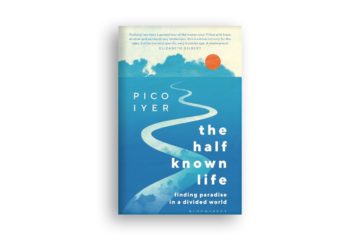 After 50 years of globetrotting, the celebrated travel writer Pico Iyer asks himself whether it is possible to find paradise in a violent, fragmented world. In pursuit of an answer, he stitches together a selection of his trips to beautiful, troubled spots, including Jerusalem and Kashmir, for his latest book. At first, his enquiry seems too wide and too vague. Iyer’s disparate writings on Iran, Israel and Australia only scratch the surface of the problems in each country, while “paradise” itself is defined too broadly. The author’s visit to Broome, a remote town hundreds of miles from Perth, is especially lacking in depth: interesting snippets about, for example, the effect of the 19th-century pearl boom on its Aboriginal community, do not receive further investigation.
 Tom played an incredibly important role in the history of modern cinema. Back in the 1970s, Tom was part of a counterculture generation who saw something new in the arthouse films being made in Europe. To him they were radical in a completely new way. They could change the world. Culture could be political.
 Rob Reid in Ars Technica:
 Claudia Dreifus in The Nation:
 Herman Mark Schwartz in Phenomenal World:
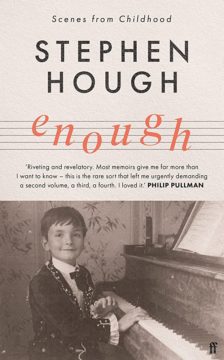 “A writer is God,” says Hough admiringly, thinking of God – he is a Catholic convert – rather than claiming godlike powers for himself. He then quotes the Bible on the word being made flesh as “an idea floating in the air is caught, a concept becomes carnal”. The piano leaves ideas afloat, airily uncatchable: Hough’s book describes “the liquid lasso” of a stone thrown into a pond in Debussy’s Reflets dans l’eau, and in the notes to his recent recording of Federico Mompou’s Música Callada he remarks that these brief, whispery religious meditations evaporate as they are played. Defying the monochrome abstraction of the keyboard, Hough always sets himself to make sounds tell stories without words. In his reimagining, Tippett’s Piano Concerto proceeds from an orchestral rumbling “under the soil of the earth to the tinkle of arpeggios tracing a delicate tune above the treetops”.
 Leaders in the U.S. scientific community must dismantle the power structures that lead to racial inequities within their organizations and create an environment in which everyone feels supported,
 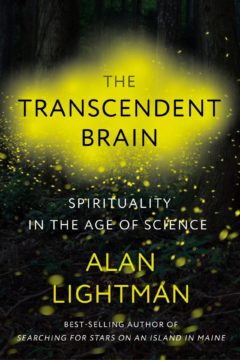 When did you begin on the project of reconciling a scientific worldview with human experience?
 Black actresses have always faced barriers. Initially, they were not allowed to be on screen at all. Then, they could only play certain types of roles: typically either as a servant and/or enslaved woman, or as an “exotic” temptress. Never a character that was fully realized, one with depth or nuance.