
Anthony Lane in The New Yorker:
 Trying to sort out who is who, and what everybody wants, is no easy task in “Joyland,” a début feature from the Pakistani director Saim Sadiq. In Lahore, a woman named Nucchi (Sarwat Gilani), who already has three daughters, remarks that her water has broken; she might as well be announcing that dinner is served. For the birth of her fourth child, she is ferried to hospital on the back of a moped driven by Haider (Ali Junejo), whom we take to be her husband. Not so. He is, in fact, the brother of her husband, Saleem (Sameer Sohail). Haider is married to Mumtaz (Rasti Farooq); they have no offspring, to the dismay of his aged father, known as Abba (Salmaan Peerzada). All of the above inhabit one household. It’s not a peaceful place, or an especially happy one, but it’s home.
That home is worth dwelling on, for it feels like a book of short stories. Not for a while—not, perhaps, since Greta Gerwig’s “Little Women” (2019)—have I been struck by so potent a sense of place. The daily routine revolves around a central courtyard, where Abba, a widower in a wheelchair, presides. “My family has lived here since before Partition,” he says. Space is tight, and one of the little girls often shares a bed with Haider and Mumtaz. The air-conditioning breaks down. (Power outages are frequent across the city, and some scenes are illuminated by cell-phone flashlights.) The fabric of the film is a weaving of new and old; we hear talk of Netflix subscriptions, yet one shot, of an open doorway, has the pious composure of a Pieter de Hooch interior, from seventeenth-century Holland, and the plot begins, if you please, with a goat being slaughtered in the courtyard. Blood pools darkly on the tiled floor.
More here.
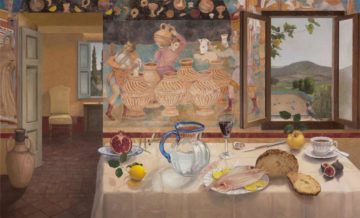 “Barbara Kassel”s evocative paintings explore the passage of time. From her loft in New York City, she paints interior and exterior views, creating a visual diary of daily life. Working with oil on panel, the smooth surfaces are meticulously rendered serene scenes. Warm reds and yellow embrace cooler blues and grays and invite the viewer into the large-scale works. Kassel describes the paintings in part biographical and instinctually narrative. Carefully exploring the world around her, she mixes observation and invention as she captures fleeting moments in time.”
 Jacob Browning and Yann Lecun in Noema:
 David Van Reybrouk in Noema:
 Daniel Bessner in Boston Review:
 Max Krahé in Phenomenal World:
 I
I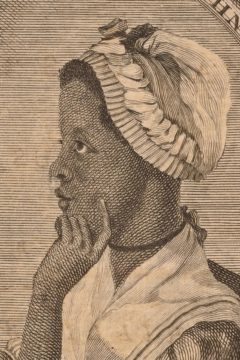 It’s a testament to Black endurance and brilliance that the little girl called Phillis Wheatley became, within 12 years of her arrival in Boston, the most significant African American poet of the 18th century. Yet, as
  John Muir and Robert Underwood Johnson were unlikely allies in the war to preserve
 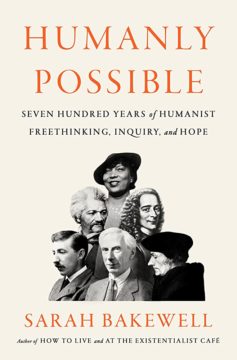 “I am human, and consider nothing human alien to me”: The famous line from the Roman playwright Terence, written more than two millenniums ago, is easy to assert but hard to live by, at least with any consistency. The attitude it suggests is adamantly open-minded and resolutely pluralist: Even the most annoying, the most confounding, the most atrocious example of anyone’s behavior is necessarily part of the human experience. There are points of connection between all of us weirdos, no matter how different we are. Michel de Montaigne liked the line so much that he had the Latin original — Homo sum, humani nihil a me alienum puto — inscribed on a ceiling joist in his library.
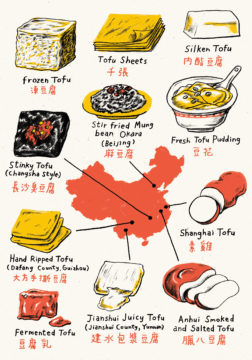 Guiyang didn’t have many restaurants, per se. The metropolis was more of a city-wide night market. Even in the pre-COVID days, streets like Qingyun Road were only half-filled with cars, to leave room for tents and tables that stretched to the horizon, and for smoke and steam that rose into the clouds. Eateries didn’t burden you with 14-page menus, common at Shanghainese or Northeastern restaurants. No — a làoguō 烙锅 shop sold laoguo (think Korean BBQ with more vegetables, cooked over a clay pot dome). A sīwáwa 丝娃娃 shop sold siwawa (shreds of 20-plus varieties of fresh and pickled vegetables that you roll into a thin, rice cake-like taco). And tofu stands sold tofu. But probably not the tofu you’re thinking of.
 There’s now an
  Just before Christmas, federal health officials confirmed
 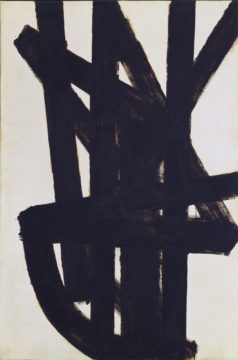 I’ve found myself thinking a lot about that epigraph in the wake of two back-to-back events this past October. One was Soulages’s death at age 102, the other a visit to the monographic room recently devoted to Pierrette Bloch (1928–2017) at the Musée d’Art Moderne de Paris (MAM). Comprising eight objects from between 1974 and 1999, all belonging to the museum’s permanent collection, the focused presentation offered a welcome opportunity to think broadly about a singularly poetic body of work exhibited regularly in Europe but rarely in the US. Particularly in the wake of Soulages’s death, however, it also invites fresh consideration of the two artists’ longtime dialogue. Introduced in 1949 by Bloch’s art professor Henri Goetz, the pair were friends for nearly seven decades, and their lives and oeuvres were closely intertwined. Early in her career, Bloch used a spare room in Soulages’s house as her studio, and each collected work by the other. Slightly older than the artists of Supports/Surfaces but avowedly attentive to their investigations, Bloch developed a similarly expanded practice of painting, moving beyond the stretched canvas support to engage a broad array of nontraditional and often notably humble materials. Her work brilliantly illuminates both the fecundity and the limits of the “materiological” Soulages brought to the fore through Segalen’s striking image of signs woven in stone.