
Sarah Rose Sharp at Hyperallergic:
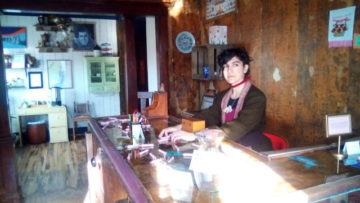 Nothing really prepares one for the experience of entering the Huckleberry Explorer’s Club (HEC), a small museum in a duplex in Detroit’s burgeoning Core City neighborhood whose ground floor houses a general store full of secondhand oddities for sale at throwaway prices…. One of the items on display is a wedding ring that Golberg discovered inside a desk she found on a street in Brooklyn. An inscription on the ring reads, “Steven and Julie” with the date February 12, 1988.
“I just felt so moved by this object, thinking through all of the different possible scenarios as to how that ring got to be inside the desk; it felt like this object had so much aura around it,” Golberg said. “More and more as I started, these sorts of things came into my life, and it wasn’t just about the things themselves or the picture [she took], but the relationship between two of us. It was kind of like I was marrying this moment.”
Golberg began marking her objects with little tags that offer context, dates, or adjacent experiences.
more here.
 Last August, the author
  For the last 60 years or so, science has been running an experiment on itself. The experimental design wasn’t great; there was no randomization and no control group. Nobody was in charge, exactly, and nobody was really taking consistent measurements. And yet it was the most massive experiment ever run, and it included every scientist on Earth.
 Many opponents of Netanyahu’s judicial overhaul have called for Israel to finally draft a constitution, but any serious attempt will mean choosing between a democratic state and one that privileges Jewish citizens above all others.
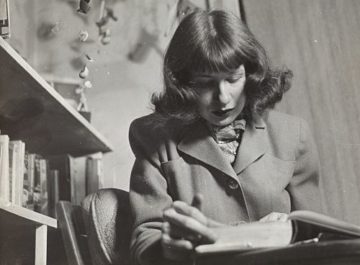 “She had no sympathy,” Spiegelman tells us, “for people who paraded their inner misfortunes.” Clampitt’s dismissive attitude toward the self-indulgences of confessional verse, which commanded so much attention in the 1960s and 1970s, was a product, he writes, of “her stern midwestern upbringing.” And her models: Hopkins,
  One morning in Maine, soon after dawn, I stood by the ocean just as a light fog began moving in. The rising sun became a gauzy fire. Suddenly, the air started to glow. Fog scattered the sunlight, bounced it around and back and forth until each cupful of air shone with its own source of light. In all directions, the air beamed and shimmered and glowed, and the gulls stopped their squawking and the ospreys became quiet. For some time, I stood there spellbound by the silence and the glowing air. I felt as if inside a cathedral of sunlight and air. Then the fog burned away and the glow disappeared.
 The federal raid on the Branch Davidian compound, thirty years ago, was flawed from the start.
 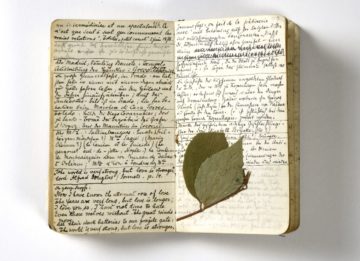 What is it about Rainer Maria Rilke? The influence of the Bohemian Austrian poet on modern culture reads like a who’s who of the great and the good. W. H. Auden, Cecil Day-Lewis, and Edith Sitwell claimed to be directly inspired by him. The first English translations of his work, published by Leonard and Virginia Woolf’s Hogarth Press, became classics in their own right. He has been set to music (both classical and rock) and proven himself a Hollywood touchstone, most recently providing the
  As I’ve mentioned before, economist, blogger, and friend Bryan Caplan was
  I hate preaching to the converted. If you were Buddhists, I’d
 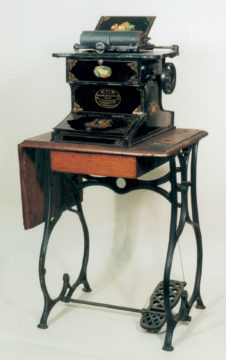 Twain bangs the keys—swiftly. For Remington’s levers, links, and triggers had made the typewriter resemble in kinetic spirit a kind of machine gun. Making writing rapid-fire, Remington turned a rather staid and quiet activity—writing—into one dominated by force and noise and physical effort. Sharp, metal characters smashed themselves against a platen, hitting with enough percussive force so that each letter impressed itself deeply into the paper. By 1881, with the introduction of the Remington II, a faster machine than its predecessor, sales exploded. From 1881 to 1890, typists increased in number from 5,000 to 33,400; and by 1900, according to census figures, America could boast 112,600 typists and stenographers. A good typist developed a distinctive rhythm, clacking out line after continuous line. A truly fast typist commanded attention. And respect. And sometimes even suspicion. At the Rosenberg spy trial, in 1952, the prosecuting attorney sharpened the government’s case against Ethel Rosenberg by asking the jury to visualize the female, Jewish suspect sitting behind her typewriter, “hitting the keys, blow by blow, against her own country in the interest of the Soviets.”
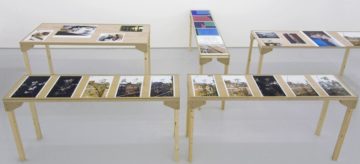 EACH PHASE of research-based art presents a different understanding of what constitutes knowledge and a different approach to spectatorial labor. In the first phase, the artist invites the viewer to piece together parts from the materials provided to form their own historical narrative and to experience in their bodies and minds the complexity of a given (usually counterhegemonic) topic. Knowledge aspires to be new knowledge. In the second phase, the viewer listens to or reads a narrative crafted by the artist. Facts may be partly fictionalized, but there remains a sense of correcting or enhancing history, often through a counter- or micronarrative. The third phase returns the viewer to sifting through information, albeit now in a formal, less interactive mode. Knowledge is the aggregation of preexisting data, and the work accordingly invites meta-reflection on the production of knowledge as truth. In each case, though, despite creating the look or atmosphere of research, artists are reluctant to draw conclusions. Many of these pieces convey a sense of being immersed—even lost—in data.
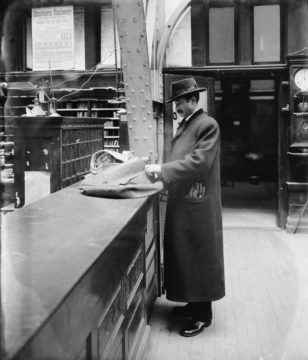 When the London newspaper the Athenian Mercury, edited and published by the author and bookseller John Dunton, first answered questions about romance, bodily functions, and the mysteries of the universe in 1691, it may have created the template for the advice column. But the history of advice stretches back even further into the past. Advice—whether unsolicited, unwarranted, or desperately sought—appears in ancient philosophical treatises, medieval medical manuals, and countless books. Lapham’s Quarterly is exploring advice through the ages and into modern times in a series of readings and essays.
 One of the most astonishing passages in the Talmud, a book chock-full of astonishing passages, gingerly asks the question at the core of every single human pursuit: What, precisely, is the meaning of life?