McKenzie Prillaman in Nature:
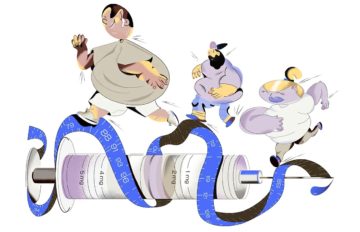 The hotel ballroom was packed to near capacity with scientists when Susan Yanovski arrived. Despite being 10 minutes early, she had to manoeuvre her way to one of the few empty seats near the back. The audience at the ObesityWeek conference in San Diego, California, in November 2022, was waiting to hear the results of a hotly anticipated drug trial. The presenters — researchers affiliated with pharmaceutical company Novo Nordisk, based in Bagsværd, Denmark — did not disappoint. They described the details of an investigation of a promising anti-obesity medication in teenagers, a group that is notoriously resistant to such treatment. The results astonished researchers: a weekly injection for almost 16 months, along with some lifestyle changes, reduced body weight by at least 20% in more than one-third of the participants1. Previous studies2,3 had shown that the drug, semaglutide, was just as impressive in adults.
The presentation concluded like no other at the conference, says Yanovski, co-director of the Office of Obesity Research at the US National Institute of Diabetes and Digestive and Kidney Diseases in Bethesda, Maryland. Sustained applause echoed through the room “like you were at a Broadway show”, she says.
More here.
 C
C Brann’s new book sweeps across the vast range of things that hold her interest. It thus invites us to enjoy the life of the mind and to live from our highest selves. A thoughtful encounter with this book will make you, I swear, a better person. The book includes chapters on Thing-Love, the Aztecs, Athens, Jane Austen, Plato, Wisdom, the Idea of the Good. The first half provides an on-ramp to the chapter titled “On Being Interested,” which falls in the dead center of the book. This central chapter serves as more than a cog in the wheel: it is an ars poetica. Addressing issues of attention, focus, and interest itself, as well as how and where to deploy these functions throughout our lives, “Being Interested” offers a solution for any seeker intrigued by the notion that happiness is not an accident but a vocation. Brann characterizes the pursuit of happiness as “ontological optimism […] to be maintained in the face of reality’s recalcitrance.” In her 2010 book Homage to Americans: Mile-High Meditations, Close Readings, and Time-Spanning Speculations, Brann recounts her experience of waiting for a delayed flight at the Denver Airport. Rather than whining about the tedium and soul-sucking banality of the event, she turns her exquisite attention to the actual experience of “waiting.” Possessed of a consistent ability to enjoy, Brann seems literally incapable of boredom.
 IFC Films has released a
  One of the first things I learnt to say in Dutch was ‘we beat them to death with sticks’. Not exactly standard fare for the first week of language classes, but then again this wasn’t an ordinary language class. As a historian working with 16th- and 17th-century documents, I was taking a specialised class to learn to read the Dutch of the period – so, instead of learning how to talk about hobbies or ask directions to the train station, we jumped straight into texts from the so-called Golden Age of the Netherlands.
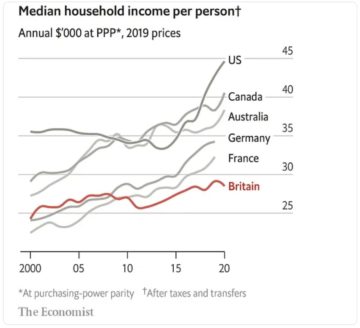 After a year of political turmoil and financial embarrassment, Britain ends 2022 shaken. There is a new spate of talk about national decline. Once again the UK is falling behind. The outlook is uncertain. It is symptomatic that Perry Anderson chose already in 2020, to author yet another gigantic essay for the
 Though never a household name, Bruce Duffy drew rapturous critical praise for his 1987 debut novel,
  This past spring, the philosopher Richard J. Bernstein taught his final two classes at the New School for Social Research, in New York, where he had been a professor since 1989. One was a course on American pragmatism, the tradition to which his own work belongs. The other was a seminar on
  I
I I’m not Michel Foucault, but here’s a history of sexuality, greatly abridged: First came the slut shamers. The traditionalist, patriarchal religious haranguers. Things weren’t great for men in the before times, but they were particularly unpleasant for women. Then came the sexual revolution of the 1960s and ’70s, which involved chucking all the rules. This had some good effects (ambitious women at last permitted to leave their houses and become doctors, lawyers, bosses) and some less good ones (moviemakers permitted to assault underage girls). In the 1990s and early 2000s, following however many backlashes against backlashes, the sexual revolution re-emerged as sex positivity.
 SOMETIME THIS COMING
 One name you don’t hear a lot these days is Thomas Piketty. In 2013, the French economist burst into the popular consciousness with the publication of