
Tharin Pillay in Time Magazine:
 “I’m not used to getting nasty emails from a holy man,” says Professor Michael Levin, a developmental biologist at Tufts University.
Levin was presenting his research to a group of engineers interested in spiritual matters in India, arguing that properties like “mind” and “intelligence” can be observed even in cellular systems, and that they exist on a spectrum. His audience loved it. But when he pushed further—arguing that the same properties emerge everywhere, including in computers—the reception shifted. “Dumb machines” and “dead matter” could not have these properties, members of his audience insisted. “A lot of people who are otherwise spiritual and compassionate find that idea very disturbing,” he says. Hence, the angry emails.
More here.
Enjoying the content on 3QD? Help keep us going by donating now.
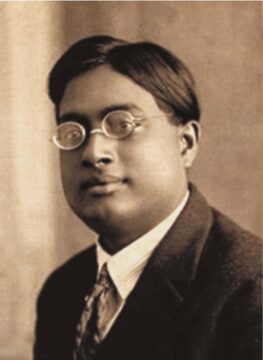 On a summer day in 1924, a young Indian physicist named Satyendra Nath Bose sent a paper and a letter to Albert Einstein. It would shape the nascent field of quantum mechanics and secure Bose a place in the annals of scientific history.
 Six years ago, Belgian dendrochronologist Valerie Trouet blew me away with
 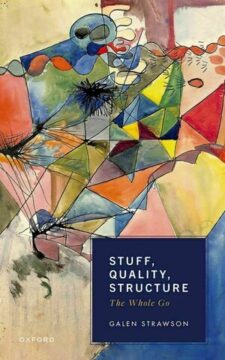 As the reader might have guessed, the views that Strawson defends in the book are far apart from mainstream views in contemporary analytic metaphysics. Moreover, it is worth mentioning that the style of the book is also distinctive. For one, the focus of the book is on developing a unified “big picture” view of fundamental matters in metaphysics, so one might find less detailed argument and critical engagement with alternative views in this book than in other contemporary books in metaphysics, e.g., one could easily write an entire book on categorical monism, or on the powerful qualities view, or on thing-monism, or on kind-monism). The book also seamlessly incorporates references to the history of philosophy throughout. Although Strawson knows full well that his views are not very popular in contemporary metaphysics, he argues that many of his views have been endorsed by some of the most prominent philosophers throughout history (including Descartes, Spinoza, Leibniz, Kant, Schopenhauer, Nietzsche, Whitehead, Russell, and others).
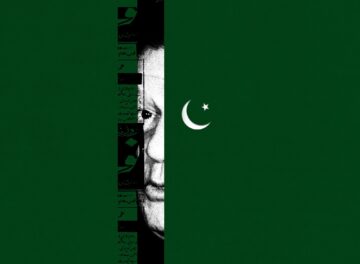 Just so we’re clear, the following is a fact. Not opinion, not a point of view, not a hot take. Fact. There is no Pakistani – male, female, dead, alive, real, imagined – as famous as Imran Khan. Every turn in a multifarious public life has abounded in fame, first as a cricket legend, then as a beloved philanthropist who built a cancer hospital for the poor, latterly as a maverick politician who swept to power promising reform, and now, as the sole occupant of a cell in Pakistan’s most notorious jail. So famous he’s been the subject of two death hoaxes – most recently in November, when he went unseen for so long that many concluded he had died.
 When I read the story, I was convalescing from an affair with a married person. I did love him back, and he didn’t change his life for me, and since you can’t heal at home from a heartbreak nobody knows about, I had gone abroad. Nothing in my life seemed to be working, and I must have searched up Cheever as part of my attempt to try the opposite of everything I had been doing. I had to admit that in the mirror “The Country Husband” held up to me, I appeared a little less broken than I felt. Writing from Francis Weed’s point of view, Cheever had, at a time when I really needed it, validated my experience of how powerful and real and obliterating extramarital love can be—even and especially for the married party. This, by the way, was years before the ubiquity of open marriages made moot the need for affairs, the way de Tocqueville has described the democratic election’s quelling the need for violent revolution. But the impulse to escape, resist, defy; the flirting with destruction, complete overhaul, change—this doesn’t go away just because one container for it has gone licit.
 Hark! A sign of the End Times. No, not the Four Horsemen, nor a black sun, nor the resurrection of the dead. The omen that the rapture is upon us is none other than artificial intelligence.