
Lytle Shaw at Cabinet Magazine:
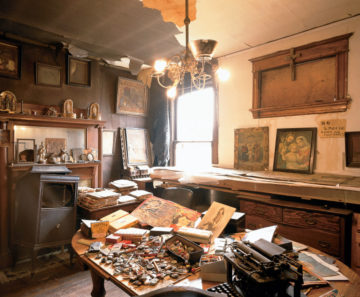 From December 31, 1957 until December 31, 1967, the artist and writer Henry Darger (1892–1973) kept a series of six ring-binder notebooks with almost daily entries on the weather in his native Chicago. On the outside cover of the first book, Darger describes the project, with encyclopedic enthusiasm, as a “book of weather reports on temperatures, fair cloudy to clear skies, snow, rain, or summer storms, and winter snows and big blizzards—also the low temperatures of severe cold waves and hot spells of summer.”
Though generally short, the entries abound in peculiarities. Darger is concerned, for instance, as much with periods of continuous temperature as with shifts—“3 to 7 am 57” (10/21/1958). Often up at 3am taking readings, Darger’s descriptive vocabulary also tends toward the moral and anthropomorphic: terms like “unsettled” and “threatening” are as common as “cool” or “hot.” Moreover, as the above epigraph suggests, the weatherman becomes a special figure. Darger’s notebooks can, in fact, frequently be read as an excruciatingly detailed moral account book of how well the weatherman was doing his job.
more here.
 For the first six weeks I can’t walk further than a few hundred metres. I feel like I’m practicing a walking meditation without experiencing the mental effects of this exercise – to focus on one activity, to centre myself. I’ve just had a baby; I am profoundly de-centred. In my current state, I can’t push the pram, or wear my new baby on my body, or drive a car. When I lie down at night, it feels like all my organs will spill onto the bed. Other fluids seep out – milk, tears. My body produces these things, and I cannot control them. I had not planned for the baby to exit my body in the way that she did, and for some reason this causes me more pain than the scar that now bisects my abdomen.
 In 1991 an academic debate spilled out of ivory towers and into the popular imagination. That year, Serge Renaud, a celebrated and charismatic alcohol researcher at the French National Institute for Health and Medical Research—who also hailed from a
  Wearing the white robes that are used to dress the dead in Japan, I bow my head deeply as drums are beaten and conch shells are blown – reminders that the first rite of my yamabushi ascetic training is beginning. My funeral is starting. Along with a small group of uninitiated who are also preparing to ‘die’, I start a symbolic pilgrimage into the afterlife, descending the slopes of Mount Haguro, a cedar-covered mountain in Japan’s northern Yamagata Prefecture.
 In the summer of 2021, Canada’s all-time temperature record was smashed by almost 5℃. Its new record of 49.6℃ is hotter than anything ever recorded in Spain, Turkey or indeed anywhere in Europe.
 IT WAS HIGH TIME
 Kent Puckett in Public Books:
 Tim Sahay and Kate Mackenzie in Polycrisis:
 Yakov Feygin in Building a Ruin:
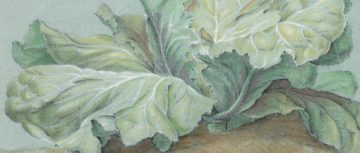 A member of the pea family, M. pudica is a small plant with tiny leaflets paired along the length of each stem and pretty lavender-pink globular flowers. The leaves give it a fernlike, feminine look, although it is also armed with thorns to ward off attacks. It’s native to Central and South America but has spread throughout the tropics partly because of its popularity as a novel ornamental that exhibits a fascinating behavior: if you touch a single leaf, the plant will swiftly fold up all its leaves before your eyes. Only a soft touch is required to bring on this collapse; after a while, you can also watch as the wilted-appearing mimosa sets about righting itself and reopening its leaves. You may have discovered the mimosa’s animal-like trick in an arboretum or store where the plants are sometimes displayed or sold. The rapid response to being touched is another defensive tactic—it startles most insects, as it does naive humans.
 Fatimah Asghar is the first recipient of the Carol Shields prize for fiction for their debut novel When We Were Sisters. The award was announced Thursday evening at Parnassus Books in Nashville, Tenn. They will receive $150,000 as well as a writing residency at Fogo Island Inn in Newfoundland and Labrador.
 A
A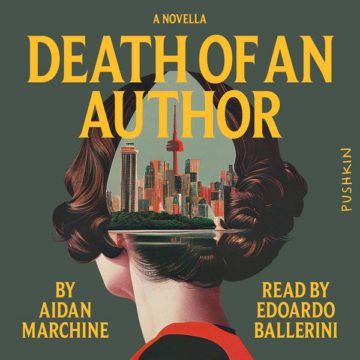 Now comes a new novella, “Death of an Author,” a murder mystery published under the pseudonym Aidan Marchine. It’s the work of the novelist and journalist Stephen Marche, who coaxed the story from three programs,