
Carl Zimmer in The New York Times:
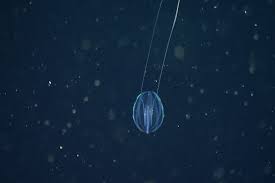 One of the greatest transformations in the history of life occurred more than 600 million years ago, when a single-celled organism gave rise to the first animals. With their multicellular bodies, animals evolved into a staggering range of forms, like whales that weigh 200 tons, birds that soar six miles into the sky and sidewinders that slither across desert dunes.
Scientists have long wondered what the first animals were like, including questions about their anatomy and how they found food. In a study published on Wednesday, scientists found tantalizing answers in a little-known group of gelatinous creatures called comb jellies. While the first animals remain a mystery, scientists found that comb jellies belong to the deepest branch on the animal family tree.
The debate over the origin of animals has endured for decades. At first, researchers relied largely on the fossil record for clues. The oldest definitive animal fossils date back about 580 million years, although some researchers have claimed to find even older ones. In 2021, for example, Elizabeth Turner, a Canadian paleontologist, reported finding 890-million-year-old fossils of possible sponges. Sponges would make sense as the oldest animal. They are simple creatures, with no muscles or nervous system. They anchor themselves to the ocean floor, where they filter water through a maze of pores, trapping bits of food.
More here.
 The group behind the radical open-access initiative Plan S has announced its next big plan to shake up research publishing — and this one could be bolder than the first. It wants all versions of an article and its associated peer-review reports to be published openly from the outset, without authors paying any fees, and for authors, rather than publishers, to decide when and where to first publish their work.
 Some of our actions have near-instant consequences. Even young children learn for themselves that drinking water is a great way to quench your thirst. But sex doesn’t immediately lead to babies. It generally takes weeks to even register a pregnancy. Months pass before the act of childbirth.
 In 2020,
 Welcome to the second edition of
  Some of us were always Team George.
 H
H If social media is to be believed,