
Over at the Watson Institute at Brown University:
Category: Recommended Reading
Zionism Über Alles
Hans Kundnani in Dissent:
In the five months since October 7, people around the world have looked on in horror as Germany has wielded the memory of the Holocaust to silence criticism of Israel’s war on Gaza. The German government’s response to the conflict itself has not been all that different from that of the United States: both have increased their supply of weapons to Israel and supported Israel against South Africa in the International Court of Justice. But Germany has gone much further than the United States in persecuting protesters, artists, and intellectuals expressing sympathy for and solidarity with the Palestinian people. It wields its responsibility for a barely distant genocide as a kind of moral authority.
This invocation of the Holocaust to police criticism of Israel is a far cry from the Erinnerungskultur, or memory culture, that many international observers once celebrated as an exemplary form of reckoning with the past. Even philosopher Susan Neiman, who five years ago wrote a book celebrating Germany’s memory culture as a model for the United States, now thinks it has gone “haywire.” Neiman speaks of a particularly German “philosemitic McCarthyism”—though since it has often also been directed against Jews who are critical of Israel, like the New Yorker writer Masha Gessen and the artist Candice Breitz, it may be more accurate to call it “Zionist McCarthyism.”
Although much attention has rightly focused on these individual cases of persecution, the genesis and evolution of Germany’s memory culture is less often discussed.
More here.
Liberal Blindspots
Tim Sahay in Polycrisis:
Protests led by farmers have been roiling Europe for months. In Belgium, Germany, Romania, the Netherlands, Poland, and France, farmers—armed with grievances ranging from subsidized Ukrainian grain imports to the EU-Mercosur trade deal and falling prices—have been taking to the streets, blocking traffic, and pelting the European parliament with eggs.
In the European halls of power, right-wing parties are taking note. In the Netherlands, populist and conservative parties have protested the ammonia tax imposed on the nation’s livestock. In Italy, figures in the ruling hard-right League and Brothers of Italy coalition have denounced EU decarbonization policies as hurting both consumers and industries. In France, Marine Le Pen, who ran for president as the National Rally candidate in the last election, is fighting against diesel taxes and for greater energy subsidies. The crystallization of a robust anti-climate coalition in the European Parliament is a real possibility after elections in June.
The farmers’ protests are a powerful reminder that the challenge to achieve “net zero” isn’t simply a technical one, but a political one. Unable to form or mobilize coalitions with working and middle classes, parties of the left have been locked out of power in much of the continent. Meanwhile, fossil-fuel interests have mobilized cross-class coalitions for militarized adaptation.
The socioeconomic risks of rebellion are not lost on incumbent governments in the global North and South. In the energy crisis of 2022–2023, European governments chose to cut fuel taxes and subsidize citizens’ energy bills on an enormous scale. Southern governments, for their part, continue to resist IMF’s consistent policy advice that they should stop supporting their populations with fossil-fuel, food, and agricultural subsidies.
Why is it so hard to stitch together a cross-class coalition for climate policy?
More here.
Deafness Is Not a Silence: On the Suppression of Sign Language
Sarah Marsh in The Millions:
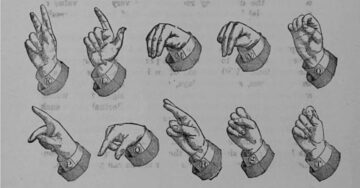 When I was editing my debut novel, A Sign Of Her Own, a quote from Ilya Kaminsky’s poetry collection, Deaf Republic, kept me company. “The deaf don’t believe in silence,” he writes, “silence is the invention of hearing people.” The quote interested me in part because my book concerned Alexander Graham Bell, a man who is often romanticized as having conquered silence through inventing the telephone. Kaminsky’s quote also resonated with me because I grew up deaf, grappling daily with people’s habit of equating deafness with silence. Deafness was understood by the adults around me to mean a lack of sound, for which the remedy was amplification delivered via technology. As a result, I’ve spent my life lipreading and wearing hearing aids, living perpetually on the edge of the acoustic, hearing world.
When I started learning British Sign Language as an adult, and ditched my hearing aids for periods of time, I didn’t find silence waiting for me. Instead, silence simply ceased to exist. As a deaf friend once told me, “Silence isn’t about noise or sound—it’s about absence of communication.”
More here.
Without Senators in Sight, Christine Blasey Ford Retells Her Story
Alexandra Jacobs in The New York Times:
 “Indelible in the hippocampus is the laughter.”
It sounded like a piece of refrigerator poetry suddenly ringing out in the wood-paneled Hart Senate Office Building: Christine Blasey Ford’s distinctive phrase describing her memory of being assaulted at 15 by Brett Kavanaugh, two years older, while his friend watched. (Kavanaugh, seeking confirmation to the Supreme Court, less poetically but “categorically and unequivocally” denied he had done any such thing, brandishing old calendars as an alibi.) Published more than five years after her 2018 congressional testimony, Blasey Ford’s new memoir, “One Way Back,” is an important entry into the public record — a lucid if belated retort to Senator Chuck Grassley’s 414-page, maddening memo on the investigation — but a prosaic one. A Big Book like this has become the final step in the dizzying if wearily familiar passage through the American media wringer: once called a “spin cycle,” now more like a clown car going through the wash tunnel.
Blasey Ford is a research psychologist, professor and devotee of surfing, who leans heavily on the sport as a metaphor for her ordeal. “You made me paddle out,” she tells her lawyers at one point, when they are advising her not to testify after weeks of preparation. “And you never, ever paddle back in once you’re out there. You catch the wave. You wipe out if you have to.”
More here.
Radiant: The Life and Line of Keith Haring
Jessica Ferri at the LA Times:
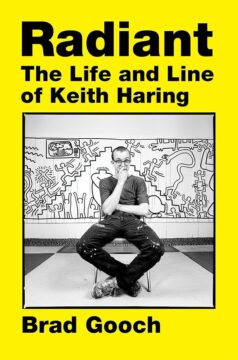 While modern audiences might be more likely to understand the import of these themes, many critics at the time discounted Haring’s work as “fast food,” as one put it, adding, “It’s a good time, it’s boogieing on a Saturday night, it’s alive, but great, no.” One curator blamed Haring’s commercial appeal for the reluctance to take his art seriously, saying, “I think Haring was so successful that other artists could not forgive him.” Gallerist Jeffrey Deitch pointed out that most artists enjoying Haring’s level of financial success would have been churning out even more sellable work. But Haring was committed to public projects such as murals, which he did for little or no compensation.
In 1987, during a period of extensive travel, Haring noticed that he was short of breath. The following year, while in Tokyo, he discovered a small purple spot on his leg that, when he returned to New York, was confirmed as Kaposi’s sarcoma. Haring told almost no one of his diagnosis in July 1988. In August, Basquiat died of a heroin overdose at 27. Writer Glenn O’Brien had once asked Basquiat who his favorite painter of his own generation was. “He didn’t hesitate, but said, ‘Keith Haring.’”
more here.
Percival Everett’s American Landscapes
Huckleberry Finn And ‘James’
Dwight Garner at the New York Times:
 Everett mostly sticks to the broad outlines of Twain’s novel. He is riding the same currents; the book flows inexorably, like a river, yet its short chapters keep the movement swift. James is on the run, of course, because he has learned that Miss Watson plans to sell him to a man in New Orleans. He will be separated from his wife and children. Huck is on the run because he has faked his own death after being beaten by his father. They find each other on an island in the Mississippi, and their flight begins. The reader slowly discovers that their bonds run deeper than friendship.
There are familiar large scenes, like Huck and James’s separation in a fog, and their encounter with the deadly con artists, the Duke and the King. But smaller moments are reproduced as well, such as James’s suffering after a rattlesnake bite and Huck’s need to dress like a girl to disguise his identity.
more here.
Saturday Poem
Listening to the Harvest
Harvest sounds hearty, sounds sure of itself — sounds like the record,
sounds like “Heart of Gold,” but even then, Neil sings that it’s the
searching for the heart of gold, and the more I harvest the more I realize
I am searching, it is work: it is being harvested by insects,
poked by thorny leaves, discerning the green of a bean
from the green of a leaf, determining the shine on the skin
of a jeweled eggplant — it’s finding everything in its exact time,
plucking it from this into that; playing god, obeying God;
in service of the harvest, on my knees, leaning into the garden,
really prostrate before the growth, in adoration of the land —
I learn to reap without violence; listen without taking;
I yield in more and more colors.
Eat with the salt of each season.
by Lauren Turner
from the Ecotheo Review
Heart of Gold by Neil Young
Friday, March 15, 2024
Amitava Kumar: Writing a Novel With Pictures
Amitava Kumar at Hazlitt:
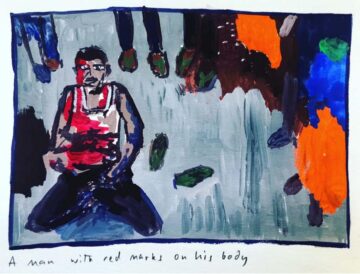 I was sitting on a train, travelling from my home in Poughkeepsie to New York City, when I saw a note on my phone asking me to write the piece below. I began thinking of a painting, a portrait of his father painted by the Indian artist Atul Dodiya, but the other memory that came to me was that I had long ago been sitting in the same Metro North train bound for New York City when the idea for my new novel, My Beloved Life, had been conjured in my mind. During that journey—I’m talking now of something that happened nine or ten years ago—I was reading Denis Johnson’s marvellous novella Train Dreams. It tells the story of an American railroad worker at the start of the last century. Train Dreams is a slim book but it has the feel of an epic. Maybe that fact had also inspired me.
I asked myself, what would the story be like if this ordinary man had been born not in Idaho but in India? My father was a small boy when India became independent from British rule. He had been born in a hut in a village in India’s poorest province. His life had gone through many changes, and it struck me that in telling the story of a single, seemingly unremarkable life, one could possibly be narrating the story of nation or an entire century. The idea formed in my mind even before I had left the train that I would one day write about my father.
More here.
An astrophysicist has much to say about the public’s lack of trust in science
Dan Falk in Undark:
 While Sutter loves science, he believes there are deep problems with the way science is actually done. He began to notice some of those problems before the Covid-19 pandemic, but it was Covid that brought many of them to the fore. “I was watching, in real time, the erosion of trust in science as an institution,” he said, “and the difficulty scientists had in communicating with the public about a very urgent, very important matter that we were learning about as we were speaking about it.”
“I was watching just one by one,” he continued, as “people stopped trusting science.”
Sutter takes issue with the hyper-competitiveness of science, with peer review, with the journals, with the way scientists interact with the public, with the politicization of science, and more. But his new book, “Rescuing Science: Restoring Trust In an Age of Doubt,’’ published this month by Rowman & Littlefield, is more than a laundry list of grievances — it’s also filled with ideas about how science might be improved.
More here.
Niccolò Machiavelli’s profound insights about the violent origins of political societies
David Polansky in Aeon:
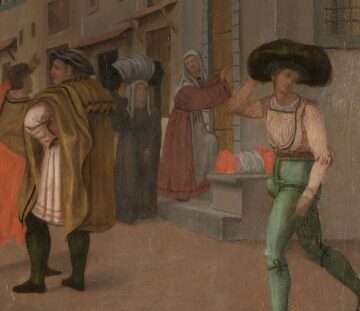 Friedrich Nietzsche once wrote: ‘Mankind likes to put questions of origins and beginnings out of its mind.’ With apologies to Nietzsche, the ‘questions of origins and beginnings’ are in fact more controversial and hotly debated. The ongoing Israel-Gaza war has reopened old debates over the circumstances of Israel’s founding and the origins of the Palestinian refugee crisis. Meanwhile, in a speech he gave on the eve of Russia’s invasion of Ukraine in February 2022, Vladimir Putin insisted that ‘since time immemorial’ Russia had always included Ukraine, a situation that was disrupted by the establishment of the Soviet Union. And in the US, The New York Times’ 1619 Project generated no small amount of controversy by insisting that the United States’ real origins lay not with its formal constitution but with the introduction of slavery into North America.
In other words, many conspicuous political disputes today have a way of returning us to the beginnings of things, of producing and being waged in part through strong claims about origins. Yet doing so rarely helps resolve them. Because these debates have become ubiquitous, we may not realise how unusual our preoccupation with political origins really is.
More here.
The videos you are about to watch are not real
Dust to Dust: W. H. Auden writes poetry for a world marked by death
Helen Rouner in Commonweal:
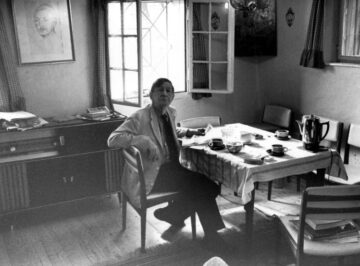 Last summer, as I sat waiting for a train in Penn Station, I noticed a figure approaching and trying to get my attention. Keenly aware that I was patronizing an ostensibly public space where the only seats were placed behind gates monitored by security guards, I was eager to part with a few dollars if asked. It took me a moment to register that the woman standing before me, wearing a blue habit and a crucifix around her neck, was asking to borrow my cell phone. She needed to call her elderly father, she said, to tell him that her train would be late, and that she would seek shelter for the night at a convent she had heard of in Boston before continuing her journey. Flooded with a sense of the auspicious, I asked her what her destination was. She said she was heading—as I somehow had felt she would be—to her father’s house on Cape Cod. She named the same town where my in-laws live, to which I, too, was traveling. My husband Jack was picking me up in Providence to drive there, I told her. Would she like a ride?
At that moment, loudspeakers announced our train’s belated arrival, and we shuffled into line together. I noticed a thick volume under her arm, with deeply lined eyes gazing out at me from the cover. The nun—Sr. Maria, she introduced herself—was reading the collected poems of W. H. Auden. Auden was one of my favorite poets, I told her, an inheritor of the Romantic tradition that was my particular academic interest. Sr. Maria was a great reader of poetry, I learned, and had just completed a PhD in Catholicism and philosophy—precisely Jack’s field of study. Minutes after he had retrieved us from the Amtrak station in Providence, the two of them were debating Hegel on ritual. At the end of an hour’s drive, just before we delivered her to her father’s house, Sr. Maria asked me to read aloud from the Auden volume. “The Cave of Making” was her latest favorite, she said. I obliged, and the three of us sat in the car, sharing the sound of the poem.
More here.
A Google AI Watched 30,000 Hours of Video Games—Now It Makes Its Own
Jason Dorrier in Singularity Hub:
 AI continues to generate plenty of light and heat. The best models in text and images—now commanding subscriptions and being woven into consumer products—are competing for inches. OpenAI, Google, and Anthropic are all, more or less, neck and neck. It’s no surprise then that AI researchers are looking to push generative models into new territory. As AI requires prodigious amounts of data, one way to forecast where things are going next is to look at what data is widely available online, but still largely untapped. Video, of which there is plenty, is an obvious next step. Indeed, last month, OpenAI previewed a new text-to-video AI called Sora that stunned onlookers. But what about video…games?
It turns out there are quite a few gamer videos online. Google DeepMind says it trained a new AI, Genie, on 30,000 hours of curated video footage showing gamers playing simple platformers—think early Nintendo games—and now it can create examples of its own.
Genie turns a simple image, photo, or sketch into an interactive video game. Given a prompt, say a drawing of a character and its surroundings, the AI can then take input from a player to move the character through its world. In a blog post, DeepMind showed Genie’s creations navigating 2D landscapes, walking around or jumping between platforms. Like a snake eating its tail, some of these worlds were even sourced from AI-generated images. In contrast to traditional video games, Genie generates these interactive worlds frame by frame. Given a prompt and command to move, it predicts the most likely next frames and creates them on the fly. It even learned to include a sense of parallax, a common feature in platformers where the foreground moves faster than the background.
More here.
Friday Poem
Arrivals
When I throw up the candied coconut
mixed in salt water, I feel empty. Jujú
holds my hand, and I tell her next year
we’ll return to the ocean. Truth feels
different in the skin of a child. I think
that if I say it enough, the waves will
pull me back to the thunderous
music of the tide. Ocean waves
feel like body armor, like I can charge
into battle with them. Years later, this last
birthday off the coast would become memories
of tortillerías, sugared tamarindo on
the side of the highway near the beach,
and the musty smell of wet earth before
the rain comes. I remember every detail of the day.
How I stubbed my toe in the morning
and was bitten by a crab in the afternoon. People
on the beach that day have become living,
breathing photographs in my mind. Windblown
hair flying in people’s eyes, my name etched
on the dunes, cousins became mermaids
on the sand, my dad—full beard just barely
graying—smiles with a Dos Equis in his hand
and gestures wildly with the other, mid-joke.
by Anais Deal-Márquez
from: Poetry, March 2024
Peter Sloterdijk | The Future of Too Big Cities
Lacan’s Notorious Art Collection
Brian Ng at Art In America:
 Lacan collected works by the likes of Duchamp and Picasso, which he displayed proudly in his country home. But to be sure, the most iconic work of his collection, also on view, was Gustave Courbet’s L’Origine du Monde (1866); today, it is owned by the Musée d’Orsay. Famously, Lacan hid this detailed rendering of a vulva behind a sliding wooden door, onto which his friend (and eventual brother-in-law) André Masson painted his own Surrealist rendition. Masson added clouds that drift above an outline of L’Origine’s body, whose curves he recast as hills, her pubic hair resembling a bunch of flowers. L’Origine du Monde almost never leaves d’Orsay. But at the Pompidou-Metz, it no longer hangs alongside other 19th-century works, which often feel prudish in L’Origine’s presence. Instead, the curators have hung it beside more recent representations of vulvas—some of them direct retorts to the famous L’Origine—by the likes of Art & Language, Mircea Cantor, VALIE EXPORT, Victor Man, Betty Tompkins, and Agnès Thurnauer. Deborah de Robertis’s photograph hangs near L’Origine, showing a 2014 performance in which the artist, wearing a gold dress referring to the painting’s gilded frame, squatted in front of the work, spreading her legs wider than Courbet’s model topart her vagina, revealing what she calls “infinity,” or “the origin of the origin,” the depth that Courbet concealed.
more here.
The Peril Of Catastrophism
Ted Nordhaus at the New Atlantis:
 In these cases, climate science theory and observations are well aligned. Climate change has increased the frequency of extreme heat events and decreased the frequency of extreme cold events. It has led to global sea level rise and glacial melting. At the regional level, some areas have also seen increases in phenomena like extreme precipitation events that are very directly linked to warming global temperatures.
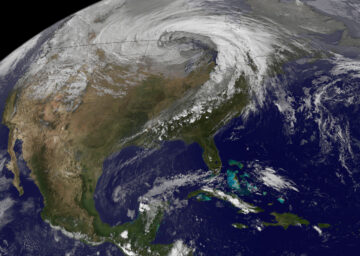
But for most climate and weather phenomena, the effects are much more complicated and don’t always run in the same direction. Warmer surface and ocean temperatures, for instance, produce more rain from hurricanes, because warmer air can hold more water vapor. But climate change can also create countervailing factors, such as increases in wind shear, which may make it harder for hurricanes to develop and persist, and decrease their frequency.
Media accounts have been quick to tie hurricanes and other complex phenomena to climate change. But there is little data to suggest, thus far, that these events have actually gotten worse.
more here.
Thursday, March 14, 2024
Gabriel García Márquez’s Last Book
Michael Greenberg at the NYT:
 What is most jarring is that the story has all the hallmarks of García Márquez; despite its deficiencies, the writing is unmistakably his. At its center is Ana Magdalena Bach, who is a virgin when she marries and remains contentedly faithful to her husband until, at 46, she embarks on a series of explosive one-night stands, a new one each year. She meets the men, all of them strangers, during solo visits to the Caribbean island where her mother is buried. Without fail, every Aug. 16 she lays a bouquet of fresh gladioli on her mother’s grave, clears the weeds that have sprung up around the stone and quickly fills her mother in on the latest family news. Then she gets down to the serious business of finding a partner until morning, when a ferry will take her back to the mainland.
Her first tryst is with a silver-haired “Hispanic gringo” she picks up at her hotel bar. The sex is impersonal and, for Ana, immensely exciting: She “devoured him for her own pleasure not even thinking of his.” The next morning she’s appalled to discover he left her a $20 bill. The insult infuriates her and she is tormented by both a wish for revenge and the desire to repeat the evening.
more here.